

why so many plants and fungi stink like death warmed up
- Written by: Gregory Moore, Senior Research Associate, School of Agriculture, Food and Ecosystem Sciences, The University of Melbourne
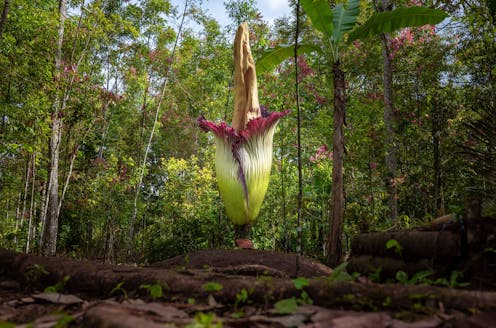
Right now, people are lining up at the Geelong Botanic Gardens to see and smell the giant corpse flower, a rare plant that stinks like a dead body.
This is the titan arum. It’s a plant that makes news whenever it flowers in a botanic garden around the world. It’s sometimes called a lily, but it’s an arum, a genus not closely related to true lilies.
Why do people travel to see it? The huge arum might only bloom once a decade. It spends huge amounts of energy preparing to flower. And when it does, it’s spectacular. Its huge flowering structure (the spadix) can be up to three metres in height and one to two metres across, which is why it has the wonderfully apt Latin name of Amorphophallus titanium, which translates as “giant misshapen phallic-like”. But the spadix is actually not a flower – it’s an inflorescence. Its true flowers are small and hidden from view at the base.
The main reason people seek it out is because of its stench. The spadix stinks like a rotting animal carcass – and the strong smell spreads far and wide. The spadix lasts only one or two days.
But why would a plant spend so much time and energy doing this? The answer is reproduction – the titan arum needs pollinators such as flies, and flies like dead things. Many other plants use the same tactic to get insects to pay attention.
The Geelong Botanic Gardens is livestreaming the corpse flower’s appearance.The stench of death
The corpse flower is native to the dense rainforests of Sumatra in Indonesia.
Many plants make their flowers attractive to bees, which like sweeter smells. But a large variety of insects can pollinate flowers. This arum has opted instead to attract flesh flies and carrion beetles, which polish off dead animals.
The corpse flower’s reddish-purple structure and stench of death attract these insects to what appears to be a rotting corpse. Even better, the plant heats up its flowering structure to about 32°C as it develops, to make it seem even more like a dead animal in a tropical rainforest. It’s a trick, and it’s a good one.
It can take decades for this plant to produce its first inflorescence and it takes a lot of the plant’s energy and reserves to produce such a huge warm structure. Mature specimens have a corm, a swollen stem base a bit like a bulb which can weigh over 100 kilograms. This is where the plant stores the energy it will need to make its giant stinky spadix.
Not surprisingly, it does not have the energy to flower every year. It might be five to ten years between flowering. But in ideal growing conditions, it can be as short as two to three years.
All of this effort goes towards making a structure at its best for about 24 hours before beginning to collapse. The titan arum’s female flowers are receptive for a very short time, meaning the window of opportunity for successful reproduction is brief.

Sometimes it’s good to be stinky
Other plants have evolved similar strategies to woo pollinators. They often earn similar monikers, such as carrion plants, corpse flowers or stinking plants.
Sumatran rainforests have produced another plant known as the corpse flower, the giant padma, Rafflesia arnoldii. This parasitic plant has no leaves or stems. It spends most of its life as long strands of fibre inside its host, a vine. But every now and again, it produces a giant flower, a metre across, and stinking of death.In Australia, our most well known carrion species is an introduced succulent, the weedy carrion flower, Orbea variegata, which originates from southern Africa.
Worldwide, there are many other plants known for their rotten smell. The North American pawpaw, Asimina triloba and species from the African succulent genus Stapelia are carrion flowers.
Some orchids from the genius Bulbophyllum also pack an olfactory punch, though they can smell more like urine or animal dung. The goal is the same: attracting scavenging flies and beetles.
 Carrion beetles normally eat dead animals – but they can be lured to become pollinators.
olko1975/Shutterstock
Carrion beetles normally eat dead animals – but they can be lured to become pollinators.
olko1975/Shutterstock
Our noses are collateral damage
While beauty may be in the eye of the beholder, scent depends on the nose of the sniffer. Smells humans find repulsive are very attractive if you’re a flesh fly.
Not all smells vile to humans are of corpses and carcasses.
The ginkgo tree, Ginkgo biloba, is famous for its golden foliage – and for its remarkable longevity as a living fossil. It’s also hugely resilient – six gingko trees survived the bombing of Hiroshima. But people tend to only plant male trees, as the female trees produce a fruit that smells like vomit for many people.
We don’t really know why it has this smell. But given it has been around 200 million years, the smell might have attracted a long extinct species to eat and spread the seeds.
Some of us are more susceptible than others. Many people complain when privets (Ligustrum spp.) are in flower, while others find some wattles (Acacia) nauseating. Even the popular hedge plant, red-tipped photinia (Photinia × fraseri) cops the occasional disparaging remark. Then there’s the ornamental pear, Pyrus calleryana, planted widely as a street tree in Australia’s southeast. Unfortunately, it smells like human semen to many people.
It’s not only plants which have learned how to make pungent smells. The wonderfully named stinkhorn fungi genus uses the same tactic as the titan arum to attract the insects and beetles it needs to spread its spores.
 Stinkhorn fungi species use stench to attract pollinators. Pictured: anemone stinkhorn and a stinkbug in the centre of the fungus.
Nareles Style/Shutterstock
Stinkhorn fungi species use stench to attract pollinators. Pictured: anemone stinkhorn and a stinkbug in the centre of the fungus.
Nareles Style/Shutterstock
The anemone stinkhorn, Aseroe rubra, is found in many parts of Australia, often close to the coast. Another species, Phallus rubicundus, is found across the tropics, including northern parts of Australia. Like many stinkhorns it is slimy, smelly and reddish.
They are not generally considered toxic and people ask if they are edible. I don’t know because my response is, “Why would anyone even think of eating something that smells like that?”
It never ceases to amaze me that faking the appearance and stench of death has been so widely adopted by plants and fungi as a means of creating new life.
Authors: Gregory Moore, Senior Research Associate, School of Agriculture, Food and Ecosystem Sciences, The University of Melbourne


















