

Shortsightedness is on the rise in children. There’s more we can do than limit screen time
- Written by: Flora Hui, Honorary Fellow, Department of Optometry and Vision Sciences, Melbourne School of Health Sciences, The University of Melbourne
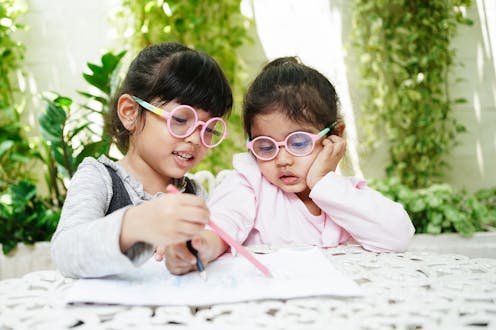
Myopia in children is on the rise. The condition – also known as shortsightedness – already affects up to 35% of children across the world, according to a recent review of global data. The researchers predict this number will increase to 40%, exceeding 740 million children living with myopia by 2050.
So why does this matter? Many people may be unaware that treating myopia (through interventions such as glasses) is about more than just comfort or blurry vision. If left unchecked, myopia can rapidly progress, increasing the risk of serious and irreversible eye conditions. Diagnosing and treating myopia is therefore crucial for your child’s lifetime eye health.
Here is how myopia develops, the role screen time plays – and what you can do if think your child might be shortsighted.
What is myopia?
Myopia is commonly known as nearsightedness or shortsightedness. It is a type of refractive error, meaning a vision problem that stops you seeing clearly – in this case, seeing objects that are far away.
A person usually has myopia because their eyeball is longer than average. This can happen if eyes grow too quickly or longer than normal.
A longer eyeball means when light enters the eye, it’s not focused properly on the retina (the light-sensing tissue lining the back of the eye). As a result, the image they see is blurry. Controlling eye growth is the most important factor for achieving normal vision.
Myopia is on the rise in children
The study published earlier this year looked at how the rate of myopia has changed over the last 30 years. It reviewed 276 studies, which included 5.4 million people between the ages of 5–19 years, from 50 countries, across six continents.
Based on this data, the researchers concluded up to one in three children are already living with shortsightedness – and this will only increase. They predict a particular rise for adolescents: myopia is expected to affect more than 50% of those aged 13-19 by 2050.
Their results are similar to a previous Australian study from 2015. It predicted 36% of children in Australia and New Zealand would have myopia by 2020, and more than half by 2050.
The new review is the most comprehensive of its kind, giving us the closest look at how childhood myopia is progressing across the globe. It suggests rates of myopia are increasing worldwide – and this includes “high myopia”, or severe shortsightedness.
What causes myopia?
Myopia develops partly due to genetics. Parents who have myopia – and especially high myopia – are more likely to have kids who develop myopia as well.
But environmental factors can also play a role.
One culprit is the amount of time we spend looking at screens. As screens have shrunk, we tend to hold them closer. This kind of prolonged focusing at short range has long been associated with developing myopia.
Reducing screen time may help reduce eye strain and slow myopia’s development. However for many of us – including children – this can be difficult, given how deeply screens are embedded in our day-to-day lives.
Green time over screen time
Higher rates of myopia may also be linked to kids spending less time outside, rather than screens themselves. Studies have shown boosting time outdoors by one to two hours per day may reduce the onset of myopia over a two to three year period.
We are still unsure how this works. It may be that the greater intensity of sunlight – compared to indoor light – promotes the release of dopamine. This crucial molecule can slow eye growth and help prevent myopia developing.
However current research suggests once you have myopia, time outdoors may only have a small effect on how it worsens.
What can we do about it?
Research is rapidly developing in myopia control. In addition to glasses, optometrists have a range of tools to slow eye growth and with it, the progression of myopia. The most effective methods are:
orthokeratology (“ortho-K”) uses hard contact lenses temporarily reshape the eye to improve vision. They are convenient as they are only worn while sleeping. However parents need to make sure lenses are cleaned and stored properly to reduce the chance of eye infections
atropine eyedrops have been shown to successfully slow myopia progression. Eyedrops can be simple to administer, have minimal side effects and don’t carry the risk of infection associated with contact lenses.
What are the risks with myopia?
Myopia is easily corrected by wearing glasses or contact lenses. But if you have “high myopia” (meaning you are severely shortsighted) you have a higher risk of developing other eye conditions across your lifetime, and these could permanently damage your vision.
These conditions include:
retinal detachment, where the retina tears and peels away from the back of the eye
glaucoma, where nerve cells in the retina and optic nerve are progressively damaged and lost
myopic maculopathy, where the longer eyeball means the macula (part of the retina) is stretched and thinned, and can lead to tissue degeneration, breaks and bleeds.
What can parents do?
It’s important to diagnose and treat myopia early – especially high myopia – to stop it progressing and lower the risk of permanent damage.
Uncorrected myopia can also affect a child’s ability to learn, simply because they can’t see clearly. Signs your child might need to be tested can include squinting to see into the distance, or moving things closer such as a screen or book to see.
Regular eye tests with the optometrist are the best way to understand your child’s eye health and eyesight. Each child is different – an optometrist can help you work out tailored methods to track and manage myopia, if it is diagnosed.
Authors: Flora Hui, Honorary Fellow, Department of Optometry and Vision Sciences, Melbourne School of Health Sciences, The University of Melbourne


















