

in Chinese Postman, Brian Castro transforms fiction into a mechanism of truth
- Written by: Tony Hughes-d'Aeth, Professor, Chair of Australian Literature, The University of Western Australia
There was a point in the 1990s where it became fashionable to emphasise that autobiography was fiction. This proposition sprang up to complement an earlier stricture that emerged with the New Criticism of the mid-20th century – namely, that the author of a work of fiction was never the narrator. So, autobiography was always fiction and fiction was never autobiography.
While both ideas had the virtue of interrupting the seductions of biographical essentialism, one comes up against their limitations when reading a book like Brian Castro’s Chinese Postman.
Review: Chinese Postman – Brian Castro (Giramondo)
Castro is the author of 12 critically acclaimed books. These have shown an impressive range and creative daring, from historical fiction (The Birds of Passage, The Garden Book) to postmodern detective fiction (Pomeroy, Double-Wolf) to espionage (Stepper) to verse novel (Blindness and Rage) to autobiography (Shanghai Dancing).

Assigning genres to these books is a little specious. Castro’s books tend only to pay lip service to literary form. Instead, they are postmodern pantomimes that mug the dictates of genre, without ever quite escaping them.
In Chinese Postman, we realise we are getting toward the end of things. Even the puns and the satire, such a persistent feature of Castro’s oeuvre, no longer work to jolt the machinery of social existence into the apparition of life.
The story follows Abe Quinn, a writer and former university professor, now in his mid-70s, who lives alone on a semi-rural property in the Adelaide Hills. At this point, we may as well say that Abe Quinn is Brian Castro, except that someone would helpfully remind us that all autobiography is fiction. As if to underline the arbitrary nature of such matters, the novel switches randomly between the first and third person.
Quinn has been married and divorced three times. He has at last given up on the idea that living with someone can do anything other than accentuate his loneliness. He has withdrawn from the worlds that once sustained him. The literary relationships, the book tours and writing festivals, the university life where he once supervised budding novelists – all of these have lost their savour. They now stare back at him with a sardonic smirk, no longer willing to mask their absurdity, their hopeless vanity.
The name Abe Quinn seems a nod to the famous anti-hero of Lu Xun’s novel The True Story of Ah Q (1922), for whom no amount of humiliation was ever quite enough to puncture his preposterous self-importance. Ah Q was Lu Xun’s damning indictment of China in the 1920s. Castro’s Chinese Postman is a similarly scathing and relentless critique of vanity.
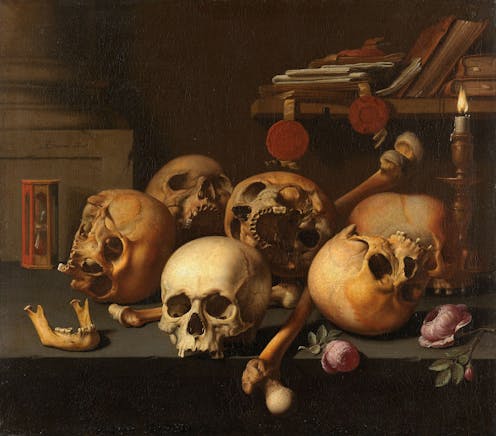
In medieval and early modern painting, vanitas was represented as a skull in the corner. A reminder that the glories depicted in the painting are always limned by the mortality of the world.
In Chinese Postman, vanitas has swollen and enveloped the narrative universe. While Abe is agonised by death’s remorseless desecration of achievement, he is also in love with death. He is in love with its durability and constancy. One gets the feeling that if Hamlet had lived into his 70s, he might look and sound a little like this.
 Still Life with a Skull and a Writing Quill – Pieter Claesz (1628).
Public domain, via Wikimedia Commons
Still Life with a Skull and a Writing Quill – Pieter Claesz (1628).
Public domain, via Wikimedia Commons
I realise this might not be everyone’s cup of tea, but I found Chinese Postman a quietly riveting book. It is not quite true to say the book is plotless, even though it unfolds in a series of aphoristic paragraphs that seem fragmentary and repetitive.
The main narrative thread comes about through an email correspondence between Abe and a Ukrainian woman in her 40s named Iryna. There is a certain knowing haplessness in this relationship. Does Iryna even exist? Is she a gifted chatbot? The confection of Russian fraudsters?
The epistolary relationship between Abe and Iryna becomes the proxy of his own terminal doubts. The test becomes the extent to which love can be sustained in the face of the possibility that its object does not exist.
In this dialectic between the nihilistic sham of love and its tantalising possibility, Abe finds himself thinking of the fate of Ukraine. Iryna’s grim reports help him to hold onto the idea that his obsession with death is not merely morbid. He is embarrassed and inspired by Iryna’s courage and the resolute defiance of the Ukrainian people.
The fact that Castro’s postman is Chinese brings into relief the other crucial element of the story. This is something that has been a distinctive feature of Castro’s work: the complex cultural inheritance that has inflected his sense of belonging in white Australia.
 Castro was born in Hong Kong in 1950 of mixed European and Chinese heritage. At home he spoke Cantonese, English and Portuguese. These biographical facts are transposed directly to the figure of Abe Quinn.
This introduces the book’s major ambiguity. Is the story primarily about the end of life? The universal appointment we all have with our own earthly cessation? Or is the book about a foundational displacement that occurs at the very outset of our personhood?
Abe’s ruminations move restlessly between these two ideas in a way that forces us to think that they are intimately connected. The book’s grief – less autobiography than auto-threnody – is torn between anticipation and radical regression.
Most pointedly, Abe feels he has been made ghostly in his own life by the fact – at least, it seems a fact to him – that he is neither Chinese nor Australian. The tragedy is that he grew up in a time when it was not open for him, as it might be now, to say that he is both Chinese and Australian. Instead of being doubly affirmed, he feels doubly negated.
The story is flecked with the incidental racism that Abe-Castro faced since moving to Australia at the age of 11 to commence boarding school. The painful moments of exclusion and ridicule seem to have never really stopped, just modulated according to his time of life.
The line of flight that Abe has taken in response to his alienation has been to find a home in literature and the world of letters. But this has not quite delivered the belonging that he feels has been withheld from him in ordinary life. Rather, literature has only redoubled his estrangement:
Perhaps he was unsuitable for the normal world. The damage that literature does is to make you unsuitable for the real world […] It opens the prison door but lets escape an eternally unfulfilled desire.
Abe is haunted by the sensation that he
can’t relate to ordinary people […] There always seems to be a subtext in what they were saying, their words like spiders in a letterbox, but it was really he who could not speak without feeling fraudulent, like an actor on stage who could not believe in his role.
This alienation of the actor from their role constitutes a crisis of faith. What the actor loses in this moment is his belief in the capacity of the audience to hear them.
Castro’s book reminded me of Charlie Chaplin’s late film Limelight (1952), in which the aging clown Calvero is no longer able to sustain the laughter that is his only sign of love. The world has moved on; vaudeville has had its day. Calvero finds himself restored, after a fashion, when he takes care of a young ballet dancer who has lost her desire to dance. As with Abe and Iryna, the refugee is rescued by rescuing the refugee.
Castro was born in Hong Kong in 1950 of mixed European and Chinese heritage. At home he spoke Cantonese, English and Portuguese. These biographical facts are transposed directly to the figure of Abe Quinn.
This introduces the book’s major ambiguity. Is the story primarily about the end of life? The universal appointment we all have with our own earthly cessation? Or is the book about a foundational displacement that occurs at the very outset of our personhood?
Abe’s ruminations move restlessly between these two ideas in a way that forces us to think that they are intimately connected. The book’s grief – less autobiography than auto-threnody – is torn between anticipation and radical regression.
Most pointedly, Abe feels he has been made ghostly in his own life by the fact – at least, it seems a fact to him – that he is neither Chinese nor Australian. The tragedy is that he grew up in a time when it was not open for him, as it might be now, to say that he is both Chinese and Australian. Instead of being doubly affirmed, he feels doubly negated.
The story is flecked with the incidental racism that Abe-Castro faced since moving to Australia at the age of 11 to commence boarding school. The painful moments of exclusion and ridicule seem to have never really stopped, just modulated according to his time of life.
The line of flight that Abe has taken in response to his alienation has been to find a home in literature and the world of letters. But this has not quite delivered the belonging that he feels has been withheld from him in ordinary life. Rather, literature has only redoubled his estrangement:
Perhaps he was unsuitable for the normal world. The damage that literature does is to make you unsuitable for the real world […] It opens the prison door but lets escape an eternally unfulfilled desire.
Abe is haunted by the sensation that he
can’t relate to ordinary people […] There always seems to be a subtext in what they were saying, their words like spiders in a letterbox, but it was really he who could not speak without feeling fraudulent, like an actor on stage who could not believe in his role.
This alienation of the actor from their role constitutes a crisis of faith. What the actor loses in this moment is his belief in the capacity of the audience to hear them.
Castro’s book reminded me of Charlie Chaplin’s late film Limelight (1952), in which the aging clown Calvero is no longer able to sustain the laughter that is his only sign of love. The world has moved on; vaudeville has had its day. Calvero finds himself restored, after a fashion, when he takes care of a young ballet dancer who has lost her desire to dance. As with Abe and Iryna, the refugee is rescued by rescuing the refugee.
 Charlie Chaplin as Calvero (1952).
Public domain, via Wikimedia Commons
The major conceit of Castro’s book is not the stage, but the letter. Abe has lost his subjective connection to his words. Despite his distinguished career as an author, he feels that he is, in the end, just the postman: the deliverer of someone else’s words to another.
The figure of the Chinese Postman becomes a complex analogy for the life of an author, whether we call this person Abe Quinn or Brian Castro. The disarming serenity of the cover photograph of a Qing postman lays plaintive claim to the Chinese ancestry of Abe-Castro. Yet it does so on the condition that this ideal is fatally consigned to a lost past. The image hovers between a crushing pathos and a deep dignity of purpose. Yet the dignity of the task is also the source of the desolation, since the letters in the canvas pouch do not belong to the carrier.
One effect of the critical dogma that insists that autobiography is fiction and fiction is never biography is to foreclose the capacity for narrative to sustain truth. The idea that there is no truth in stories is presented as somehow controversial or radical. But Castro’s Chinese Postman delivers the opposite and far more scandalous proposition, which is that fiction is the mechanism of truth.
The scandal is not that all attempts at truth fall into the trap of fiction, but that all attempts at fiction inscribe their elements of truth. In the figure of Abe Quinn, there is a truer picture of Brian Castro than even he can know.
Authors: Tony Hughes-d'Aeth, Professor, Chair of Australian Literature, The University of Western Australia
Charlie Chaplin as Calvero (1952).
Public domain, via Wikimedia Commons
The major conceit of Castro’s book is not the stage, but the letter. Abe has lost his subjective connection to his words. Despite his distinguished career as an author, he feels that he is, in the end, just the postman: the deliverer of someone else’s words to another.
The figure of the Chinese Postman becomes a complex analogy for the life of an author, whether we call this person Abe Quinn or Brian Castro. The disarming serenity of the cover photograph of a Qing postman lays plaintive claim to the Chinese ancestry of Abe-Castro. Yet it does so on the condition that this ideal is fatally consigned to a lost past. The image hovers between a crushing pathos and a deep dignity of purpose. Yet the dignity of the task is also the source of the desolation, since the letters in the canvas pouch do not belong to the carrier.
One effect of the critical dogma that insists that autobiography is fiction and fiction is never biography is to foreclose the capacity for narrative to sustain truth. The idea that there is no truth in stories is presented as somehow controversial or radical. But Castro’s Chinese Postman delivers the opposite and far more scandalous proposition, which is that fiction is the mechanism of truth.
The scandal is not that all attempts at truth fall into the trap of fiction, but that all attempts at fiction inscribe their elements of truth. In the figure of Abe Quinn, there is a truer picture of Brian Castro than even he can know.
Authors: Tony Hughes-d'Aeth, Professor, Chair of Australian Literature, The University of Western Australia 



















