

a celebration of Asian culture and art – and what it means to be Asian-Australian
- Written by: Tets Kimura, Adjunct Lecturer, Creative Arts, Flinders University
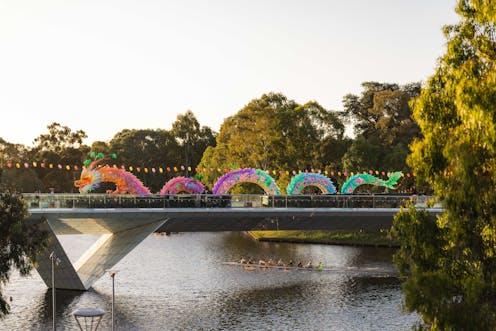
The well-documented history of Asian mass migration to modern Australia dates from the gold rush era in the mid-19th century. With a history that is longer than a century and a half, breaking down stereotypes deeply ingrained over generations remains a task.
This year’s OzAsia festival’s programming continues to challenge against these old narratives, celebrating the diverse voices and stories Asian-Australians bring to the cultural landscape of Australia.
Australian-ness from an Asian lens
Although the festival focuses on Asia, it also offers opportunities to view Australia.
In Rising out of Water, three Adelaide writers (Danielle Lim, Elvy-Lee Quichi, Matt Hawkins) offered new compelling scripts in development.
Matt Hawkins’ Typhoon, which delves into the “first world” mindset of an Australian banker in Hong Kong, was possibly the most confronting. Written by an Australian of non-Asian heritage, it asks if Australians are fair to Asians.
Hawkins suggests colonial attitudes linger through exploring a conflict between the banker and a Filipino nanny. While both love their respective daughters, the banker is “time-poor”, while the nanny is “money-poor.”
When a typhoon strikes Manila, the nanny pleads to return home to search for her daughter. The banker insists she stay in Hong Kong. Although the banker had previously shown a willingness to help the nanny’s daughter by funding her tuition, the banker prefers the nanny to continue doing domestic duties rather than looking for the missing daughter.
This story challenges Australians to query how we relate to our Asian neighbours. Do we genuinely see them equally, or only support them when it suits us?
Breaking the model minority stereotype
Is it difficult for parents of Asian heritage to let their children pursue their own paths?
The “model minority” stereotype of Asian-Australians – mirroring that of Asian-Americans – is they are “intellectually and financially successful, deferential to authority, and highly competent”.

This “success” is often attributed to strict “tiger parenting”.
Among the many established and emerging authors presenting at this year’s Weekend of Words, two stood out through their focus on memoir.
In a panel moderated by Smriti Daniel, Sita Shaw and Qin Qin both spoke to their recent memoirs, The God of No Good and Model Minority Gone Rogue, respectively.
Qin Qin, who went by the adopted English name Lisa until last year (drawn from Lisa Simpson, who, like Qin Qin, would panic if teachers go on strike), embodied the model minority stereotype in her educational achievements. As a child, she attended Kumon classes and took piano lessons. Later, she studied law, earned a postgraduate scholarship to Harvard, and worked with UNESCO.
Qin Qin spoke to her decision to step away from this path, rediscovering her love of books and beginning to write. In the United States, tiger parenting is already declining, a trend likely to take hold in Australia as well.
I wonder how many more Asian-Australians will follow her lead and free themselves from parental expectations.
Do Asians need to be minorities?
Asian-Australians are a minority in Australia. I am aware of the discrimination that historically excluded Asians in this country, including the harsh treatment against those with Japanese backgrounds during the Second World War.
At ABC RN’s Stop Everything! Live, hosted by Beverly Wang with comedian guests Benjamin Law and Urvi Majumdar, I found myself reflecting on whether “Asian-ness” matters in the discussion of current issues.
The live broadcast, held on the festival’s final Sunday, covered two major topics of the previous week: Raygun’s retirement from competitive breakdancing, and the US election.
For the latter, they discussed how pop stars’ endorsements hold less sway than the financial moves of Elon Musk. This was a conversation where cultural or ethnic backgrounds did not define the discussion.
Closing my eyes, I could not sense any division between the Asian-Australian presenters and the largely white audience. In that room, we were all simply Australians.
A universal story of growing up
Among the offerings for a family audience was The Story of Chi, a commissioned work presented by Terrapin and Contemporary Asian Australian Performance (CAAP).
The play follows the emotional journey of 12-year-old Chi, who identifies as a Japanese-Vietnamese-Australian.
While coping with the recent loss of her beloved Vietnamese father, Chi’s overprotective Japanese mother tries to “help” by arranging additional support from Chi’s school teacher. The mother’s actions put Chi on edge and offer no comfort.
Is this dynamic specific to “Asian parenting,” or is it simply a universal challenge of adolescence?
 The Story of Chi explores what it means to be an adolescent in Australia.
Adelaide Festival Centre
The Story of Chi explores what it means to be an adolescent in Australia.
Adelaide Festival Centre
For Chi, the growing distance from her mother is a natural part of her coming of age – a time marked by both physical changes and the emotional turbulence of moving from childhood to adulthood.
Adolescents often view their parents as “annoying”, a response that can be intensified by grief.
The play incorporates some elements unique to Eastern culture, such as the spiritual belief in a 49-day period before the soul is judged and sent to heaven or hell.
However, Chi’s experience resonates universally. Her coming-of-age story is not necessarily bound by cultural expectations.
Ultimately, The Story of Chi reminds us Asian-Australians are, above all, simply Australians, navigating the complexities of growing up.
Pop culture’s universal language
For younger Australians, Asian culture might simply be part of their cultural fabric.
Japanese manga and animation feel familiar rather than foreign, as they have been a part of their lives growing up.
 AnimeGO shows the deep connections to Asian pop culture in Australia.
Xplorer Media/Adelaide Festival Centre
AnimeGO shows the deep connections to Asian pop culture in Australia.
Xplorer Media/Adelaide Festival Centre
While literature and theatre are often viewed as “high culture” and may not resonate with the broader public, pop culture offers accessible entry points into Asian culture, just like food as I highlighted in my article on last year’s festival.
At this year’s festival, two key events reflected pop culture: AnimeGo and the Aussie K-poppers United Concert. The latter, a free event, proved especially popular based on audience size and enthusiasm.
Groups such as KM United, Monochrome and ABK Crew delivered dynamic, well-choreographed dancing on the outdoor stage at the Lucky Dumpling Market where everybody could freely walk in.
 SeoulVibe performing at the the Aussie K-poppers United Concert.
Adelaide Festival Centre
SeoulVibe performing at the the Aussie K-poppers United Concert.
Adelaide Festival Centre
Having observed members of local dancers of ABK Crew practising in Rundle Mall, I felt their spirited, inspirational performances were more at home on the streets than on stage. Yet, performing on stage offers a benefit too. Held on a Saturday afternoon as a free outdoor event there are older people as well as many young families. It gathers a broader audience beyond dedicated K-pop fans, creating an opportunity to introduce Asian pop culture to the broader community.
Asians are funny
Despite the growing normalisation of Asian pop culture and cuisine in Australia, certain stereotypes about Asians persist.
Comedians Jason Chong, Lawrence Leung and Urvi Majumdar took the stage for the Asians are Funny showcase, acknowledging when they began performing, the presence of Asian comedians was rare. All three shared the scepticism they faced around whether Asians could be funny.
Later, these three comedians joined the festival’s closing mock-debate, Chinese Food vs Indian Food. The debate was hilarious and witty, showing individual and collective comedic talents and defying outdated expectations around Asian-ness.
Being Asian-Australian should mean no more than and no less than being Australian. Asian-Australians are new to Australia, but as said by Bruce Woodley and Dobe Newton, “I am, you are, we are Australian”. I am Tets Kimura. I am Australian.
Authors: Tets Kimura, Adjunct Lecturer, Creative Arts, Flinders University


















