

35 years after The Satanic Verses controversy, newly unearthed letters reveal some uncomfortable truths
- Written by: David Smith, Associate Professor in American Politics and Foreign Policy, US Studies Centre, University of Sydney
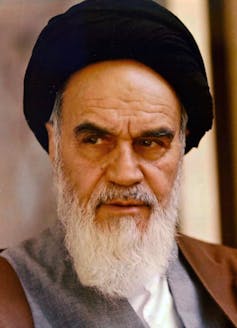
Former Malaysian Prime Minister Mahathir Mohamad is famous for his forthright statements to other world leaders. In March 1989, Mahathir wrote a letter to then UK Prime Minister Margaret Thatcher that was blunt even by his standards. Unlike a lot of his angry letters, this one wasn’t published.
Mahathir’s letter was about Salman Rushdie’s controversial book, The Satanic Verses. He wrote:
I do not think I am a Muslim fanatic. Yet I find I cannot condone the writings of Salman Rushdie in his book […] And I find the attitude of the “Western Democracies” most patronising, arrogant and insensitive.
In 2019, the UK government declassified many of its Foreign and Commonwealth Office (FCO) files on the diplomatic upheaval over the novel. Mahathir’s letter to Thatcher is one of hundreds of unpublished diplomatic documents I have seen in visits to the UK National Archives since then.
My full analysis of this letter, and Thatcher’s response to it, has just been published in the Review of International Studies. It is part of a larger project I am working on about The Satanic Verses crisis and what it tells us about the place of religion in international relations.
‘The strangest and rarest crisis in history’
The Satanic Verses, published in late 1988, was met with protests throughout the Muslim world, beginning in South Asian communities in Britain. Many Muslims felt Rushdie had insulted the Prophet Muhammad for the entertainment of Western audiences.
In early 1989, Iranian Supreme Leader Ayatollah Khomeini issued an extraordinary fatwa (or religious edict) calling for the death of Rushdie, a British citizen living in London. This led to a diplomatic standoff that the speaker of Iran’s legislature called “the strangest and rarest crisis in history”.
Khomeini, who was seeking to strengthen Islamic hardliners in Iran, urged “all zealous Muslims” to carry out his fatwa.
No other leader of a majority Muslim country supported the death sentence, which blatantly violated Britain’s sovereignty and international law. But Mahathir and others felt Western powers should ban The Satanic Verses to maintain good relations with the Muslim world.
The British government saw no reason to ban it. Rushdie and his publishers had broken no British law, as the country’s centuries-old blasphemy laws applied only to the defamation of Christianity.
Defending Rushdie’s life was, as Thatcher put it, “a simple matter”. Her government would not tolerate an Iranian incitement to murder a British citizen on British soil.
Defending his book, however, was more complicated. The British government would not ban it, but also wanted nothing to do with it.
An unusually strong and personal letter
On March 15 1989, Thatcher and Mahathir met in London to discuss matters such as arms deals and airport privatisation. The Satanic Verses issue came up only briefly, when Thatcher thanked Mahathir for his government’s “moderate” stance on the book. She explained that while she could understand the offence the book had caused, the “great religions” could withstand such attacks.
Mahathir reassured Thatcher his government would take no action beyond banning the book. He said he had set out his personal views on the affair in a letter, which he handed to Thatcher.
When her private secretary opened the letter later that day, he found it was “cast in exceptionally strong language that was not reflected in Dr Mahathir’s demeanour at the meeting itself”, according to another archival letter.
Mahathir was having none of the argument that Muslims should behave more like Christians when it came to tolerating insults to their faith. He wrote:
It is well to remember that Islam has been around only 1,400 years. The faith and fervour of the Muslims are as strong as the faith and fanaticism of the Christians of the 15th century.
Of course, our behaviour is also influenced by the mores of the time. We are more tolerant than the 15th century Christians. We do not have inquisitions, we do not burn heretics at the stake, we do not torture those who blaspheme, we do not hound the new Muslim sects as you did the Protestants, and we do not indulge in pogroms. Our behaviour is more civilised than Christians when Christianity was 1,400 years old.
Mahathir’s letter was very unusual for a diplomatic correspondence in that it did not mention either Malaysia or Britain. The “we” of his letter referred to Muslims, while the “you” referred to the West.
And the West, for Mahathir, was a Christian world, though he believed Christianity was enfeebled and decaying within it. He did not want Islam to suffer the same fate.
The West controls the world media and denies others access to it. The power is, of course, abused. […] The Muslims are a particular target. They are made out to be cruel brutes given to all kinds of savagery.
While the West claimed to believe in freedom of expression, according to Mahathir, it did not allow Muslims to defend themselves against what they considered “scurrilous misrepresentation”. Rushdie’s book was the final straw.
Your belief in this so-called ‘freedom of expression’ for one disillusioned and misguided man is stronger than your belief in the value of good relations with 1 billion souls.
In that case, he reasoned, the West could hardly blame Muslims for defending their own principles.
“Prime Minister,” he concluded, “I am much saddened.”
A disconnect between two world views
In another archival letter, Thatcher’s private secretary noted that British officials were “rather rocked by the severity” of Mahathir’s letter.
Thatcher instructed FCO officers to draft a “reasoned response” on her behalf. David Gillmore, former high commissioner to Malaysia, warned they must try to address Mahathir’s points or the reply would sound “condescending and supercilious”.
Written in Thatcher’s voice, the letter said she was “well aware of the distress” the book had caused Mahathir and many in the Islamic world. The reply avoided creating a perception the government was responsible for it.
I must emphasise that the British Government do not in any way condone or endorse Mr Rushdie or the content of this book.
Although freedom of speech was a principle of major importance, Thatcher insisted Britain was not seeking to impose its values on the Muslim world. The issue had “nothing to do with relations between Christians and Muslims”. Rather, it was one of national sovereignty and international law.
When it came to the heart of Mahathir’s complaint, Thatcher’s response resorted to language that was polite, firm and vague:
I was especially saddened to hear you suggest that the Western-controlled media made a particular target of the Muslim world. I cannot agree that this is the case. I believe that this century has seen a growing understanding between the nations, cultures and religions of the world. We must continue to work to improve that understanding.
The British government’s view was that states in the modern age could overcome differences once caused by religion. As such, Thatcher’s response would only represent Britain, not Christendom, despite the many symbolic and even legal ways the British state was still tied to Christianity.
This was one of the reasons Thatcher and Mahathir were doomed to talk past each other. For Western leaders, political authority had superseded religious authority in the 17th century. In diplomacy today, the things that mattered were sovereign states.
The leaders of Muslim countries also viewed sovereign states as important –they were the basis of their own legitimacy. And they had to defend the state against religious radicals who wanted to remake the world along classical Islamic lines.
But for leaders like Mahathir, who grew up in a British colony, religion was still a vital force in diplomatic relations. He viewed the Western insistence on a secular world order as a continuation of colonial dominance over the Muslim world.
The legacy of The Satanic Verses
We can see from this exchange how the British government wanted to distance itself from The Satanic Verses, even as it sought to protect Rushdie.
While many fellow writers, including Muslims like Naguib Mahfouz, leapt to the defence of Rushdie and The Satanic Verses, the book had few defenders in the British government. (One exception was Rushdie’s local MP, the future Labour leader, Jeremy Corbyn.)
In his recent memoir, Knife, Rushdie notes that he got a far more sympathetic response when he was nearly murdered in 2022 than when the fatwa was issued in 1989.
Despite the British government’s notable lack of support for Rushdie’s book, Muslims in Britain and around the world felt the political and cultural power of the West was aligned against them.
This continues to be important for understanding controversies around derogatory images of the Prophet Muhammad in the West. They are never just about the images. They are also about a global imbalance of power that goes back to colonialism.
Mahathir and Thatcher were mutual admirers of each other – and both can claim to have been their countries’ most transformative leaders of the past 50 years. Mahathir, now 99, is still active in Malaysian politics despite recurring health issues.
Mahathir’s anger in this letter did not reflect personal animus against Thatcher. It foreshadowed his future emergence as a global advocate of Islamist causes. His modernist brand of Islamism may well outlast Khomeini’s, despite the violent legacy of Khomeini’s fatwa against Rushdie.
Authors: David Smith, Associate Professor in American Politics and Foreign Policy, US Studies Centre, University of Sydney


















