

Gladiator II features a naval battle held in the Colosseum. These brutal spectacles really happened
- Written by: Craig Barker, Head, Public Engagement, Chau Chak Wing Museum, University of Sydney
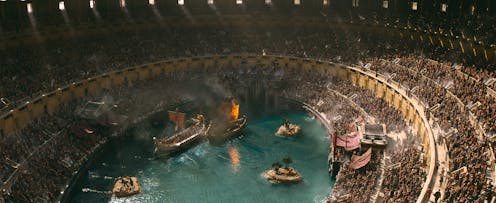
It’s one of the most thrilling sequences in Ridley Scott’s new film Gladiator II, the long-awaited sequel to the 2000 Oscar-winning blockbuster.
Water gushes from the Colosseum’s fountains and floods the arena. A crew of men led by the film’s hero, Lucius Verus (played by Paul Mescal), row a warship while firing arrows at another ship. Sharks loom in the surrounding water, while the Emperor Caracalla (Fred Hechinger) watches on laughing.
Gladiator II trailer.It’s Hollywood’s first re-enactment of an ancient Roman naval battle – and it’s spectacular. The special effects from this sequence will have been a major component of the film’s reported US$310 million budget.
But is there much history to be found here, especially given Ridley Scott’s disdain for historical realities in his films? Did the Romans watch naval battles as entertainment?
Whatever is viewed in the circus and the amphitheatre […] let this be the only sea fight known to posterity. – Martial in Liber Spectaculorum, book 28
War on the water
The term “naumachia” refers to both the staging of naval battles for mass entertainment and the structure or natural feature in which these recreations took place. Naumachiae did exist. And while they seem to have been rare, the death rates would have been high.
Much of what we know of them (and what is written in this article) comes from writing from a handful of historians, including Suetonius, Dio Cassius and Tacitus.

The earliest known naumachia was hosted by Julius Caesar in 46 BCE. Suetonius describes a basin dug near the Tiber river, in Rome’s Campus Martius area, which was large enough to host ships with more than 2,000 combatants and 4,000 rowers – all prisoners of war.
An even grander event was held in 2 BCE by the emperor Augustus for the inauguration of the Temple of Mars Ultor. It was held on an artificial lake, or “stagnum”, spanning more than 530 metres by 350 metres. An estimated 270,000 cubic metres of water would have been required to fill it.
This naumachia featured the reenactment of a naval battle between the “Athenians” and “Persians”. According to Augustus himself, more than 3,000 men fought in 30 vessels.
The largest recorded naumachia came some years later. This reenactment of battle between the “Rhodians” and “Sicilians” was staged by Claudius in 52 CE on the natural lake in Abruzzo, Italy. The event consisted of 100 naval ships and 19,000 combatants – all prisoners who had been condemned to death.
According Dio Cassius, the condemned men saluted Claudius with the phrase Ave imperator, morituri te salutant, or “Hail emperor, those who are about to die salute you”. Although this phrase is now commonly and erroneously assumed to have been spoken by gladiators prior to combat, this remains the only recorded example of its use.
Naumachiae were commonly presented as historical or pseudo-historical reenactments of real naval conflicts. Claudius’ spectacle, for instance, was between fleets representing the “Rhodians” and the “Sicilians”.
Naumachiae in amphitheatres
A new development took place in the 1st century CE: naumachiae began being performed in amphitheatres. The earliest recorded event took place in 57 CE under the rule of emperor Nero, in a wooden structure thought to have been located in the Campus Martius.
For the inauguration of the Flavian amphitheatre (the Colosseum) in 80 CE, Emperor Titus presented two naumachiae: one in Augustus’ stagnum and the other in the Colosseum itself. Titus’ successor, Domitian, is also said to have flooded the Colosseum to host a naumachia circa 85 CE.
The term naumachiae became less frequent in historical literature after the Flavian era (69–96 CE). There’s no evidence the Colosseum was hosting naumachiae as late as the 3rd century, when Gladiator II is set.
Other water spectacles across the Empire
There is some better-preserved evidence of aquatic spectacles on a smaller scale outside of Rome. In Spain, ampitheatres at Verona and Mérida feature central basins connected to water supply and drainage channels.
However, only modest naumachiae would have been possible in these – the arenas presumably covered with wooden floorboards when not used for this purpose.
 The ampitheatre at Mérida, Spain, with a sunken basin visible in the centre of the arena.
Wikimedia, CC BY-SA
The ampitheatre at Mérida, Spain, with a sunken basin visible in the centre of the arena.
Wikimedia, CC BY-SA
Water was also used in other forms of entertainment, such as to display marine animals. For instance, in 2 BCE 36 crocodiles were released in a flooded arena and hunted. It was also common for female swimmers to portray Nereids (water nymphs) in flooded arenas, similar to modern artistic swimming.
However, there is no evidence of sharks ever being on display – despite Ridley Scott’s insistence.
A case study from Cyprus
Just as there is evidence of older Roman theatres being converted for gladiator contests and beast hunts, there is also strong evidence of theatres having been modified for aquatic spectacles. This includes theatres in the Greek cities of Corinth and Argos, as well as in Ostia, Italy.
Recent investigations by University of Sydney archaeologists have revealed further evidence of such modifications at the site of Paphos in Cyprus.
They’ve found evidence of the Paphos theatre’s orchestra being converted for water spectacles in the mid-third century – its floor covered with a cement and coloured stone. With an estimated capacity of 310 cubic metres, this theatre was likely too small to host naumachiae, but would have been ideal for displaying animals or water nymphs.
A semicircular containment wall about one metre high separated the audience from the action, while drains and terracotta pipes indicate the flow of water from a large reservoir excavated behind the theatre. Analysis of the plaster on the floor has also confirmed it was waterproof.
The site provides a valuable contribution to our understanding of Roman water spectacles.
 In this photo of the Paphos theatre, you can see the semi-circular containment wall surrounding the orchestra. This wall acted as abarrier between the arena and the audience in the third century CE.
Photo by Bob Miller/Paphos Theatre Archaeological Project, CC BY-SA
In this photo of the Paphos theatre, you can see the semi-circular containment wall surrounding the orchestra. This wall acted as abarrier between the arena and the audience in the third century CE.
Photo by Bob Miller/Paphos Theatre Archaeological Project, CC BY-SA
So when you’re watching the naval battle in Gladiator II, it’s worth remembering how the ancient Romans viewed this spectacle in much the same way. Just like back then, a lot of money was spent to bring this entertainment to life.
Luckily, nobody had to die this time around.
Authors: Craig Barker, Head, Public Engagement, Chau Chak Wing Museum, University of Sydney




















