

how NZ, Australia and Canada are all struggling with colonial politics
- Written by: Dominic O'Sullivan, Adjunct Professor, Faculty of Health and Environmental Sciences, Auckland University of Technology, and Professor of Political Science, Charles Sturt University
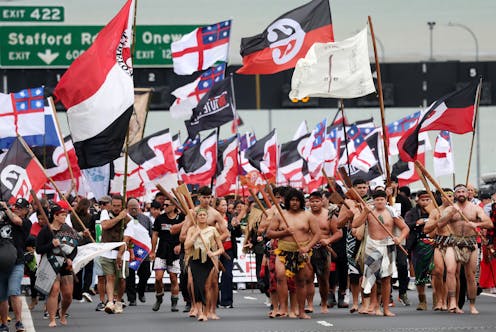
With the ACT Party’s Principles of the Treaty of Waitangi Bill having its first reading in parliament last week, the debate and protests have been – understandably – focused on the local historical and political landscape.
But New Zealand isn’t alone in struggling with ideas about the truth of colonialism and its impacts, and how these should influence policy debates and legislation.
Similar debates are playing out in British Columbia in Canada and Queensland in Australia. In both cases, the question of colonialism’s relevance when thinking about social, political and economic equality has become politically contentious.
ACT leader David Seymour says his Treaty principles bill aims to promote equality by limiting the influence of te Tiriti o Waitangi/Treaty of Waitangi in public life – because, he argues, it is too often interpreted to give Māori more say in decision-making than others.
The counter arguments have been well canvassed: that te Tiriti does, in fact, protect Māori rights to authority over their own affairs and to participate in public life with a distinctive cultural voice; and that these are essential components of equality.
But in New Zealand, as in Canada and Australia, there is still no general consensus on colonialism’s role in the poor and often violent relationship between the state and Indigenous peoples. And because the truth of these relationships remains contested, so does the possibility of genuine equality.
Indigenous rights in British Columbia
In 2019, British Columbia became the first jurisdiction in the world to enact legislation to implement the UN Declaration on the Rights of Indigenous Peoples.
But this year, the Conservative Party of British Columbia made it a major election issue and campaigned to repeal the province’s Declaration on the Rights of Indigenous Peoples Act.
The New Democratic Party government was narrowly returned, but Conservative leader John Rustad claimed the UN declaration “was established for conditions in other countries, not Canada”.
Like the declaration itself, however, the British Columbian law didn’t create any new rights for Indigenous peoples. The declaration simply said human rights belong to them as much as to anybody else, and apply to their cultures, languages and land.
Australia, Canada and New Zealand were three of just four UN member states to vote against the declaration in the first place (in 2007), but all later changed their positions. In 2021, Canada passed federal legislation to implement the declaration.
In 2010, New Zealand’s then prime minister, John Key, said the UN declaration “both affirms accepted rights and establishes future aspirations”. Under the current National-NZ First coalition agreement, however, the same declaration is no longer being considered for legal ratification in New Zealand.
Meanwhile, British Columbia’s law requires annual reporting to parliament on progress towards things such as “ending Indigenous-specific racism and discrimination” and “social, cultural and economic wellbeing”.
The aim is to require accountability and strengthen evidence-based (“truthful”) policymaking as part of a democratic process that works equally well for everybody.
Truth-telling in Queensland
Queensland’s newly elected Liberal National Party government recently confirmed its promise to close down the state’s Truth-Telling and Healing Inquiry and repeal its Path to Treaty Act.
“Truth-telling,” according to the inquiry’s official statements, “is an accurate and inclusive account of Queensland’s history.” In particular, it acknowledges that good public policy, which works equally well for everyone, can’t be based on an assumption that everyone’s experiences, values and expectations are the same.
The then Australian prime minister, Scott Morrison, admitted this in 2020 when he said Indigenous policy failed because:
We perpetuated an ingrained way of thinking, passed down over two centuries and more, and it was the belief that we knew better than our Indigenous peoples. We also thought we understood their problems better than they did. We don’t.
In other words, solutions to the problem Morrison identified require an explicit commitment to public institutions that work equally well for everyone. And better outcomes for everyone are a measure of genuine political equality.
Open societies thrive on debate and evidence
The Principles of the Treaty of Waitangi Bill would require a referendum to become law were it to pass.(That’s unlikely, given the coalition partners won’t support it beyond the select committee stage.)
But referendums reduce complex questions to a simple yes-no binary. Ideas that are simply wrong can have as much weight as any other. In fact, the absence of knowledge, or sheer emotion, can decide an issue with profound impacts on people’s lives.
“If you don’t know, vote no” was the successful slogan (borrowed from elsewhere) used in Australia’s referendum last year on an Aboriginal and Torres Strait Islander Voice to Parliament. Ultimately, truth becomes a casualty when “don’t know” prevails.
As the former British minister and last governor of Hong Kong, Chris Patten, has argued:
Open societies thrive on press freedom, vigorous debate, and evidence-based policymaking. While liberal democracies do not always live up to this ideal, the understanding that this is how things should work […] is the source of their strength.
Liberal democracy means we are all entitled to our opinions, but our fellow citizens also deserve our considered judgment on important issues.
This means bringing truth into the arguments for New Zealand’s Treaty Principles Bill, critiquing British Columbia’s Indigenous rights legislation based on an honest account of what the legislation does, and recognising that genuine equality in Queensland requires truth-telling.
Without truth we can’t know what equality looks like. This remains the challenge for all societies responding to colonialism.
Authors: Dominic O'Sullivan, Adjunct Professor, Faculty of Health and Environmental Sciences, Auckland University of Technology, and Professor of Political Science, Charles Sturt University


















