

‘climate finance’ for the Pacific is mostly loans, saddling small island nations with more debt
- Written by: Steven Ratuva, Director, Macmillan Brown Centre for Pacific Studies, University of Canterbury
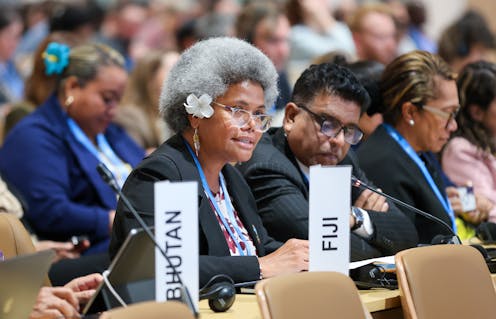
As this year’s UN climate summit reaches its final stage of negotiations, Pacific scholars are calling on world leaders to improve the dispersal system of climate finance to support people living in small island nations.
Last week, we presented the Conference of the Parties (COP29) with a report from the largest Pacific climate adaptation study. The Pacific Ocean Climate Crisis Assessment (POCCA) amplifies voices of people with lived experience. It collates data and case studies about climate impacts island nations are already facing and local adaptation strategies they are already practising.
The report shows that climate finance has been mainstreamed into global financial structures which follow the same patterns as development aid.
This means the main global financial institutions, including the World Bank and the International Monetary Fund, become the “accredited” institutions involved in dispersing funds, adding loan components and making direct access difficult for Pacific nations.
Loading recipient countries with more debt
As a result, some 72% of the money is in the form of loans by the time it reaches people on the ground. The real beneficiaries are private contractors in developed countries who are brought in to build climate-resilient infrastructure.
What may have started off as a humanitarian gesture has ended up loading recipient countries in the Global South, particularly in the Pacific, with more debt.
Recent research shows extreme weather is already costing vulnerable island nations US$141 billion each year. Estimates suggest this will rise to $1 trillion annually by 2030.
Climate finance is an essential point of negotiation at COP29, with the goal of increasing the contributions by wealthy countries.
Last year’s climate summit in Dubai agreed to establish a new fund to compensate developing countries for losses and damages from natural disasters caused by climate change. This diplomatic effort was spearheaded by a group of small island developing states and it is important this fund fills the gaps in current climate finance.
However, closing the gap between the funds currently available and the money needed is only one aspect. We must also transform the process of dispersal to make sure money directly benefits people who already face climate impacts on a daily basis.
Indigenous knowledge and local adaptation
Our report also highlights a range of climate adaptation strategies, including relocating households and villages, already employed by Pacific peoples across the region.
As descendants of great navigators and oceanic settlers who traversed the world’s largest ocean for millennia, Pacific peoples have long developed sophisticated adaptive capacities. Despite living in some of the planet’s smallest and most environmentally challenging places, they have been responding to change in locally relevant and innovative ways for centuries.
This includes traditional building techniques which produce more flexible houses that are easier to rebuild and coastal protections against sea-level rise and beach erosion.
Adaptation practices used in Pacific Islands are mostly based on community Indigenous knowledge and skills passed down over generations. For example, in French Polynesia, the traditional practice of building elevated houses with floors 1.5m above ground level is now subsidised by the government as part of risk prevention.
Pacific islands have also focused increasingly on ecosystem-based approaches that build on their Indigenous knowledge and benefit both communities and ecosystems. In Fiji, Indigenous knowledge has helped to identify native vegetation suitable for reducing coastal erosion and flooding.
Relocation is an adaptation option of last resort. The report includes two case studies of community relocation in Fiji, which highlight the importance of including all social groups in planning to foster positive outcomes.
Changing the narrative
Pacific peoples are intrinsically connected to the ocean and have developed systems of social and ecological resilience which allows them to bounce back quickly from disruption.
Many Pacific people are indeed affected by climate change. But the constant narrative of vulnerability is problematic. It undermines the very idea of Indigenous and local Pacific agency and resilience.
The complexity of climate impacts requires us to look at what is happening on the ground, especially when applying science-based models and their inherent uncertainties to inform local adaptation decisions.
The report recommends enabling pathways that combine Indigenous knowledge, contemporary science methods and government decision tools to safeguard a balance between ground-up and top-down approaches to adaptation and resilience.
Pacific Island communities have always lived on islands affected by drought, tsunami and tropical cyclones. They had to survive on islands with limited resources.
Over millennia, Pacific peoples developed local knowledge, including cultural principles and social structures, to thrive in these circumstances. Given existential threats and challenges, especially those facing atoll island communities, we need to draw on climate-related Indigenous knowledge and practices.
In contrast to narratives of vulnerability, legacies of resilience are key to successful climate adaptation.
Authors: Steven Ratuva, Director, Macmillan Brown Centre for Pacific Studies, University of Canterbury


















