

Modern Australian
The Times

Yes, you still need to use sunscreen, despite what you’ve heard on TikTok

  • Written by Katie Lee, PhD Candidate, Dermatology Research Centre, The University of Queensland
Yes, you still need to use sunscreen, despite what you’ve heard on TikTok

Summer is nearly here. But rather than getting out the sunscreen, some TikTokers are urging followers to chuck it out and go sunscreen-free.

They claim it’s healthier to forgo sunscreen to get the full benefits of sunshine.

Here’s the science really says.

How does sunscreen work?

Because of Australia’s extreme UV environment, most people with pale to olive skin or other risk factors for skin cancer need to protect themselves. Applying sunscreen is a key method of protecting areas not easily covered by clothes.

Sunscreen works by absorbing or scattering UV rays before they can enter your skin and damage DNA or supportive structures such as collagen.

Woman's face under visible light and UV, showing how sunscreen that is not visible to the naked eye absorbs and scatters UV light. The left side of the face has sunscreen on and the right does not.
In this photo, I (Katie) am wearing sunscreen only on the right side of my face. Sunscreen absorbs and scatters UV light (right side) even when you can’t see it with the naked eye (left side). The right-hand photo also shows where clusters of sun damage are accumulating in the skin (dark spots) and where I’ve been careless about applying the sunscreen evenly – under my eye, on my cheek and missing my ear completely. Author provided/UQ

When UV particles hit DNA, the excess energy can damage our DNA. This damage can be repaired, but if the cell divides before the mistake is fixed, it causes a mutation that can lead to skin cancers.

The energy from a particle of UV (a photon) causes DNA strands to break apart and reconnect incorrectly. This causes a bump in the DNA strand that makes it difficult to copy accurately and can introduce mutations. NASA/David Herring

The most common skin cancers are basal cell carcinoma (BCC) and squamous cell carcinoma (SCC). Melanoma is less common, but is the most likely to spread around the body; this process is called metastasis.

Two in three Australians will have at least one skin cancer in their lifetime, and they make up 80% of all cancers in Australia.

Around 99% of skin cancers in Australia are caused by excessive exposure to UV radiation.

Excessive exposure to UV radiation also affects the appearance of your skin. UVA rays are able to penetrate deep into the skin, where they break down supportive structures such as elastin and collagen.

This causes signs of premature ageing, such as deep wrinkling, brown or white blotches, and broken capillaries.

Sunscreen can help prevent skin cancers

Used consistently, sunscreen reduces your risk of skin cancer and slows skin ageing.

In a Queensland study, participants either used sunscreen daily for almost five years, or continued their usual use.

At the end of five years, the daily-use group had reduced their risk of squamous cell carcinoma by 40% compared to the other group.

Ten years later, the daily use group had reduced their risk of invasive melanoma by 73%

Does sunscreen block the health-promoting properties of sunlight?

The answer is a bit more complicated, and involves personalised risk versus benefit trade-offs.

First, the good news: there are many health benefits of spending time in the sun that don’t rely on exposure to UV radiation and aren’t affected by sunscreen use.

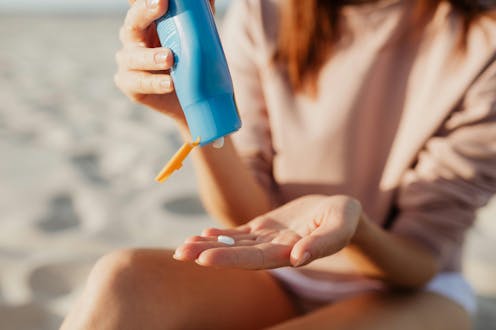
Woman applies sunscreen
Sunscreen only filters UV rays, not all light. Ron Lach/Pexels

Sunscreen only filters UV rays, not visible light or infrared light (which we feel as heat). And importantly, some of the benefits of sunlight are obtained via the eyes.

Visible light improves mood and regulates circadian rhythm (which influences your sleep-wake cycle), and probably reduces myopia (short-sightedness) in children.

Infrared light is being investigated as a treatment for several skin, neurological, psychiatric and autoimmune disorders.

So what is the benefit of exposing skin to UV radiation?

Exposing the skin to the sun produces vitamin D, which is critical for healthy bones and muscles.

Vitamin D deficiency is surprisingly common among Australians, peaking in Victoria at 49% in winter and being lowest in Queensland at 6% in summer.

Luckily, people who are careful about sun protection can avoid vitamin D deficiency by taking a supplement.

Exposing the skin to UV radiation might have benefits independent of vitamin D production, but these are not proven. It might reduce the risk of autoimmune diseases such as multiple sclerosis or cause release of a chemical that could reduce blood pressure. However, there is not enough detail about these benefits to know whether sunscreen would be a problem.

What does this mean for you?

There are some benefits of exposing the skin to UV radiation that might be blunted by sunscreen. Whether it’s worth foregoing those benefits to avoid skin cancer depends on how susceptible you are to skin cancer.

If you have pale skin or other factors that increase you risk of skin cancer, you should aim to apply sunscreen daily on all days when the UV index is forecast to reach 3.

If you have darker skin that rarely or never burns, you can go without daily sunscreen – although you will still need protection during extended times outdoors.

For now, the balance of evidence suggests it’s better for people who are susceptible to skin cancer to continue with sun protection practices, with vitamin D supplementation if needed.

Authors: Katie Lee, PhD Candidate, Dermatology Research Centre, The University of Queensland

Read more https://theconversation.com/yes-you-still-need-to-use-sunscreen-despite-what-youve-heard-on-tiktok-232708

Road Signs: Understanding Their Role in Clear and Effective Signage

Effective signage and display hardware can help businesses communicate information, promote products and organise customer or visitor movement. Road...

Bottle Label Printing: Key Factors to Consider Before Your Next Packaging Run

Effective packaging begins with understanding the product, bottle material, artwork and production requirements when planning bottle label printing. H...

Planning a Long-Distance Move With Interstate Movers Melbourne

Moving between states involves more planning than a typical local relocation. Along with packing and transporting household belongings, you need to...

Understanding the Role of an I/O Controller in Industrial Automation

Modern industrial systems depend on accurate communication between sensors, machines and control systems. An I/O controller can help manage this commu...

How the Right Mining Hose Supports Demanding Operations

Mining environments place considerable demands on equipment used for material transfer, water management and processing. Hoses operating in these co...

Simple Ideas for Making Social Gatherings More Memorable

We have all been to those parties where everyone just stands around the kitchen island, staring at their phones, waiting for someone else to make a mo...

Outdoor Wall Lights: Improving Exterior Lighting Around Your Home

Lighting can influence how a room looks, feels and functions, so the right fitting should be selected according to both appearance and practical req...

Commercial Office Cleaning: Combining Routine Office Cleaning With Melbourne Service

Keeping a workplace clean requires a service that can accommodate everyday tasks as well as the particular needs of the business. Professional comme...

Caravan Sales in Queensland: How to Find the Right Caravan for Sale QLD

Caravan ownership is about more than having somewhere to sleep while travelling. For many Queenslanders, it is one of the best ways to explore regio...

What Sir Walter Buffalo Turf Actually Costs in 2026 (And Why Quotes Vary So Much)

Two quotes landed on a Hills District homeowner's kitchen table last spring for the exact same 80-square-metre backyard. One said $12 a metre. The o...

Nearly 1,300 NSW Hospital Beds Are Occupied By People Who Are Ready To Go Home

1,276 people in NSW hospitals have been medically cleared for discharge but remain in hospital because they're still waiting for NDIS or aged care sup...

National Survey Launched to Measure Operational Impacts of Federal NDIS Policy Reforms

The effects of recent NDIS reforms are beginning to move beyond policy papers and into day to day service delivery. A new national survey is asking ...

Beyond the Nappy Cake: Baby Shower Gifts That Get Used

What new Australian parents unwrap, keep, and quietly thank you for months later. Six weeks after my daughter was born, I did an audit of the baby sh...

Parent-Advocates Are Reshaping Frontline Disability Service Delivery

Parents have always been part of the disability sector. They advocate, coordinate services, challenge decisions and often become the person holding ev...

Vista Cruises Enters "Two-Flagship Era" as Vista Aurora Completes Inaugural Voyage

Vista Aurora Sets Sail along the Yangtze. (Photo courtesy of the company)YICHANG, China — August 5, 2026 — Vista Aurora, a high-end interprovinc...

A Digital Preparation Checklist For International Medical Conferences

An international medical conference compresses many responsibilities into a few days. A delegate may need to present research, move between venues, ...

The Growing Popularity of Lab Grown Diamonds in Sydney and Hong Kong

The diamond industry has changed significantly in recent years as more buyers seek ethical, affordable, and sustainable alternatives to mined diamon...

Modern AI SEO Agency vs Traditional SEO: What’s the Difference

Search engine optimisation has changed dramatically over the past few years. Search engines have become smarter, user behaviour has evolved, and bus...

















