

The online world isn’t always safe. Here’s what to know before posting photos of your child
- Written by: Catherine Jane Archer, Senior Lecturer, Communication, Edith Cowan University
Australian celebrity and “public relations maven” Roxy Jacenko has said she regrets turning her daughter, Pixie Curtis, into a child social media influencer.
The 13-year-old’s Instagram account had long been used by her mother to generate income via brand sponsorships and online businesses such as Pixie’s Bows and Pixie’s Toys. But Jacenko is now saying the money wasn’t worth the negative effects of Pixie’s public persona, which included being bullied at school.
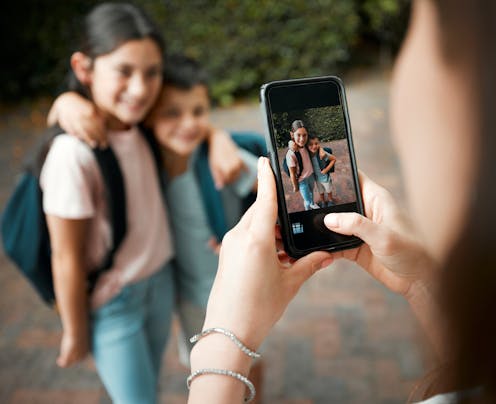
This admission, along with the government’s decision to ban social media for under-16s, is a timely reminder for parents to reflect on how they share images of their own children online – even for those of us who don’t intend to make our children influencers.
Parents’ views on ‘sharenting’
A 2019 survey of 613 Australian parents (mostly mothers) found 15% posted images of their children to Facebook at least once a week, while 13% posted at least weekly to Instagram. Only 20% said they never shared images to Facebook, and 37% never shared them to Instagram.
Research has found parents who choose to not share images of their children are often driven by concerns over privacy and future consequences.
Parent “influencers”, however, remain much more likely to do this – and are often unaware of the potential risks. Nonetheless, a number of them are now pushing back against the practice and offering alternatives to posting images of one’s children online.
According to research by one of us (Katrin), many Australian parents understand their children’s images and details (such as name, address and school) can be considered sensitive information.
They associate this identifiable information with risks posed by bad actors (such as paedophiles) who could identify and follow their children both online and offline. These concerns are further fuelled by media reports of such incidents.
Many parents will use strategies to minimise risk, such as by blurring children’s faces in online posts, or covering them with emojis. They may also crop the image, or have the child turn away from the camera to protect their identity.
That said, some people may still be able to identity the child in question, such as by feeding the image through an online image search and certain AI tools. An image’s metadata may also include details such as where and when a photo was taken, making it easier to trace.
Balancing risks with benefits
Although the concerns are clear, sharing images of one’s children in online spaces can also have many benefits for families.
By reducing the information they share about their kids, parents may also miss out on opportunities to gain social support from peers and celebrate major milestones in their kids’ lives. After all, many families use social media platforms as digital family albums and tools to archive key memories.
Katrin’s research also found that families – particularly those from diverse cultural backgrounds – may also use these platforms to maintain important connections with loved ones living overseas.
Similarly, parents from non-traditional family structures, such as same-sex parents, often depend on social media as important spaces to proudly share, advocate for and normalise their experience of family life.
What to ask yourself before you post
Despite the move to ban social media for children under 16, it doesn’t look like Australia will follow France’s lead in curtailing sharenting through legislation such as a children’s image rights law.
In France, this law aims to tackle the risks of sharenting by enshrining children’s right to privacy. It means protecting children’s privacy is among a parents’ legal duty – and that children legally need to be consulted.
Nonetheless, there are several things parents can consider before they share their child’s data, including images and video. For instance, they can:
1. get consent from a child (if they are old enough) before before posting about them
2. share carefully. Try sharing less through public avenues, or be more mindful of your audience. Ensure identifiable information such as school logos are not featured in images. You can even remove a photo’s metadata
3. review the policies and practices of institutions your child may be part of. Check if they ask for children’s consent before taking video or photographic images – as well as options for opting out
4. have a conversation with your child, partner and other family members (such as grandparents) about an approach that feels comfortable when it comes to sharing your child’s images. You may ask friends and family members to reduce unnecessary sharing
5. consciously select password-protected apps or online platforms to share photos with family and friends, rather than social media
6. regularly review each platform’s provided privacy settings, and purposefully use these features. For example, you may set your Facebook account to “private”, or only participate in private Facebook groups.
Posting content online comes with a range of risks, some of which remain unknown in the face of developing technologies. But it can also have immeasurable benefits. It’s important all family members consider these nuances and share the responsibility of making balanced, informed decisions about their online practices.
Authors: Catherine Jane Archer, Senior Lecturer, Communication, Edith Cowan University


















