

Most NZ dairy farmers put profitability first – but some are planting native trees anyway
- Written by: Elizabeth Elliot Noe, Postdoctoral Fellow in Biodiversity, Lincoln University, New Zealand
Globally, about 40% of ice-free land is used for agriculture, managed by farmers and herders.
In Aotearoa New Zealand, this share is even higher, with 51% of land used for agriculture and horticulture. Of this, currently about 10% is used for dairy farming.
When natural habitats are cleared for agriculture, most native biodiversity is lost. Dairy farms represent intensive farming systems with significant detrimental consequences for biodiversity, water and soil quality. However, hedgerows, riparian plantings and shade trees can enhance native biodiversity within these landscapes.
In our new study, we visited 14 dairy farms and interviewed farmers in the Waikato and Canterbury. The research was qualitative, allowing for an in-depth exploration of the experiences, values and priorities New Zealand dairy farmers have for their land and the implications for native biodiversity on farms.
We found dairy farmers have multiple values and priorities but limited time, resources and energy. While working within external constraints such as land ownership or regulations, farmers will act on what they value most.
Unlike most developed countries, New Zealand’s agricultural sector is entirely exposed to global markets. About 95% of dairy products are exported and government support is the lowest among OECD countries. Perhaps unsurprisingly, we found most dairy farmers list economic viability as their highest priority.
When biodiversity is a trade-off
While being profitable is a necessity, maximising profitability is an option. Our interviewees say they would trade off some profit for other values, such as spending time with family, enjoying one’s work, having a visually pleasant home and work environment, improving animal welfare and minimising some negative environmental consequences of dairy farming.
Waikato farmer Riley argued:
You have to make money to keep [the farm] afloat, to be sustainable. But it doesn’t have to spit out millions of dollars in profit. And we want the lifestyle, and we want everything to be better than when we found it.
Beyond the constraints of making a living and paying off farm debt, the landowner’s value hierarchy determines whether they incorporate native biodiversity into farm landscapes.
Our interviewees spoke of many barriers to planting natives, including the cost of plants and ongoing maintenance, labour and lack of knowledge of which species to plant where.
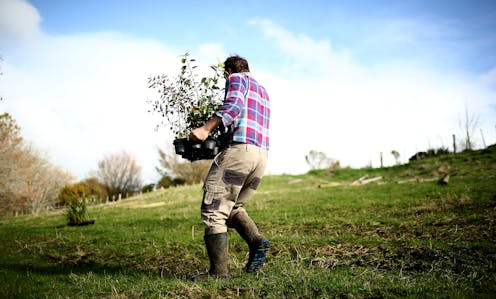
Apart from land ownership, however, these barriers are surmountable to those farmers for whom native biodiversity ranks highly in their hierarchy of values. They acknowledged that planting natives took time and cost money, but it was important enough to them to do it regardless.
These farmers had incorporated native biodiversity into their farm management. For them, planting natives was not an optional extra but an integral part of running a sustainable dairy farm. Their definition of land improvement, sustainability and being a good farmer had come to include planting natives.
Competing for land
Currently, farm productivity and native biodiversity are usually viewed as being incompatible and in competition for land. This is a sentiment dairy farmers voiced in our study as well.
Most participants did not see a clear connection between native biodiversity and milk production, and therefore did not believe planting natives could benefit the productivity or profitability of their farms. Some described areas of native vegetation as “lost land”.
Some of our participants did, however, see opportunities for native biodiversity to contribute towards other values, such as the attractiveness of the farm or animal welfare by providing shade and shelter for cows.
Many studies confirm that on-farm benefits are critical for the adoption of new management practices. Clarifying and emphasising known benefits of native biodiversity to the farm is therefore vital.
Value hierarchies can also shift over a farmer’s lifetime. How highly farmers value native biodiversity will influence how much land they are willing to “lose” for something other than milk production.
Even for the “greenest” dairy farmer, however, strong convictions about the morality of using land for food production will limit how much native biodiversity is acceptable on farm. Native species will primarily be restricted to “marginal” land, mirroring Aotearoa’s broader approach to have conservation land in unproductive mountainous areas.
Unless we can draw a clear connection between native biodiversity and the economic viability of a dairy farm, making space for natives will continue to depend on landowners’ value hierarchies.
Incorporating care for native biodiversity into what it means to be a good farmer has potential to contribute to some transformation of agricultural landscapes. This requires cultural change – a change in the socially embedded understandings and symbols of good farming.
A gradual shift may already be underway, as is suggested by the experiences of those participants who have seen changes in their own value hierarchies and in those of wider farming communities.
Some farmers perceived a shift from the older to the younger generation, with younger farmers being taught to consider the environmental consequences of their practices. Some older farmers described their increasing appreciation of native plants, though they still struggled with the idea of using land for something other than growing pasture.
We need to consider how as a nation we can work towards a shared understanding of good landcare and healthy landscapes.
Authors: Elizabeth Elliot Noe, Postdoctoral Fellow in Biodiversity, Lincoln University, New Zealand


















