

A new report links being homeless in Australia to dying 40 years early
- Written by: Lisa Wood, Professor, University of Notre Dame Australia
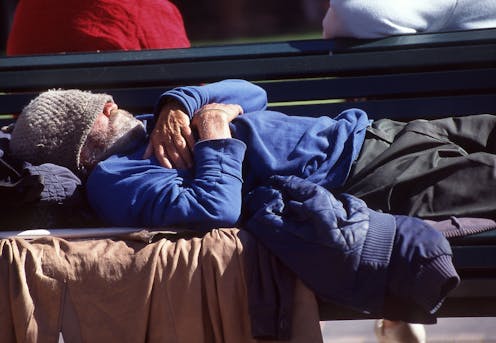
Homelessness has now taken the lead as Australia’s largest and most damning disparity in life expectancy.
A landmark report from the Australian Institute of Health and Welfare looked at the deaths of those seeking help from specialist homelessness services in their last year of life between 2012-2022.
The sheer number of deaths – around 12,500 over the ten-year period – is staggering, as is the upward increase over time. But so are the disparities.
The average age of death for the general population in Australia is 83. That’s more than three decades longer than the homeless population in this data – they average just 46 years.
And the main causes of death – suicide and accidental poisoning (including by drug overdoses) – show the issue goes beyond housing. It is about the opportunities for hope and good health many Australians take for granted.
What gets counted counts
For too long, the death toll and enormous life expectancy gap associated with homelessness has been largely invisible in national data.
Deaths of people who have experienced homelessness rarely make it into newspaper death notices or obituaries, nor in national mortality data.
Their invisibility in death is linked to the invisibility in life of people who are homeless. It symbolises wider systemic abandonment and policy inertia on homelessness.
A landmark snapshot
The report from the Australian Institute of Health and Welfare is the first of its kind in Australia and confronts us with a sobering snapshot.
The figure of almost 1,500 deaths in the 2021-2022 financial year (the most recent year of data reported) is confronting. It is higher than Australia’s annual road toll death.
The report shows the main causes of death were suicide (12-15%) of all deaths over the ten-year period) and accidental poisoning (14-20%).
This population accounts for one in 20 suicides in Australia, and one in six deaths by accidental poisoning.
Yet the most recent national strategy on suicide prevention makes no mention at all of homelessness.
Deaths of despair
These latest statistics reflect what has been described in international literature as “deaths of despair”.
This term refers to deaths from drug overdoses, suicide and alcohol-related disease among people with compounded social and economic disadvantage.
What lies behind these figures are lives often marked by awful adversity, trauma, poverty and exclusion.
In my research, I have spent time with people in Perth trying to survive on the streets, often with multiple health conditions. Their despair was palpable. The longer people remain homeless, the more their health and hope erodes.
However it’s important to note they are also lives of incredible survival and resilience. In this context, living beyond age 50 is literally survival “against the odds.”
Compounding health conditions
The Australian Institute of Health and Welfare report shows a litany of other preventable conditions are also killing those who have experienced homelessness. These include coronary heart disease, lung cancer and diabetes.
Diabetes is a classic example of how homelessness affects management of a common chronic disease. What can you do when a hospital discharge summary says “store your insulin in the fridge” but you don’t have a kitchen?
This is a population left behind on many of Australia’s public health and preventive health successes, such as the downward trends in smoking and bowel and cervical cancer screening success.
UK research found almost one in three homeless deaths were attributed to conditions that could have been prevented or treated. This is likely conservative.
For people who have endured homelessness, the medically documented “cause” of death can mask many factors and the complexity of multiple health conditions.
Our research
Sadly, these statistics do not come as a surprise.
They echo evidence from recent studies in Australia, the United Kingdom and the United States.
Similar life expectancy gaps are seen in our own monitoring of deaths among people who have experienced homelessness in Perth. Our data shows there are on average two deaths a week in this population, in Perth alone.
Are we getting better or going backwards?
We can’t reverse the trend revealed in this gloomy new data unless we also challenge the increasing “normalisation” of homelessness in our country.
Yes, there is a housing crisis. But we are also not turning off the tap of drivers of homelessness, such as domestic violence, poverty, and intergenerational trauma.
This latest report is a good first step in countering the invisibility of homelessness.
It adds further weight to homelessness sector calls, to not only monitor and report annually on homeless deaths, but also to ramp up investment in ending homelessness in this country.
But we hope this won’t be a one-off report. The data should be updated annually. In England, Wales and Scotland — where deaths of people experiencing homelessness are publicly reported each year — a recent open consultation revealed the value of these data.
Future reporting should not be limited to deaths of people who sought assistance from a specialist homelessness service within the last year of their life. There is considerable evidence, including recent Australian research that any lifetime experience of homelessness increases the risk of premature death.
Housing is health, and rapid access to housing is fundamental to reducing life expectancy gaps and restoring hope.
If this article has raised issues for you, or if you’re concerned about someone you know, call Lifeline on 13 11 14.
Dr Andrew Davies from Homeless Healthcare contributed to this article.
Authors: Lisa Wood, Professor, University of Notre Dame Australia


















