

How sharing stories about river restoration can inspire others to take care of waterways
- Written by: Katharina Doehring, Freshwater Scientist, Cawthron Institute
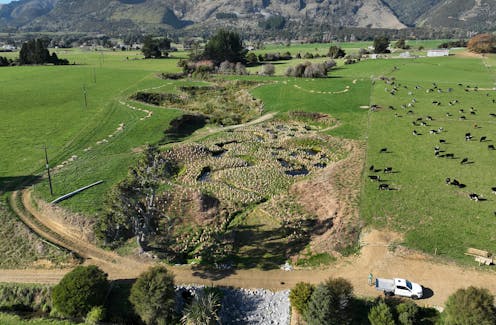
Water is the lifeblood of our planet. But in Aotearoa New Zealand, a staggering two-thirds of the rivers monitored for water quality are classified as unswimmable. Only 2% of large lakes are deemed to be in “good health”.
Unfortunately, this decline is due to the human impacts of urbanisation, intensive agriculture and poor land management. Many communities that depend on freshwater sources have witnessed this deterioration firsthand.
To address this critical issue, numerous catchment care groups have emerged over the past decade, championing sustainable land management to enhance the health of New Zealand’s rivers, lakes, aquifers and wetlands.
These groups engage in activities such as planting native vegetation along waterways, erecting fences to keep livestock at bay and altering farming practices to be more environmentally friendly. Many people care deeply about the land and water, and their intricate, collective knowledge is a powerful force for change.
Collective storytelling as a tool for freshwater restoration
Over the past few years, we have been listening to these communities and exploring a tool that might elevate their efforts and empower those who haven’t yet started on their river restoration journey. It’s a simple and ancient tool rooted deeply in human history and embedded in our social identities today: collective storytelling by trusted storytellers.
Rural communities, including food producers, identify with trusted peers. When they share their experiences, others can learn from them. We saw that this kind of trust motivates people to get involved in caring for waterways, for the benefit of generations to come. It is independent of changing governments and policies, and grows stronger when passionate people come together, united by their shared sense of place.
Our research highlighted an absence of collective storytelling in national freshwater restoration efforts and pioneered a way to develop this at scale.
To this end, we have been working with the Land Air Water Aotearoa (LAWA) environmental reporting platform. Communities can now share their restoration knowledge as “Actions for Healthy Waterways” in the form of stories. Beyond reporting facts and figures alone, stories represent more meaningful narratives that others striving for healthy waterways can relate to.
We interviewed 23 land managers and met with five catchment care groups across Aotearoa New Zealand. We discussed why knowledge sharing is important, how knowledge should be shared and who may be best placed as knowledge brokers.
Based on those conversations, we highlight three guiding principles of collective storytelling that can enhance the restoration of rivers, lakes, wetlands and aquifers.
1. Respected storytellers
Trust is crucial. It influences who is believed and who inspires action. When peers share their experiences, particularly farmers discussing restoration efforts, collective responsibility is created and drives others to participate.
One food producer encapsulated this sentiment, noting:
If you start creating that collective responsibility, then you can go, ‘Oh yeah, you’ve put a hundred [trees in] – we’ll do a hundred, too.
Catchment champions – locally respected individuals who are driving restoration activities and encouraging others – are immensely important in amplifying these stories. We found authentic storytellers could be individuals or an entire catchment group, as long as they held this trust.
In the New Zealand context we would say they had the mana (authority, prestige, status, charisma). One participant shared:
I’m a newcomer, so I was learning what’s gone well and what works. I don’t want to make someone else’s mistake, I can’t afford to already, so if I go “Oh this works well”, I will do that, too.
2. Authenticity in storytelling
The content of stories is as vital as the tellers. It needs to be genuine and honest.
Catchment care groups emphasised that restoration stories need to include failures as well as successes. Celebrating successes, like the return of a fish species, while also acknowledging challenges, such as vegetation die-off, creates a more genuine narrative. This unconditional storytelling fosters connection through shared experiences.
As one participant highlighted:
It is important to share what we know about land management and restoration: the things that worked and the things that didn’t work.
3. Future generations motivate action
The motivation behind restoration efforts is a crucial aspect of knowledge sharing.
Our research shows that rural communities expressed a profound responsibility to act triggered by a concern for future generations.
Farmers frequently voiced a desire to leave rivers in better condition for their children and grandchildren, saying:
We acknowledge that we are only passing through, so that whatever we do now should have long lasting impacts for our children.
This inter-generational perspective fosters a long-term commitment to restoration. While our study participants were Pākehā (New Zealanders of European ancestry), this view aligns well with kaitiakitanga, the integral Māori principle of environmental stewardship. It illustrates a shared deep sense of responsibility for future generations.
Given that reversing damage to freshwater systems will require sustained effort over time, collective storytelling that emphasises inter-generational goals helps cultivate patience and resilience within communities. It also possibly avoids disappointment when improvements are not seen as quickly as hoped.
We advocate for the broader integration of collective storytelling as a valuable strategic tool in restoring the health of waterways globally. At the same time, we emphasise that restoration is only one part of improving freshwater health.
Substantial changes in land use will also be needed in New Zealand and elsewhere to prevent further degradation. Authentic, local and collective storytelling can help both the transition in land use and restoration.
Authors: Katharina Doehring, Freshwater Scientist, Cawthron Institute


















