

the Treaty principles debate and an honest reckoning with history
- Written by: Anne Salmond, Distinguished Professor of Anthropology and Māori Studies, University of Auckland, Waipapa Taumata Rau
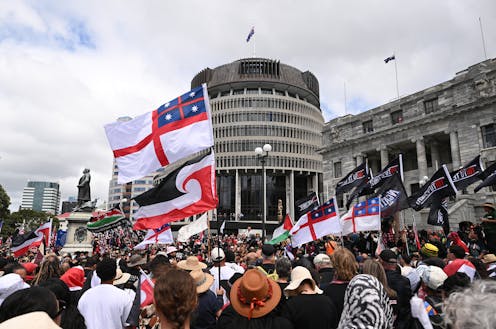
After the hīkoi, the haka, the flags and the tumult, what next?
In the absence of obvious answers, a thoughtful and respectful discussion about te Tiriti o Waitangi/Treaty of Waitangi would be timely, to help guide us into the future.
How can that be managed, however? Like any debate, it will be characterised by differences of opinion, within te ao Māori (the Māori world) as well as beyond it.
How those differences are handled will be vital. And that is the challenge facing the Justice Select Commmittee, now calling for submissions (closing January 7) on the Principles of the Treaty of Waitangi Bill.
Diversity and consensus
Aotearoa New Zealand has always been diverse, from the arrival of the first star navigators from different islands in the Pacific, and the migration of different hapū or kin groups around the country, to the arrival of settlers from Europe and elsewhere.
When te Tiriti was signed in 1840, each rangatira (chief), official or missionary who spoke at Waitangi, Mangungu, Kaitaia or elsewhere had their own views about its virtues and weaknesses, its promises and dangers.
Despite that, in 1840 they were able to reach a consensus, on the speaking grounds and beyond. Most of the rangatira who engaged in the debates in fact signed te Tiriti.
Various settlers, missionaries and officials were also involved in these discussions, although their exchanges among themselves and with Governor William Hobson are less well documented.
In 1840, the population was small, perhaps 80,000 tangata māori (indigenous inhabitants) and about 2,050 settlers. It was highly cosmopolitan, with many people (including tangata māori) coming and going to and from other parts of the world.
It was also diverse because not all settlers came from the United Kingdom. By 1840, people from many different parts of the world were living in New Zealand.
No mention of ‘race’ in te Tiriti
The key parties to te Tiriti o Waitangi were the queen of England and her representative, the kāwana or governor, the settlers, the rangatira with their hapū, and ngā tangata māori o Nu Tirani (the indigenous inhabitants of New Zealand).
(In Te Tiriti, the term “māori” is used throughout as an adjective, meaning normal, everyday or, in this context, indigenous. Those who came from England were “ngā tangata o Ingarani”.)
In 1840, the relationships among the various rangatira, hapū and indigenous inhabitants were defined by kinship, not “race” – a colonial concept with no scientific validity and a terrible history, associated with slavery, genocide and other atrocities.
Whānau (extended families) and hapū were highly flexible, with membership being limited by practical commitment as well as descent from a shared ancestor.
These kin groups included those who married in, so long as they contributed to the life of the group. By 1840, some of those who had married in had arrived from outside New Zealand.
Some new arrivals later became the founders of kin groups that were named after them, although their different countries of origin were also remembered – the Manueras, the O’Regans and the Jacksons, for example.
In addition to their kin groups, individuals were identified by their papa kāinga or places of origin, as marked by ancestral mountains and rivers.
The queen was also identified in this same way, by her country of origin, as “Te Kuini o Ingarani” – the Queen of England. This is the idea of “tangata whenua” in action – person and place intertwined. Again, there is no mention of “race” anywhere in te Tiriti.

What the Treaty articles say
In te Tiriti o Waitangi, each of the parties – queen, kāwana, settlers, each of the rangatira with their hapū, and ngā tangata māori o Nu Tirani – had their own mana.
In the Preamble and Ture/Article 1 of te Tiriti, the rangatira gave the queen, absolutely and forever, the right to appoint a kāwana as a “kai whakarite” (literally, one who makes things equal) to introduce kāwanatanga (governance) and ture (laws) to bring about peace and tranquil living across their lands.
In Ture/Article 2, the queen promised each of the rangatira with their hapū and members that she will uphold the tino rangatiranga (independence) of their lands, dwelling places and all of their ancestral treasures.
This was not a gift, but a recognition of their preexisting rights and duties as tangata whenua (literally, land people) in their own territories.
In Ture/Article 3, in return for the gift of kāwanatanga, the queen promised to protect ngā tangata māori of New Zealand, and give to them “ngā tikanga rite tahi” – absolute equality as persons – with her subjects, the inhabitants of England.
This is a multilateral, rather than a bilateral agreement. In the process of signing te Tiriti, each rangatira and hapū (and their members) retained their tino rangatiratanga, qualified only by their agreement to the exercise of the kāwanatanga of the queen.
They have done so ever since, in the Northern War and the Land Wars, for instance, when some hapū fought for and some against the settler government, and in the modern Treaty settlement process.
Breaking an agreement
So, what does this mean in the 21st century? How can these relationships best be reflected in contemporary constitutional arrangements?
How can we achieve a way forward that weaves us together as New Zealanders, rather than divides us? What kind of process would be wise and fair?
Unfortunately, the Treaty Principles bill starts the debate off on the wrong foot.
Most New Zealanders, I think, would agree that if one party to any agreement – the sale of a house, an employment contract or a divorce settlement, for example – is allowed to alter its terms without reference to the other party or parties, that would be fundamentally unfair.
That is exactly what has happened in the bill, however. Its terms have been drawn up by one party, the Crown – and in reality, by ACT, a small political party with only 8.6% of the vote at the last election – and without the backing of the rest of the coalition government.
The other parties to te Tiriti, the various rangatira and their hapū whose tino rangatiratanga is at stake, and whose members with their tikanga were promised absolute equality with the incoming settlers, have been excluded from having any say about the terms of the bill, and how these change the terms of the original agreement.
Most New Zealanders, if they’d signed an agreement in good faith, would be furious to find the other party was trying to unilaterally change its terms in their own favour. In most situations, that would not only be unfair, it would also be illegal.
If in the process, they were accused of seeking special treatment for themselves, when they were simply trying to uphold the terms of the original agreement, they’d be bitterly angry and upset.
As for individuals, so for groups. As we can see from other countries where different groups are set against each other in this kind of way, whether by “race”, ethnicity or religion, this is dangerous, and the outcomes are generally catastrophic.
Seeking consensus
Rather than letting ourselves be polarised into hostile camps, it would be wiser for New Zealanders to regard diversity as a strength, to think of what’s fair for others as well as ourselves, and to weave ourselves together.
To do this, there are a few questions we might ask ourselves.
For instance, what is the debate over te Tiriti really about? Is it really about democracy and the rights of ordinary New Zealanders? Or is it, as has been argued elsewhere, about removing impediments to the privatisation of public assets and projects that might be subject to Treaty claims?
If in Te Tiriti the queen of England solemnly promised each of the rangatira and their hapū and its members te tino rangatiratanga (independence) of their lands, dwelling places and ancestral treasures, and in return they agreed to her kāwanatanga (governance), is it wise, fair or even legal to unilaterally try to redefine that agreement?
If each of the rangatira and their hapū have a measure of autonomy under te Tiriti, how might that work? What might the relationship between tino rangatiratanga and kāwanatanga look like in the 21st century?
How can a consensus fairly be sought on these questions?
If the queen of England promised ngā tangata māori “ngā tikanga rite tahi” (absolute equality) with her subjects, the incoming settlers, has that promise been kept?
If the answer is yes, how can one explain all the negative statistics for Māori in health, education, justice and the economy that demonstrate fundamental inequities at present?
If the answer is no, and the queen’s promise has been broken, how can this situation best be remedied?
Do the promises of tino rangatiratanga and ngā tikanga rite tahi suggest the rangatira, hapū and ngā tangata māori should have a significant say about what approaches are most likely to be effective?
Above all, perhaps, if roles were reversed and the descendants of settlers were the descendants of the rangatira and their hapū – or vice versa – how would they like to be treated?
Perhaps the select committee, under National MP James Meager’s leadership, can help answer these questions.
That will only happen, however, if its members can rise above party politics, attend to the evidence, and work together to promote peace (rongo), tranquil living (ata noho) and the absolute equality (nga tikanga rite tahi) Queen Victoria promised in 1840.
Authors: Anne Salmond, Distinguished Professor of Anthropology and Māori Studies, University of Auckland, Waipapa Taumata Rau


















