

A new model accurately predicts the migration of humpback whales – and may help them survive climate change
- Written by: Jasper de Bie, Research Fellow, Coastal and Marine Research Centre, Griffith University
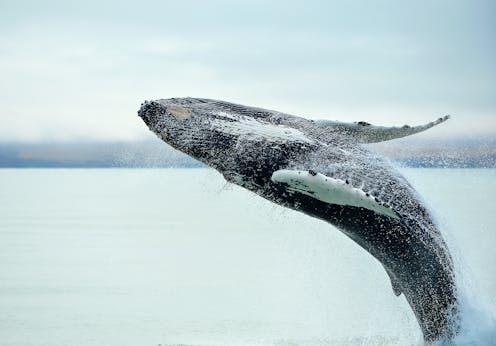
This year’s humpback whale (Megaptera novaeangliae) season in Australia has almost come to an end. The beloved mammals are on their way to Antarctica for a summer of feeding. Next year from April onwards, millions of people will again witness their movements and acrobatic displays – either from the coast or by joining one of the hundreds of whale-watch boat operators.
But as much as we like to watch humpback whales, we still know very little about them. They are notoriously difficult to study in the field. While they are known for their surface activities, they spend most of their time underwater and outside the range of direct observations.
One of the biggest mysteries of all is how these animals make decisions to determine what they do and where they go.
This is where our new research, published in Marine Mammal Science today, comes in. We developed a model which effectively captures key humpback whale behaviours and their resulting southward migratory movements in east Australia. It can help anticipate challenges whales may face in the future. In turn, it may aid efforts to better conserve these majestic animals.
A comeback
Following the end of commercial whaling, the worldwide recovery of humpback whale populations has been very successful. In Australia, the species was removed from the threatened species list in 2022.
However, scientists fear the effects of climate change may now be the biggest threat to their survival.
Our previous research examined which environmental factors matter in humpback whale ecology. For instance, while water temperature may have little impact in the cold Antarctic waters, breeding grounds further north that are too warm could drive humpback whales to seek better conditions elsewhere.
Currently we rely on satellite tags to inform us of their large-scale whereabouts. But unfortunately, this provides little information on humpback whale activities on a smaller scale, such as how they socialise, hunt, or react to specific conditions.

Movements through space and time
To address this, we turned to computer models, as these can deal with scarce or inconsistently collected data. In particular, “agent-based” models are designed to capture the behavioural response of an agent (in this case, a pod consisting of a humpback whale mother and one calf) to the environmental conditions they encounter. Based on this information, the models then project movements through space and time.
We developed the first such model to simulate migratory movements of humpback whale mother and calf pods between the Great Barrier Reef and the Gold Coast bay. Along this route is Hervey Bay, an important resting area due to its calm and sheltered waters, where the pairs may stay for up to a few weeks before continuing migration.
As humpback whales are almost always sighted in waters between 15 and 200 metres deep and below 28°C, we took a simple yet reasonable approach where we assumed they avoided waters too shallow, deep, or warm as they swam southwards.
This “avoidance” response would be similar to us going indoors when it is too hot outside or raining heavily: a simple decision to move away from somewhere we are not comfortable.
 The model is designed to capture the movement of a humpback mother and calf pod.
Michael Smith ITWP/Shutterstock
The model is designed to capture the movement of a humpback mother and calf pod.
Michael Smith ITWP/Shutterstock
A combo of current and swimming speed
To estimate how fast whales were moving, we combined the speed of the current with an estimate of real-world swimming speeds by migrating mother and calf pairs along the Gold Coast.
Our simulations accurately predict the routes taken by migrating mother and calf pairs but point to a change in direction after Hervey Bay so whales remain close to the coastline.
Other research has shown that this “distance to shore” is an important variable to consider when studying humpback whales.
Results also highlight the importance of water depth when entering Hervey Bay and ensuring the whales avoid getting too close to shore or into the deep ocean.
A tool for conservation
What the model does less well is accurately predict travel time between the Great Barrier Reef and the Gold Coast bay.
There are a few reasons why this may be the case. For example, the aforementioned underwater movements and associated behaviours are difficult to capture and convert into meaningful components of our model. Research has started to reveal detailed dive profiles but is time consuming and expensive.
We also assume that swimming speed remains more or less constant over time regardless of whether it is day or night. However, research into daily activity patterns has, so far, focused primarily on feeding and mating behaviours rather than variations in swimming speed.
Nevertheless, the current version of our model provides a suitable framework for simulating humpback whale migration and can be expanded to investigate a response of this species to future changes in ocean conditions. In theory, it can be applied to other marine species too, as long as relevant behavioural response data is available.
The development of such predictive models is increasingly important to aid conservation efforts and guide effective strategies for protecting vulnerable species affected by climate change.
Authors: Jasper de Bie, Research Fellow, Coastal and Marine Research Centre, Griffith University


















