

landmark study reveals stark failure to halt Murray-Darling River decline
- Written by: Jamie Pittock, Professor, Fenner School of Environment & Society, Australian National University
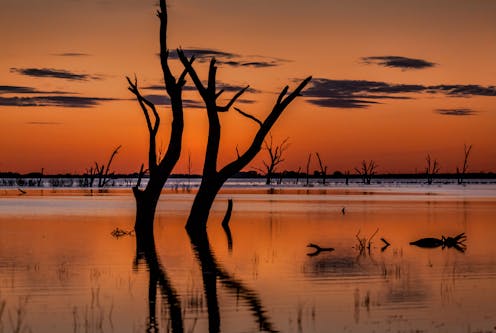
Some A$13 billion in taxpayer dollars and 30 years of policy reform have failed to arrest the devastating decline in the health of Australia’s most important river system, the Murray-Darling Basin, new research shows.
The four-year study released today involved 12 scientists from Australia’s leading universities, and draws on data from 1980 to 2023. It is the most comprehensive report card to date on government policies to protect the Murray-Darling.
We found expensive and contentious reforms, including the once-vaunted Murray-Darling Basin Plan, have mostly failed to improve outcomes for people and nature along the river system.
The result is deeply alarming for a natural asset so fundamental to Australia’s environmental, cultural and economic wellbeing. Here, we outline our findings, and present a plan to turn this situation around.
A river system in peril
The Murray-Darling river system starts in southern Queensland, winds through New South Wales and Victoria and reaches the sea near Adelaide in South Australia.
Historically, state governments have allowed too much water to be taken from the system, primarily to irrigate crops. This has caused extensive environmental damage such as toxic blue-green algae blooms, dramatic falls in bird and fish populations and undrinkable town water supplies, to name just a few.
The damage has been exacerbated by invasive species, climate change, dams that block water flows, and bush clearing which makes water running into rivers more salty.
What’s more, colonisation dispossessed the nearly 50 Indigenous nations in the basin. They now collectively have rights over less than 0.2% of surface water in the river system.
Government reform to improve the health of the basin dates back more than three decades. In 1994, Australian governments agreed to cap further licenses to extract water from the Murray-Darling. In 2008, Prime Minister John Howard’s “once and for all” reform, known as the Water Act, became law. It aimed to reallocate water from irrigation to the environment.
The reform is largely being implemented through the $13 billion Murray Darling Basin Plan enacted in 2012. The historic deal between state and federal governments was supposed to rein in the water extracted by farmers and make sure the environment got the water it needed.
Almost $8 billion was spent implementing the plan to June 2023. But has this massive taxpayer investment delivered the promised benefits for people and nature? Our new findings suggest the answer is largely no.
Applying expert eyes
When the basin plan was adopted, governments cut funding to the independent audit which monitored the river system’s environmental health. It was replaced with far less effective monitoring systems.
The new systems did not set clear targets to be achieved, or assess real-world outcomes for people and the environment. For example, a government might measure the timing and frequency of water flowing at specific river locations, rather than the numbers of threatened fish species across the basin.
The indicators are also complex and monitored by government agencies and their consultants, so the results are not independent.
For this study, we developed our own monitoring system. It involved 27 indicators of success across the themes of Indigenous, environmental and social wellbeing, economic performance and compliance with water laws. We used publicly available data spanning more than 40 years.
The study released today reports our essential findings.
What we found
Troublingly, we found that after more than a decade of the Murray-Darling Basin Plan, 74% of success indicators were not met. This means there was either no improvement or worsening conditions.
In particular, only two of 12 environmental indicators were met.
Among our findings were:
flows required to achieve environmental outcomes were not met at 65% of river gauge sites assessed
water returned to rivers is not effectively used to restore the environment. For example, 79% of Commonwealth environmental water releases from 2014–19 stayed in river channels rather than spilling out to rejuvenate floodplain wetlands
the abundance of waterbirds is declining and the incidence of very large fish-kill events is increasing, as witnessed at Menindee Lakes, NSW, twice in the past decade
Indigenous rights over water are declining as a percentage of surface water, and water flows to Indigenous-controlled wetlands has not increased. This grossly inadequate situation prevents Indigenous Peoples from managing water on Country, harming their health and wellbeing
the basic human right to access adequate, safe drinking water is not being met in many towns, including predominantly Indigenous communities such as Wilcannia, NSW.
The findings are not all negative. We found irrigation communities are not necessarily suffering economically from federal government buy-backs of water entitlements. For example, the period of most water buybacks coincided with marked increases in profits for irrigated farms.
The finding is contrary to claims in several studies, including one commissioned by the Murray-Darling Basin Authority.
Two environmental indicators show an upward trend. Populations of large-bodied freshwater fish are improving, coinciding with the end of commercial fishing. Pleasingly, nitrogen and phosphorus concentrations in the Murray River have fallen.
A video outlining the importance of the Barka, or Darling River, to Indigenous people.What does all this mean?
So what can we learn from these failures to ensure the Murray-Darling river system is brought back to health?
In 2023, the federal Labor government enacted the “Restoring Our Rivers” laws, to increase the return of water to the environment. This was a very important step, but there’s a long way to go.
The Murray-Darling Basin Plan is due for review in 2026. Clearly, monitoring to date has been inadequate. Our paper outlines ways to fix this, so real outcomes are achieved.
Among our suggestions, river ecosystems could be mapped to ensure Australia meets its international obligation this decade to restore 30% of inland water ecosystems and include 30% of these ecosystems in protected areas.
And those responsible for implementing the basin plan, primarily state and federal government agencies, should be held accountable when targets are not met.
Urgent reform is needed to ensure Australian taxpayers get a return on their investment. We must ensure the Murray-Darling basin and the communities that rely on it can prosper in the decades ahead.
Authors: Jamie Pittock, Professor, Fenner School of Environment & Society, Australian National University


















