

NZ’s gas shortage was not caused by the offshore exploration ban – but it was still a flawed policy
- Written by: David Dempsey, Associate Professor in Natural Resources Engineering, University of Canterbury
Historically, gas in New Zealand traded below NZ$10 per gigajoule. When prices hit $50 per gigajoule in August this year, anyone with gas to sell could have made a lot of money.
But there clearly wasn’t much gas around. In the end, the big generators Genesis and Contact had to buy gas off Methanex to keep the lights on.
How did this happen? It’s tempting to blame the previous government’s ban on offshore oil and gas exploration. The current government has indeed listed the gas shortage as a reason for its plan to reverse the ban.
But diving into gas statistics held by the Ministry of Business, Innovation and Employment (MBIE) suggests this probably wasn’t the case.
Although the ban was introduced in 2018, companies had already halted most offshore exploration two years prior. And even if a new discovery had been made around 2018, it would probably have taken too long to develop to be ready for 2024.
Why New Zealand ran low on gas
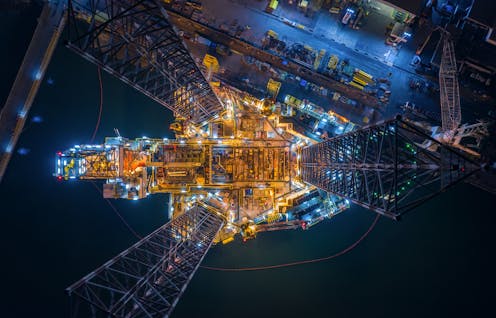
When the 2018 ban was announced, only one offshore permit had been granted during each of the previous two years. As MBIE statistics show, this was quite a drop compared to the period between 2012 and 2016, with an average of six permits per year.
Exploration drilling was down, too. During 2013 and 2014, 40 wells were drilled, but only five between 2015 and 2018. Had any major gas fields turned up, those companies would have been entitled to develop them regardless of the ban – but that didn’t happen.
Past experience in New Zealand shows offshore developments take a long time. The fastest was Pohokura, a major field in North Taranaki, which took six years from discovery to gas flowing. If exploration permits had been obtained in 2018 and successful discoveries made during a subsequent drilling campaign, it most likely wouldn’t have translated to available gas in 2024.
In January 2024, MBIE estimated New Zealand had about 8.5 years worth of gas reserves (1,300 petajoules) at 2023 rates of consumption. There’s certainly gas left, but it can’t all be accessed when needed.
Gas fields are like ATMs – you can only take out so much each day regardless of how much you have in the bank. The flow of gas has been squeezed in recent years by poor production at Pohokura and was compounded in mid-2024 by higher demand from electricity generators when hydro lakes were running low.
If New Zealand had another large offshore gas field, this arguably wouldn’t have happened. But it’s not at all obvious we would have had that capacity in 2024 even without the exploration ban.
Risky investment
Nevertheless, the ban did have some major impacts on New Zealand.
It broadcast a message of urgency and intent to tackle emissions from the fossil fuel industry. Denmark followed suit with their own ban in 2020 and Ireland in 2021. France has been more reticent, proposing a future ban from 2040 but allowing new exploration until then.
The ban also sent signals to large multinational energy companies that New Zealand is a risky place to invest. The fossil fuel industry is rightly uncertain about its future role in New Zealand. Some will see this as a good outcome in pursuit of climate goals. But how far does the uncertainty spread and what might it mean?
The spectre of political intervention creates an investment risk for companies. This is because the large capital works these companies undertake are often debt-funded over a decade or more. Hence, companies need to be confident in their future freedom to operate.
Emissions Trading Scheme distortions
In 2021, the Climate Change Commission released draft advice implying that, due to its high emissions, the Far North’s Ngāwhā geothermal power station would need to close.
The suggested closure was removed in the final advice, and Ngāwhā emissions have since been eliminated. In 2022, in the face of high carbon charges under New Zealand’s Emissions Trading Scheme (ETS), engineers worked out how to capture and inject carbon dioxide back underground.
The case of Ngāwhā is an ETS success story. Economic pressure was applied to a large emitter and, faced with going out of business, it changed its practices.
A feature of the ETS is its general ambivalence about where emissions come from. One tonne of carbon dioxide produced using natural gas to generate electricity in winter is charged the same as one tonne of carbon dioxide produced when driving freight across the country.
In theory, the market decides which activities can afford to continue and which should die out. In reality, however, the ETS is distorted because it grants free allocations to high-emmiting industries which would otherwise face trade disadvantages. Last week, the government also removed agricultural emissions from the ETS.
This is not to say that other policies aren’t useful in shoring up the deficiencies of emission pricing. But the effectiveness of the exploration ban is debatable. Offshore interest seemed to have already largely subsided and its lack of cross-party support ensured it was shortlived.
On the other hand, the political message it broadcast to major energy players may ultimately ensure its enduring legacy, by dissuading future gas investment.
Structurally, the challenges of 2024 remain. Declining gas reserves must be divided between electricity generators and exporter industries, and the hydro system is vulnerable to similar climate fluctuations.
On a more positive note, utility solar and grid-scale batteries continue their relentless expansion. Of the 22 renewable projects applying for fast-track consent, ten are solar farms.
Authors: David Dempsey, Associate Professor in Natural Resources Engineering, University of Canterbury


















