

these 4 projects blend First Nations knowledge and science to rewrite our understanding of the past
- Written by: Sally Hurst, Adjunct Fellow - Faculty of Science and Engineering, Macquarie University
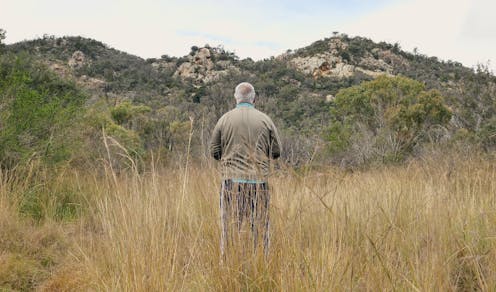
A lot of things scientists study are part of Country – the lands, waters and skies to which First Nations peoples are connected. In Australia, there has to date been little respect for the significance or value of cultural knowledge in scientific practice.
Here is how one of us (Steve Ahoy, Anaiwan Elder and cultural knowledge holder) puts his perspective:
Everything is Country. To Aboriginal people, fossils are artefacts. We don’t see or distinguish between our artefacts and a fossil. Our artefacts come from Mother Earth; a fossil comes from Mother Earth. I come from the Earth. I walk the Earth. I die, I go back to the Earth. The Earth can continue without us. We can’t continue without the Earth.
In our new research, we explored four grassroots initiatives promoting First Nations cultural knowledge alongside Western scientific knowledge. These initiatives show these two perspectives can complement one another and together create a rich tapestry of knowledge about the past.
Institutional distrust
In Australia, especially on land that does not have exclusive Native Title claim, it is not common practice for Earth scientists to consult with local First Nations communities to seek permission before extracting materials such as fossils, rocks or minerals. Archaeologists are required to consult with First Nations communities, but the developers they advise often have no obligation to change their actions in response to the consultation.
Museums have traditionally been warehouses for both natural and cultural heritage collections. However, a history of colonial collecting practices has led to deep-rooted distrust in these institutions among First Nations communities.
As Ahoy puts it:
In my experience, I have never seen a museum freely engage with our community and say ‘Hey, we’ve got your stuff, do you want it back?’ It’s always us having to go through the authorities to […] force the return of our cultural heritage.
Grassroots initiatives represent more trusted ways to protect and communicate about heritage.
1. Found a Fossil project
Fossils and First Nations artefacts are different in their formation, preservation and significance. However, both can be found across the vast Australian landscape, and members of the general public often uncover these objects.
Legislation surrounding the protection of fossils and First Nations artefacts varies across land types and differs in each state and territory in Australia. Information about these rules can be vague, confusing and difficult to find (if it exists at all).
This situation has led to many serious misunderstandings, especially propagation of myths about land reclamation – the idea that if you find Aboriginal cultural heritage on your property, your land could be taken away. (Ironically, removal from their land was exactly what many First Nations communities have historically faced.)
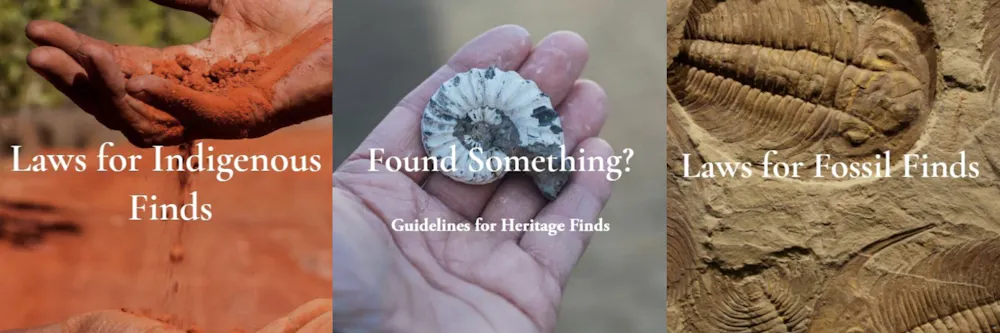
In 2021, one of us (Sally Hurst) started a project called Found a Fossil to understand what members of the Australian public might do if they discovered something, and to raise awareness of heritage protection in an accessible way.
The project surveyed members of the public about their knowledge and created a guide for what to do it if you find a fossil or artefact, in consultation with First Nations peoples, palaeontologists and archaeologists.
The project is the first of its kind in Australia. It acknowledges and promotes the deep connection between natural and cultural heritage, and the need to protect it into the future.
2. Museum of Stone Tools
The Museum of Stone Tools is a digital, open-access collection of 3D models of artefacts. As an online repository, the museum allows in-depth exploration and knowledge sharing, without issues associated with managing physical collections.
The platform has allowed universities and physical museums, students, archaeologists and First Nations groups to use these digital objects for cultural training, education and managing heritage, even when an object has been returned to Country.
 The Museum of Stone Tools interface, showing a 3D model of an Aboriginal stone tool from the traditional Country of the Widi people.
Museum of Stone Tools
The Museum of Stone Tools interface, showing a 3D model of an Aboriginal stone tool from the traditional Country of the Widi people.
Museum of Stone Tools
3. Broome dinosaur trackways
In Western Australia, on what former premier Colin Barnett once called “an unremarkable beach” near Broome in the state’s north, thousands of dinosaur footprints are preserved in rocks exposed by shifting sands.
The tracks have been a part of Dreaming stories of the peoples of the West Coast Saltwater Sun Down law and cultural group, traditionally known as Goolarabooloo, for thousands of years. Some of the tracks left by three-toed feet, for example, are associated with a creator-being known as Marala, or the “Emu-man”.
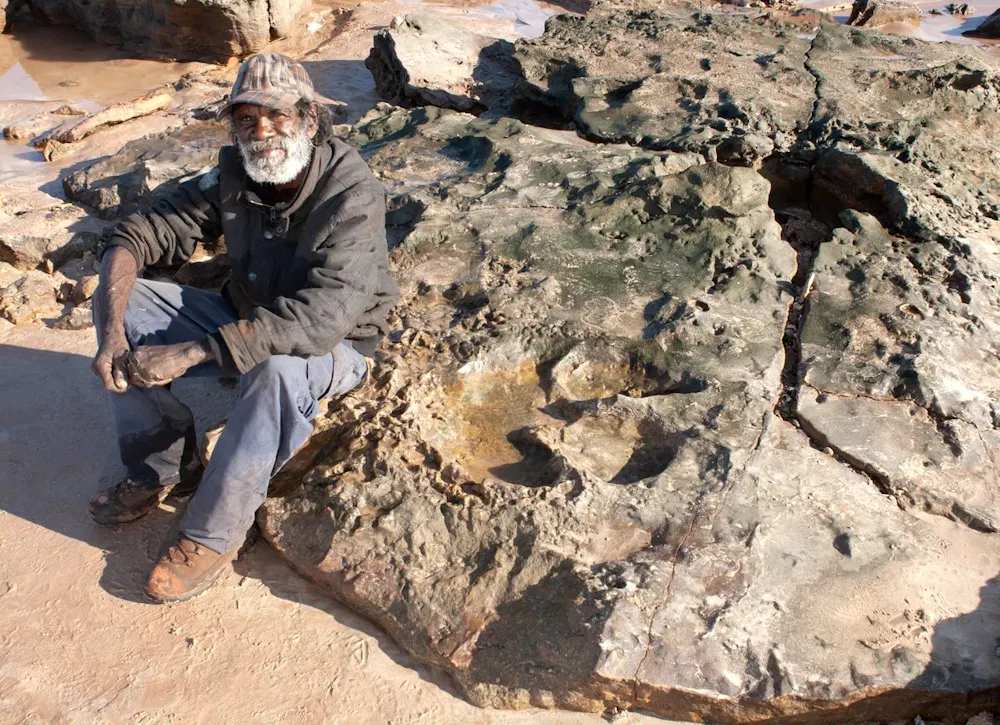 Goolarabooloo Maja (Law Boss) Richard Hunter alongside dinosaur tracks subsequently named Walmadanyichnus hunteri (Hunter’s mark of Walmadany).
Steven Salisbury
Goolarabooloo Maja (Law Boss) Richard Hunter alongside dinosaur tracks subsequently named Walmadanyichnus hunteri (Hunter’s mark of Walmadany).
Steven Salisbury
In 2015, after several years of collaborative research between palaeontologists from the University of Queensland and Goolarabooloo traditional custodians, the Dinosaur Coast Management Group was established. This is a not-for-profit collective comprising knowledge holders and other members of the Indigenous community along with professional, Western-trained palaeontologists and local dinosaur track enthusiasts.
The main purpose of the group is to inform the public about the significance of the coastline and its dinosaur tracks. The group also works with local interest groups to devise strategies to protect the area from impacts associated with greater numbers of visitors and coastal development. At the same time, the group works to create job opportunities for people in Broome, through educational activities and guided tours for visitors.
4. Rola[STONE] documentary
The documentary Rola[STONE] explores the connections between geology, landscape and cultural knowledge on Anaiwan Country around Armidale, New South Wales. One of us (geoscientist Marissa Betts), in collaboration with Anaiwan Elders, directed the film. It shows how the landscape can be read through a scientific lens and through the Dreaming stories of those who have deep connections to Country.
Rola[Stone] was filmed on Anaiwan Country, NSW, and won an award at the Earth Futures Film Festival in 2022.Valuing layers of knowledge
These case studies show the potential of positive engagement with First Nations peoples, communities and knowledge. They show there are myriad ways to dovetail multiple and different perspectives to promote mutual, two-way benefits.
In Ahoy’s words:
We want people to work with us, instead of us being forced to work with them. Building transparent, educational partnerships is the only way we can guarantee the free two-way flow of information.
Scientists and others working in Western institutions have the opportunity to create meaningful collaborations with First Nations peoples to promote their voices, and share cultural knowledge for the benefit of both parties. In this way we can weave together not just a rich story of the past, but of our future.
Authors: Sally Hurst, Adjunct Fellow - Faculty of Science and Engineering, Macquarie University


















