

Ginger, tortie, calico – the mystery gene responsible for orange colour in cat coats has been found
- Written by: Frank Nicholas, Emeritus Professor of Animal Genetics, University of Sydney
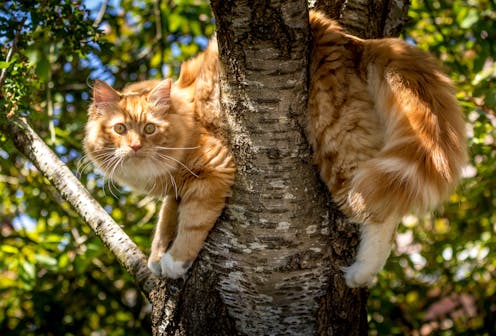
Orange and tortoiseshell house cats (torties) have long been an enigma for hair coloration in mammals: now, the genetic basis of their distinctive coat colour has been unveiled.
Orange is an ancient colour variety. Ginger cats are evident in Egyptian tomb artworks and some mummified cats may have been gingers. From Garfield and Puss in Boots to Hermione Granger’s Crookshanks and Goose the Flerken in the Marvel universe, ginger (or orange) cats are everywhere in popular culture today.
Orange isn’t the most typical coat colour in cats. Most cats are non-orange, usually brown or grey tabbies with some pattern of black stripes, swirls or spots, or black or blue solid-coloured cats.
Tortoiseshell cats have a brindling pattern (mixture) of orange and non-orange hairs throughout the coat, with some areas mostly orange or non-orange. Calico cats have distinct patches of orange and non-orange, in addition to extensive regions of white. Gingers are mostly male, while tortoiseshells are typically female.
Now, after more than 110 years, two new studies finally reveal the gene and the variant for orange coat colour.

A visionary theory
In 1912, before the XX/XY sex-determining system was discovered in cats, American geneticist Clarence Cook Little proposed a visionary theory to explain how cats inherit orange and non-orange coat colours.
He built on the idea of a “sex-producing factor”, symbolised as X, that was gaining acceptance at that time (mainly from work on sex-determination in insects). He proposed:
let’s suppose female cats have two copies (XX) of the sex-producing factor X, while male cats have just one copy (X—)
let’s also suppose there is something associated with the sex-producing factor X that affects coat colour and exists in two forms: normal (the non-orange form) and variant (the orange form).
This theory predicts that tortoiseshell cats have one of each form of the X factor, in which case they must be XX, and therefore must be female. Because males have only one X factor, they will be either orange or non-orange, but never tortoiseshell.
Little’s theory also explains the common observation that ginger cats are mostly male. If matings are not arranged on the basis of coat colour, and if we assume, for example, that 20% of male cats are ginger (having just one X factor of the orange form), the proportion of female ginger cats is expected to be much lower, as they need to receive two copies of the orange X factor.
Mathematically this can be calculated as 20% x 20% = 4%, meaning that we would expect only 4% of female cats to be orange.
Eventually, the X factor was revealed as the X chromosome, and the “—” as the Y chromosome.
Tortoiseshell and calico males do sometimes occur, but it’s usually due to an abnormality of the number of sex chromosomes, such as one too many X chromosomes (XXY), which also causes sterility.
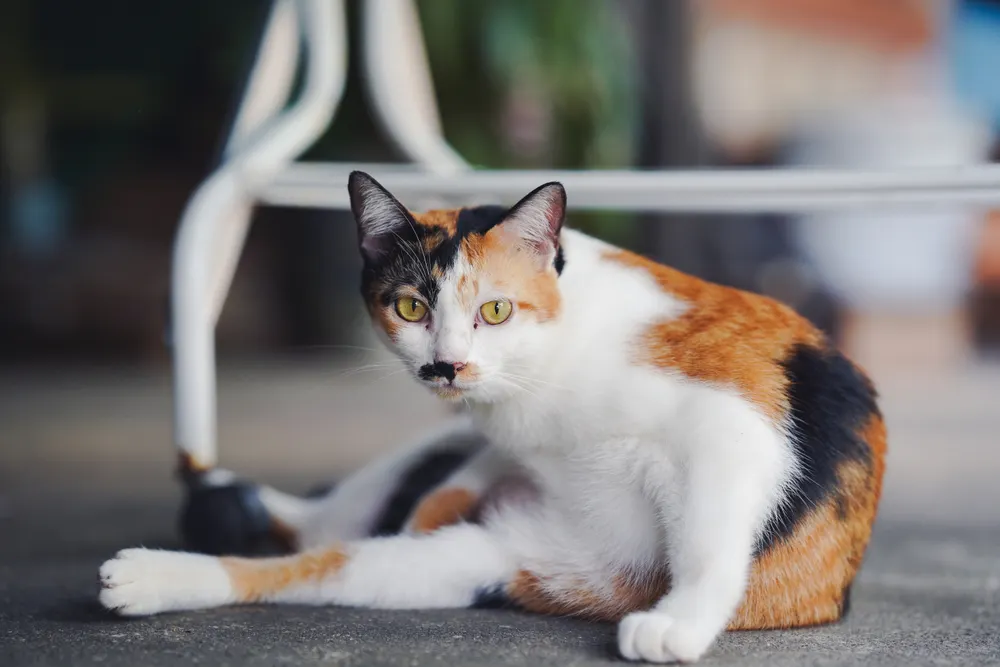 Calico cats have white in their coats in addition to patches of orange and non-orange.
Oporty786/Shutterstock
Calico cats have white in their coats in addition to patches of orange and non-orange.
Oporty786/Shutterstock
Modern science confirms Little’s visionary theory
Little’s set of assumptions gave rise to predictions that have actually worked in practice for more than 110 years. This is a great example of the power and utility of what might have initially appeared to be an extraordinary theory.
The newly posted, not yet peer-reviewed reports of independent discoveries by a Japanese team and an American team have now found the something that Little proposed to be associated with the sex-producing factor X.
It’s a gene that’s part of the X chromosome. It produces a protein whose name is a bit of a mouthful: RHO GTPase-Activating Protein 36. The official gene symbol ARHGAP36 is not very descriptive, so we will simply call it the Orange gene.
The Orange gene has a known role in hair follicle development, but scientists didn’t previously know it is also involved in pigment production. This means that a new pathway for pigment production has been discovered, opening the way for exciting and important research into a basic biological process.
 Ginger cats are mostly male.
Ivan Lopatin/Unsplash
Ginger cats are mostly male.
Ivan Lopatin/Unsplash
A curious bit of deleted DNA
The other important discovery by these research teams is that the orange form proposed by Little is a large DNA deletion (loss of genetic material) of part of the Orange gene, and the non-orange form is the unchanged or “wild-type” version of that same gene.
While the deletion does not appear to change the protein that is produced by the gene, it does seem to impact when and where the protein is produced. Both discovery teams showed the Orange gene is persistently switched on in orange areas but is mostly switched off in non-orange areas of a cat’s coat.
Even though much remains to be discovered, ginger cats and their owners around the world can rejoice – the genetic basis of their distinctive coat colour has finally been worked out, more than 110 years after it was first proposed.
Authors: Frank Nicholas, Emeritus Professor of Animal Genetics, University of Sydney


















