

Watergate, mums, and well-organised independents
- Written by Axel Bruns, Professor, Creative Industries, Queensland University of Technology
The 2019 Australian federal election has many stories, but a handful stood out especially clearly on social media. As in 2013 and 2016, we have been busy capturing the activities by and directed at the Twitter accounts of House and Senate candidates, from the close of electoral rolls to election day itself.
This provides an insight into the most visible candidates and parties, and shows how attention on them ebbs and flows over the course of the campaign. It also points to some specific themes and events that have emerged at various points in time.
An independent invasion?
As usual during federal campaigns, Liberal and Labor candidates received the greatest share of attention by a substantial margin. But the story of this election is the engagement with independent candidates. In 2016, over the course of a 25-day campaign, independents received some 46,000 retweets and mentions. In 2019, in 23 days of campaigning so far, these numbers have almost doubled to 85,000 tweets involving independent candidates.
Among the most prominent independent candidates are Zali Steggall (challenging Tony Abbott in Warringah), Kerryn Phelps (campaigning to hold Wentworth, which she won after Malcolm Turnbull left parliament), and Rob Oakeshott (the former independent MP looking to make a comeback in Cowper).
Together, the three account for some two-thirds of all tweets directed at independent candidates. If there is an independent invasion this election, as some media coverage predicts, it remains strongly centred on a handful of high-profile challengers.
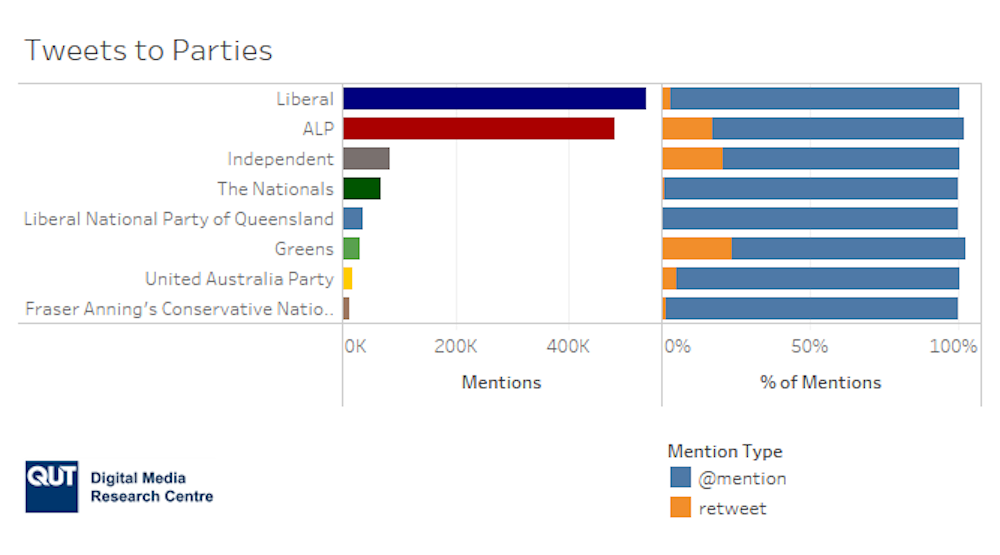 Mentions and retweets of candidates in the 2019 Australian federal election, aggregated by party affiliation, April 22 to May 14.
Axel Bruns/QUT Digital Media Research Centre
Mentions and retweets of candidates in the 2019 Australian federal election, aggregated by party affiliation, April 22 to May 14.
Axel Bruns/QUT Digital Media Research Centre
No retweets = no endorsement?
Twitter users’ engagement with independents, as well as with some opposition parties, is also qualitatively different from how they engage with government candidates. Labor, independent, and Greens candidates receive considerably more retweets than their Coalition counterparts.
Of all the tweets directed at opposition candidates, between 17% (ALP) and 24% (Greens) are retweets. Meanwhile, fewer than 3% of tweets at Liberal candidates, and fewer than 1% of tweets at National or LNP candidates, are retweets.
Many Twitter users take pains to stress that retweets do not necessarily mean endorsement, and this is true in principle. But what this significant lack of retweets for Coalition candidates does mean is that their own tweets receive considerably less amplification and visibility than those of their challengers.
Every retweet makes the original tweet visible to a new set of followers. If you don’t receive any retweets, you’re stuck only with those users who follow your own account. This may be a substantial number for Coalition frontbenchers (Prime Minister Scott Morrison, for example, has 147,000 followers), but it can’t compete with the added reach that retweets generate.
We have seen this lopsided pattern before. In 2016, Labor, independents and Greens candidates received considerably more retweets than Coalition accounts. Notably, in both the 2016 and 2019 elections, the Coalition government was on the back foot in the polls.
In 2013, on the other hand, at the end of the Rudd-Gillard-Rudd years, neither Labor nor the Coalition attracted substantial numbers of retweets, and only the Greens enjoyed substantial amplification of their election messages on Twitter.
Watergate washes through the system
In any election campaign we have tracked on Twitter since 2010, the accounts of the major party leaders invariably received the greatest level of engagement – this is an indication of how presidential Australian politics has become, in spite of our electoral system.
However, immediately after the start of the official 2019 campaign, former Nationals leader Barnaby Joyce briefly and unwittingly stole the show. For a day or two, he was the most mentioned Australian politician on Twitter because of his association with the Murray-Darling water buyback controversy. The associated hashtag #Watergate also trended during that time.
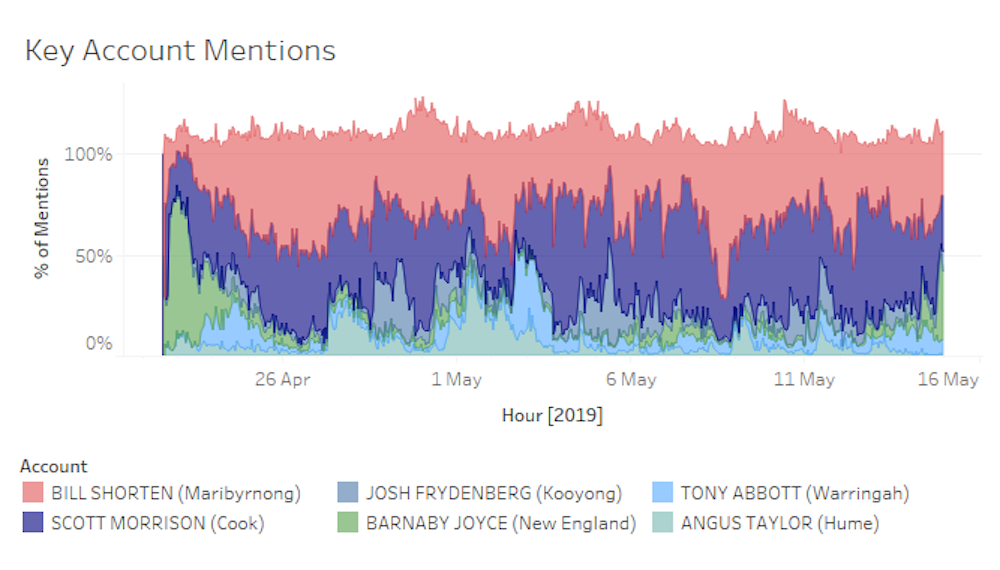 Engagement per hour (mentions and retweets) with the six most visible candidate accounts in the 2019 Australian federal election, April 22 to May 14.
Axel Bruns/QUT Digital Media Research Centre
Engagement per hour (mentions and retweets) with the six most visible candidate accounts in the 2019 Australian federal election, April 22 to May 14.
Axel Bruns/QUT Digital Media Research Centre
Even later in that first week of the campaign, Joyce as well as energy minister Angus Taylor (who had been a director of a Cayman Islands company connected to the controversy) continued to receive substantial mentions on Twitter.
Read more: Australia's 'watergate': here's what taxpayers need to know about water buybacks
From week two of the campaign onwards, #Watergate receded, and the focus turned strongly towards the leaders. This was due especially to the three televised leaders’ debates during that time.
But on May 8 the focus turned overwhelmingly to Bill Shorten, as he responded forcefully to a Daily Telegraph story questioning his late mother’s life story.
Read more: View from The Hill: Shorten turns Daily Telegraph sledge to advantage
Our data clearly show how strongly that moment cut through the noise of the campaign: from midday to the evening news, more than 50% of all candidate mentions were directed at Bill Shorten’s account. “Mum” was also one of the highest-ranked topic areas in tweets directed at Labor party candidates over the entire campaign.
Taxes and truth
During any campaign, political parties attempt to push particular agendas and framings into the public discourse, some of which are picked up and amplified by social media. For this election, the major topics in our Twitter sample are: taxes; climate change; truth in political advertising and media; and workers’ rights and conditions.
Topic prominence isn’t necessarily uniform across party lines though. When looking at specific parties or politicians mentioned by name on Twitter in association with certain topics, a more detailed picture of public sentiment emerges.
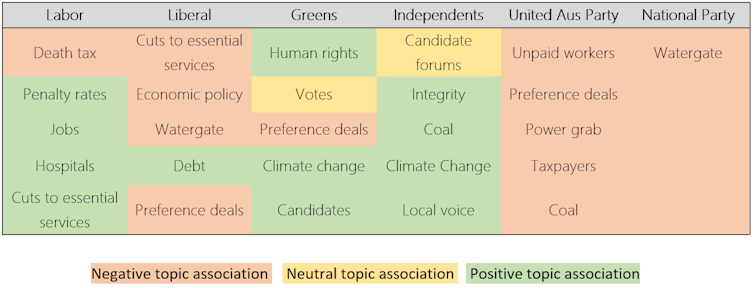 Top topic rankings in tweets directed towards specific parties in the 2019 Australian federal election, April 22 to May 14.
Daniel Angus/QUT Digital Media Research Centre
Top topic rankings in tweets directed towards specific parties in the 2019 Australian federal election, April 22 to May 14.
Daniel Angus/QUT Digital Media Research Centre
Labor has been berated for its “death tax”, despite this not being the party’s policy at all. By contrast, Labor has garnered support online for its positions on protecting penalty rates, jobs, and restoring funding to public services.
The Liberal Party didn’t escape the Watergate scandal, copping criticism for its role in this issue along with the Nationals. It has also been criticised for cuts to essential services and what many Twitter users see as unfair economic policy. However, the party’s base has supported its messages relating to reducing national debt.
The Greens and independents were understandably aligned in the eyes of Twitter users on the issue of climate change, with most users lending support to Greens and independent candidates for progressive policies and action on this issue.
Finally, despite its millions spent on marketing, and early polls suggesting a bump in support, the United Australia Party has received some of the most critical attention on Twitter, with discussions about unpaid workers, preference deals, power grabs, taxpayer dollars, and coal at the centre of this online backlash.
Interactions between candidates
But how are the candidates engaging with each other? We used social network analysis techniques to gain a deeper understanding of this question. In our visualisation of those interactions (mentions and retweets), the three major parties are most prominent: Labor (red), Liberal (blue), and Greens (green), along with a considerable amount of activity by independents (yellow).
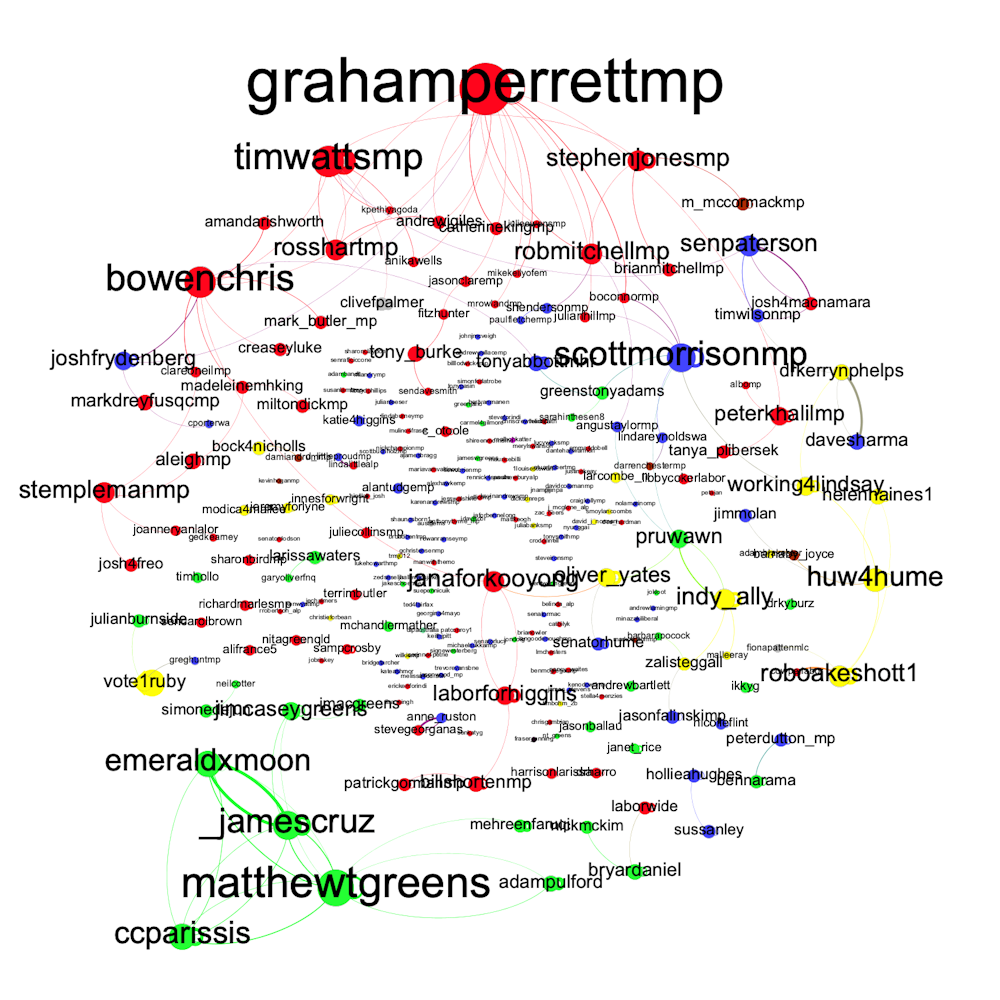 Network map of interactions (mentions and retweets) between candidates’ accounts in the 2019 Australian federal election.
Tim Graham/QUT Digital Media Research Centre
Network map of interactions (mentions and retweets) between candidates’ accounts in the 2019 Australian federal election.
Tim Graham/QUT Digital Media Research Centre
Unsurprisingly, the network shows that candidates from the same party interact more often with each other. For instance, the bottom part of the network shows a dense cluster of Greens candidates with strong, reciprocated links between one another.
The Labor contingent is similarly actively engaged with one another, with Graham Perrett one of the most active points of connection.
The pattern is not as obvious for Liberal candidates, however, who appear more spread out in the network and don’t show the same level of activity and engagement with each other. This arguably lends credence to Labor’s claim throughout the campaign to have a unified team, in contrast to an internally riven Liberal party.
Overall, Labor candidates were 2.3 times more likely to interact with each other than Liberal candidates during the campaign. Similarly, Greens candidates were 3.7 times more likely than Labor candidates, and 8.3 times more likely than Liberals, to interact with fellow candidates of their own party.
This pattern is even more pronounced for independents, who are four times more likely to interact with each other compared with Labor candidates, and nine times more likely compared with Liberal candidates.
Read more: Morrison's message is light on ideology and strong on soothing ahead of the election
Such patterns show the degree of coordination between candidates from the same party: they are looking to boost each other’s election messaging by mentioning and retweeting one another. Fifteen prominent independents, including Steggall and Oakeshott, have also adopted this tactic by forming a loose alliance.
By contrast, the fact that Liberal candidates are least likely to engage with one another is perhaps also a reflection of their electoral positioning. With opinion polls largely pointing to defeat, Coalition candidates are forced to take the fight to their opponents — on Twitter and elsewhere.
Authors: Axel Bruns, Professor, Creative Industries, Queensland University of Technology

















