
Why is soccer fandom so linked to violence?
- Written by: Milad Haghani, Senior Lecturer of Urban Risk & Resilience, UNSW Sydney
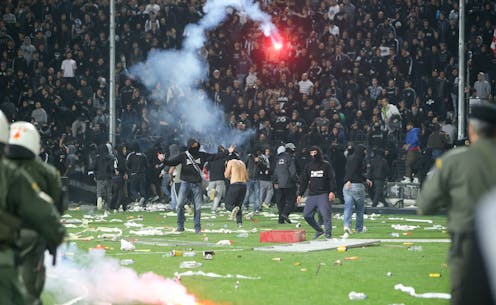
Soccer’s global allure is unmatched, yet its history is shadowed by tragedies.
At a recent soccer match in Nzérékoré, Guinea, a controversial refereeing decision led to unrest, resulting in crowd violence that claimed more than 50 lives.
In 2022, violence at Indonesia’s Kanjuruhan stadium during a match led to the deaths of 135 people, as security forces responded to pitch invasions with tear gas, triggering chaos and ultimately a crowd crush.
These incidents are stark reminders of the risks tied to violence in sports crowds. They stem from structural failures, poor crowd management, and often complex group dynamics that lead to violent behaviour.
Soccer crowds are especially prone to violence, which raises a pressing question: what is it about soccer and its fan culture that makes such incidents more likely to occur?
Read more: Dedicated Roman gladiator superfans were the football hooligans of their day
Soccer fan violence: a recurring pattern
Catastrophic incidents rooted in fan violence have been intertwined with the history of this sport.
Perhaps the most extreme case is the Soccer War (more commonly known as the Football War) of 1969, when World Cup qualifiers between El Salvador and Honduras inflamed existing political tensions. Clashes between fans added to the animosity, and within days, the two nations were at war. More than 2,000 people died in the brief conflict.
There are other cases throughout the history of the game:
Estadio Nacional Disaster (1964, Peru) – Riots broke out after a disallowed goal during a Peru-Argentina match in Lima. Police used tear gas, causing chaos as fans tried to escape through locked exits. More than 300 people died.
The Heysel Stadium Disaster (1985, Belgium) – Clashes between Liverpool and Juventus fans before the European Cup final caused a wall to collapse. Thirty-nine people were killed and more than 600 were injured.
Port Said Stadium Riot (2012, Egypt) – After a match between Al-Masry and Al-Ahly, fans attacked each other with weapons while exits were blocked. Seventy-four people died and hundreds were injured.
The most notable case in Australia was the chaotic Melbourne Derby in 2022, when fans stormed the pitch at AAMI Park after a flare was thrown back into the stands. Melbourne City’s goalkeeper, Tom Glover, was struck with a metal bucket, leaving him concussed and bleeding.
Further back, in 1985, a National Soccer League match between Sydney Olympic and Sydney Hakoah erupted into chaos following a controversial referee decision. The chaos remains one of the most notorious examples of soccer crowd violence in Australia’s history.
In 1985, bitter rivals Sydney Olympic and Sydney Hakoah clashed in a NSL match at Pratten Park.Soccer fan violence can take many forms
Soccer’s immense popularity means larger, more diverse fanbases with deeply ingrained rivalries.
Fans often see their team as a core part of their identity, with this strong group affiliation sometimes heightening “in-group versus out-group” dynamics. At times, this can lead to hostility.
And it’s not just fan-on-fan violence: soccer fan violence takes many forms. Violent and antisocial acts range from verbal abuse and offensive chants to property damage, vandalism, pitch invasion and physical assaults.
In some countries, soccer fan violence has worsened since the pandemic.
In the United Kingdom, recent police statistics reveal a 59% increase in arrests compared to pre-pandemic levels, with incidents of disorder reaching an eight-year high. Notably, 70% of offences were committed by people aged 18–30.
Players can be affected, too. A 2023 workplace safety report from the International Federation of Professional Footballers highlighted the escalating issue of violence against professional players, emphasising its detrimental impact on their physical and mental wellbeing.
The report reveals a significant number of players have experienced abuse, including threats and physical assaults, both on and off the field. Data shows fan violence against players is most common in Europe (particularly the UK, Italy and Germany) followed by Africa.
What’s behind the trend?
1. Social identity
Soccer fan violence is often deeply tied to social identity dynamics.
Studies from Germany and Brazil emphasise the role of identity fusion, where fans experience an intense bond with their teams and fellow supporters.
This fusion creates a “warrior psychology”, making threats to the group feel personal, to the point that it can drive fans to defend their identity aggressively.
High-stakes rivalry games exacerbate this: violence surges up to 70% during derby matches in Germany. These studies show that match-day violence is driven more by rivalry and group dynamics than game outcomes.
In Brazil, the same identity fusion has been shown to drive hostility, especially toward rival fan groups, as fans perceive out-group threats as existential.
2. Sociodemographic characteristics
Studies have highlighted how “fanatic” supporters – often young, unemployed, and with lower levels of education – are more likely to engage in violence, which is shaped by group norms and accepted aggression levels.
Studies in the UK have revealed historical shifts. While hooliganism once thrived in working-class and hyper-masculine cultures, better crowd management and gentrification have reduced in-stadium violence, though confrontations still occur away from arenas.
3. Drug and alcohol use
Substance use can magnify aggression.
In the UK, cocaine use among fans is higher than the national average.
The combination of the growing fan drug culture in soccer with identity fusion can develop into aggressive behaviour, particularly during intergroup conflicts.
Alcohol, while not universally causal, can also fuel confrontations by lowering inhibitions and amplifying territoriality.
What can be done?
Despite these patterns, some regions have seen significant improvements.
In the UK, decades of reforms, such as CCTV, all-seater stadiums, and higher ticket prices have fostered a more “sanitised and gentrified” fan culture, with fans themselves often regulating violent behaviour.
However, such measures can also displace violence to less-visible spaces, where rival groups arrange confrontations to avoid police detection.
Reducing soccer-related violence requires a multifaceted approach addressing both structural and psychological drivers. Evidence suggests creating positive group dynamics, rather than simply suppressing fan identity, is key.
Further strategies could also include:
- initiatives to reframe rivalries as positive and reciprocal
- better policing tactics using dialogue and de-escalation rather than force
- improvements in managing crowd flows and reducing friction points, such as minimising counterflows of rival fans during departures
- substance use interventions, particularly targeting drug use.
The challenge, however, lies in implementing these solutions while preserving the unique passion and energy that make soccer the world’s most beloved sport.
Authors: Milad Haghani, Senior Lecturer of Urban Risk & Resilience, UNSW Sydney
Read more https://theconversation.com/why-is-soccer-fandom-so-linked-to-violence-245143


















