

Olga Tokarczuk’s The Empusium defies classification
- Written by: Anthony Macris, Professor of Creative Writing, University of Technology Sydney
You’ve got to hand it to the Nobel Prize in Literature committee: its citations are masterpieces of brevity and precision. Entire lifetimes of tireless, painstaking effort, thousands of pages written over decades, are summed up in a statement of around 20 words.
The work of Polish writer Olga Tokarczuk, the 2018 Nobel Laureate, is a case in point. The hallowed Swedish academy awarded her the prize “for a narrative imagination that with encyclopedic passion represents the crossing of boundaries as a form of life”. That’s 18 words, if you’re counting.
These qualities are richly in evidence across her varied output, which includes not only the novels for which she is principally known, but short stories, poetry and non-fiction.
The Empusium – her first novel since The Books of Jacob, the 900-page opus that clinched her the Nobel – marks the latest instalment in this unique writer’s journey across boundaries, driven by her insatiable curiosity about the human condition and the physical world.
Review: The Empusium: A Health Resort Horror Story – Olga Tokarczuk, translated by Antonia Lloyd-Jones (Text Publishing)
The Empusium’s premise is both ingenious and intriguing. It is best summed up in the novel’s subtitle: “A health resort horror story.”
Taking as its departure point Thomas Mann’s The Magic Mountain (1924) – a canonical example of Mitteleuropean proto-existentialism – The Empusium is a deft new take on the novel of ideas and convalescence. It provides not only a feminist reworking of Mann’s themes, but a trip into the mythic and phantasmagorical, with a detour into murder mystery thrown in for good measure.

It is September 1913 and the young engineering student Mieczyslaw Wojnicz has just arrived at a sanitorium in Görbersdorf (then part of Germany, now in west Poland), where he is to be treated for tuberculosis.
Our hero stays in the quaint Guest House for Gentleman, situated high in the Silesian mountains and surrounded by deep forest. There he undergoes various cures and sits about drinking, sometimes to the point of semi-stupefaction, the magic-mushroom infused liqueur Schwärmerei, which he and the other guests are encouraged to imbibe in copious amounts.
It is the perfect scenario for Tokarzcuk’s narrative. She weaves together a complex tapestry of philosophical musings, misogynistic early 20th-century beliefs, and a mysterious series of bloody, ritualistic murders.
In keeping with the homosocial norms of the time, Wojnicz’s companions in convalescence are all men. Principal among them are a Catholic traditionalist named Longin Lukas, a social humanist named August August, and a theosophist named Walter Frommer. When the men aren’t getting sauced on Schwärmerei, undergoing their treatments, taking mountain walks, or tucking into generous meals of roast meat, salted herring and blackberry compote, they talk and talk.
Their musings often circle back to the topic of women, the discussions ranging greatly in their degree of chauvinism. It is usually the German Catholic who can be relied on to champion patriarchy at its regressive worst. “Woman,” Lukas opines, drawing on Darwin,
is like an evolutionary laggard. While man has gone on ahead and acquired new capabilities, woman has stayed in her old place and does not develop. This is why a woman is handicapped, incapable of coping on her own…
On and on it goes. Women are deemed public property because they bear children. Women have a duty to satisfy male desire because, if deprived of “the means of relief”, men would fall ill. Even the sanatorium’s doctor gets in on the act. According to Dr Semperweiss, mothers can be particularly dangerous, infecting their children “with excessive emotionality, which eventually leads to all sort of illnesses and feebleness of spirit”.
Woynicz, our sensitive, mild-mannered young hero, does not join in this chorus, and not only for reasons of a moderate temperament or illness. He also harbours a secret that puts him at odds with the norms of the time. His gentler masculinity offers welcome relief from all this pernicious hairy-chested posturing. It becomes evident in his friendship with the seriously ill art student Thilo, with whom he strikes up a caring, tender relationship – one that provides great comfort to Thilo as his condition becomes increasingly critical.
Horror and myth
The subtitle promises horror, but readers expecting a riff on contemporary gore will be disappointed. While there are some blood-and-guts moments – for example, the exploding duck-heart soup served up to Wojnicz in a country inn – Tokarczuk’s take on the horror genre is mainly in terms of atmospherics.
In a setting that is all mountains, deep forest and villages, she draws inspiration from sources reminiscent of Grimm’s fairy tales and medieval Gothic, with a dash of Grand Guignol and a bigger dash of Greek myth.
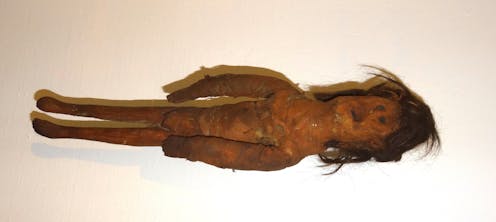
 Tokarczuk excels at the creepy and the unsettling, as evidenced in the Tuntschi that Wojnicz stumbles upon in his solitary walks in the forest. The Tuntschi are female sex “puppets” assembled from forest debris by men who work in the woods. They make these doll-like figures with twigs, stones and leaves, complete with fully functioning nether regions fashioned from moss where they find sexual relief. According to legend, the mistreated dolls can come to life and seek revenge on their abusers.
The novel is populated by other mythical female entities, who pop up from time to time. They appear as an omniscient agency that watches the goings on in the sanatorium, though their relationship to the main action is ambiguous. As mystical beings, they bear witness to the machinations of poor misguided humanity from on high, but they intermittently crash the narrative, somewhat like the Eumenides (the Furies of ancient Greek myth) in T.S. Eliot’s play The Family Reunion. There is also a reference to the Empusa: the entity that gives the novel its title. This shapeshifting female figure with a leg of bronze, also drawn from Greek mythology, is referred to as a monster.
Taken together, these various female – sometimes beyond gendered – forces constitute an alternate realm, a world beyond the world, which looms in and out of view like a set of movable clues in a detective story. Tokarczuk seems to be suggesting they represent a kind of world-in-waiting, a vitalist dimension of human experience and potential that will only be liberated once we overcome our prejudices and learn to tolerate difference.
A fascinating duality
The novel’s multi-layered, multi-genre story is rendered in what is often first-rate prose. Tokarczuk displays a Nabokovian facility with language. Her writing is rich, yet also disciplined and restrained, full of striking imagery, inventive metaphors and poetic observations. Describing the main sanatorium building, she writes: “the sharp, pseudo-Gothic turrets reminded Wojnicz of a gramophone needle, extracting concealed sounds from the record of the sky.”
The novel’s setting is a place she knows well: Tokarczuk grew up in its vicinity. It shows in her vivid evocations of the sharpness of the mountain air, the light on the lakes, the earthy scent of the forest floor when her characters go hiking and mushroom picking.
The Empusium is a hard book to classify. That is part of its design and charm. Tokarczuk has stated that she is resistant to genre practices and categorisations, seeing them as complicit in the standardising effects of the publishing industry and barriers to creative expression. However we might read her attitude, it is clear she is determined to dismantle the guardrails of genre and to follow her own instincts.
Her quirky, ebullient imagination thrives in this environment of self-mandated risk-taking. Underlying her freewheeling approach is a clarity of vision, oriented towards social justice and compassion for humanity. The way she assembles disparate elements always has a purpose, both political and aesthetic. She is not an iconoclast for its own sake, but always seeks some higher understanding, some fresh new angle, on an issue of importance.
Above all, The Empusium abundantly demonstrates that there is a fascinating duality in Tokarczuk’s grasp of the world. Her sensibility values both mythos and logos, the liminal and the defined, the sharp focus and the blur. It helps that she is such an accomplished writer. In lesser hands, a novel constructed along these lines could easily fall apart. With one hand, Tokarczuk confidently guides the reader through the scenes and settings of her finely etched narrative; with the other, she gently ushers us into themes of near-cosmic indeterminacy, the main impetus driving the imagination of this vital, necessary writer.
Authors: Anthony Macris, Professor of Creative Writing, University of Technology Sydney
Tokarczuk excels at the creepy and the unsettling, as evidenced in the Tuntschi that Wojnicz stumbles upon in his solitary walks in the forest. The Tuntschi are female sex “puppets” assembled from forest debris by men who work in the woods. They make these doll-like figures with twigs, stones and leaves, complete with fully functioning nether regions fashioned from moss where they find sexual relief. According to legend, the mistreated dolls can come to life and seek revenge on their abusers.
The novel is populated by other mythical female entities, who pop up from time to time. They appear as an omniscient agency that watches the goings on in the sanatorium, though their relationship to the main action is ambiguous. As mystical beings, they bear witness to the machinations of poor misguided humanity from on high, but they intermittently crash the narrative, somewhat like the Eumenides (the Furies of ancient Greek myth) in T.S. Eliot’s play The Family Reunion. There is also a reference to the Empusa: the entity that gives the novel its title. This shapeshifting female figure with a leg of bronze, also drawn from Greek mythology, is referred to as a monster.
Taken together, these various female – sometimes beyond gendered – forces constitute an alternate realm, a world beyond the world, which looms in and out of view like a set of movable clues in a detective story. Tokarczuk seems to be suggesting they represent a kind of world-in-waiting, a vitalist dimension of human experience and potential that will only be liberated once we overcome our prejudices and learn to tolerate difference.
A fascinating duality
The novel’s multi-layered, multi-genre story is rendered in what is often first-rate prose. Tokarczuk displays a Nabokovian facility with language. Her writing is rich, yet also disciplined and restrained, full of striking imagery, inventive metaphors and poetic observations. Describing the main sanatorium building, she writes: “the sharp, pseudo-Gothic turrets reminded Wojnicz of a gramophone needle, extracting concealed sounds from the record of the sky.”
The novel’s setting is a place she knows well: Tokarczuk grew up in its vicinity. It shows in her vivid evocations of the sharpness of the mountain air, the light on the lakes, the earthy scent of the forest floor when her characters go hiking and mushroom picking.
The Empusium is a hard book to classify. That is part of its design and charm. Tokarczuk has stated that she is resistant to genre practices and categorisations, seeing them as complicit in the standardising effects of the publishing industry and barriers to creative expression. However we might read her attitude, it is clear she is determined to dismantle the guardrails of genre and to follow her own instincts.
Her quirky, ebullient imagination thrives in this environment of self-mandated risk-taking. Underlying her freewheeling approach is a clarity of vision, oriented towards social justice and compassion for humanity. The way she assembles disparate elements always has a purpose, both political and aesthetic. She is not an iconoclast for its own sake, but always seeks some higher understanding, some fresh new angle, on an issue of importance.
Above all, The Empusium abundantly demonstrates that there is a fascinating duality in Tokarczuk’s grasp of the world. Her sensibility values both mythos and logos, the liminal and the defined, the sharp focus and the blur. It helps that she is such an accomplished writer. In lesser hands, a novel constructed along these lines could easily fall apart. With one hand, Tokarczuk confidently guides the reader through the scenes and settings of her finely etched narrative; with the other, she gently ushers us into themes of near-cosmic indeterminacy, the main impetus driving the imagination of this vital, necessary writer.
Authors: Anthony Macris, Professor of Creative Writing, University of Technology Sydney 

















