

Queensland and Tasmania win it for the Coalition
- Written by Nick Economou, Senior Lecturer, School of Political and Social Inquiry, Monash University
Our “state of the states” series takes stock of the key issues, seats and policies affecting the vote in each of Australia’s states.
We’ll check in with our expert political analysts around the country every week of the campaign for updates on how it is playing out.
Queensland
Maxine Newlands, Senior Lecturer in Political Science at James Cook University
The Coalition’s emphatic win in Queensland has been the story of the 2019 federal election. The Coalition, with some help from preference votes, took out 23 of the 30 seats – up from 21 seats in 2016.
Shorten spent three years campaigning in north Queensland, with over 20 town hall events, yet in the last five weeks the then Labor leader was seen just a few times in north Queensland.
Marginal Coalition seats have been shored up with an 11.3% swing in Dawson and 10.7% in Capricornia.
Labor took 20 years to win Herbert from the Coalition in 2016, but it’s easily slipped back into Coalition hands. With a 7.6% swing to the Coalition, it could be a long time until Labor holds Herbert again.
The Coalition win in Longman (3.9% swing) chips away at Labor’s Brisbane base, leaving Labor exposed with no seats outside the state capital.
Peter Dutton will begin his seventh term in Dickson, with preferences from United Australia Party (UAP) and Pauline Hanson’s One Nation (PHON) getting him over the line. But a predicted upward swing from 1.7% to 2.1%, still leaves Dickson vulnerable.
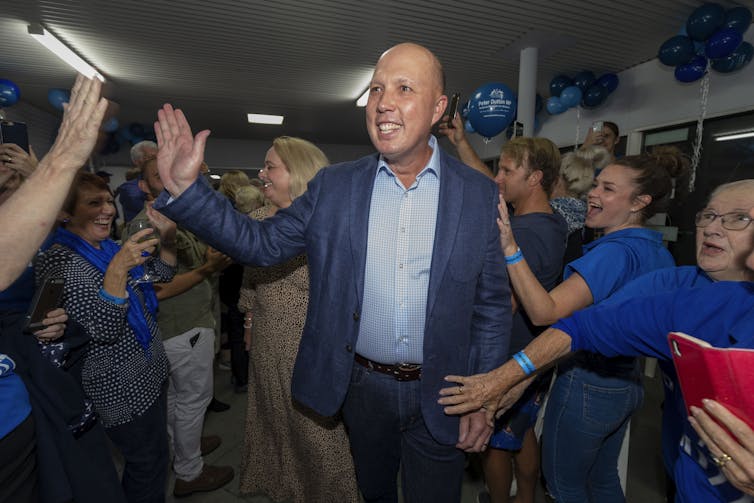 Member for Dickson Peter Dutton arrives with his wife Kirilly to celebrate the win of the Dickson electorate against Ali France on Election Night in Brisbane.
Glenn Hunt/AAP
Member for Dickson Peter Dutton arrives with his wife Kirilly to celebrate the win of the Dickson electorate against Ali France on Election Night in Brisbane.
Glenn Hunt/AAP
The 2019 election will be remembered as an election that pitted the economy against the environment. No parties seemed able to offer policies for both. And a majority of voters apparently prioritised economics over environmental policy in the search for job security.
The Carmichael mine might not be the silver bullet that economists hope for by bringing jobs and reducing youth unemployment, but voters’ desire for big infrastructure projects that bring knock-on community benefits secured the Coalition’s victory.
The coalition’s strategy to promise little, but provide enough detail to offer hope is a tried and tested approach. By contrast, Labor’s consistent policy announcements and change mantra left them open to criticism over higher taxes for retirees and uncertainty on costings for climate change.
The blame game between federal and Queensland Labor has begun. The Adani mine remains the elephant in the room, setting the scene for next year’s Queensland state election.
Victoria
Nick Economou, Senior Lecturer in the School of Political and Social Inquiry at Monash University
Contrary to general expectation, Victoria has not delivered a government majority to Labor. With more than 75% of the vote counted, the two party swing to Labor is less than 0.5%. The only certain gains for the opposition are the seats of Dunkley and Corangamite, which were already notionally Labor after a redistribution.
To the list of Liberal heroes mentioned by Scott Morrison on election night should be added Michael Sukkar in Deakin and Jason Wood in La Trobe, both of whom defended their potentially vulnerable seats. Sukkar’s performance was particularly noteworthy given the ferocity of the campaign run against him by those angered by his conservative stand on marriage equality, and his contribution to the fate of former Liberal leader Malcolm Turnbull. He will probably be rewarded with a ministerial appointment.
Independent Helen Haines has won Indi and the Greens’ Adam Bandt retains Melbourne, but all other non-major party challenges in the lower house contest failed. That includes Julia Banks in Flinders (comfortably won by Liberal Greg Hunt); Julian Burnside in his bid on behalf of the Greens to oust Josh Frydenberg in Kooyong; Jason Ball’s attempt to win Higgins on behalf of the Greens (it is a Liberal retain); and the field of aspirant independents who rolled out in Mallee (won by the National party).
In the Senate, meanwhile, both Labor and Liberal are guaranteed of at least two seats each. The Greens are hovering close to a quota at 11.7% of the vote, and with 1.5% of Animal Justice Party preferences likely to flow through to lead candidate Janet Rice.
Labor’s rather weak primary vote means there won’t be a significant transfer of quota to the Justice Party, so it’s unlikely that Derryn Hinch will be returned. The final seat will be a tussle between the third placed candidate on the Liberal ticket, David Van, and a right-of-centre minor party candidate that could still be the United Australia Party, depending on how preferences flow.
The expectation of a better result for Labor was based on opinion polling that measured two party support for the opposition at 54%. Currently the two party vote result is 52.2% – a strong level of support for Labor, but clearly insufficient to result in a significant transfer of seats. This was, indeed, a quite typically Victorian outcome.
Tasmania
Richard Eccleston is Director of the Institute for the Study of Social Change at the University of Tasmania
Tasmania, and the northern seats of Bass and Braddon, were always going to be key elements of a Coalition victory, and so it proved to be.
Indeed, Tasmania is a microcosm of the national election result, with inner urban electorates becoming more progressive, while regional seats have swung to the Coalition. Across the board support for independents, minor parties and the informal vote was up, reflecting broad-based voter disillusionment.
It seems clear Labor’s Justine Keay will lose the North West seat of Braddon, having suffered a 5% two-party preferred swing to Liberal challenger and new member Gavin Pearce. There was, however, a 4% swing against the Liberals on the primary vote with Liberal-aligned independent Craig Brakey securing 11%.
Bass is again on a knife edge.
Sitting Labor member Ross Hart is trailing his Liberal challenger Brigid Archer by less than 500 votes, with about 12,000 pre-poll votes to count. The final result in Bass may determine whether the Coalition can govern in its own right or whether it has to rely on the likes of the Katter Australia Party.
It’s clear that Bass and Braddon continue to be volatile and marginal and will be a focus of future federal campaigns.
Any hopes the Liberals had of securing the rural seat of Lyons were dashed with the resignation of their candidate Jessica Whelan midway through the campaign. Labor’s Brian Mitchell was returned with a small swing, as was sitting member Julie Collins in Franklin.
In the Hobart-based seat of Clark, independent Andrew Wilkie secured over 50% of the primary vote, while the combined Liberal and Labor vote was just 37%. The fact that almost two thirds of voters in the state capital didn’t vote for either of the major parties highlights the fundamental challenges facing our political parties and system of government more generally.
Election night coverage inevitably focuses on the lower house, but the composition of the Senate will have a big impact on how Scott Morrison governs. In the Tasmanian Senate race, it appears that the Liberals and Labor will each secure two seats. The Greens Nick McKim will also be returned, while Jacquie Lambie is best placed to win the final seat and resume her colourful political career.
Read more: Key challenges for the re-elected Coalition government: our experts respond
New South Wales
Stewart Jackson, Lecturer in the Department of Government and International Relations at the University of Sydney
Bill Shorten and the Labor Party went into the 2019 election with some expectation of reversing the decline in their vote in NSW. They hoped to capture at least three seats (Gilmore, Reid and Banks), with the chance of another in Page, while retaining marginal seats such as Macquarie and Lindsay.
By the end of election night it was clear that things had not gone to plan. While Gilmore went to Labor’s Fiona Phillips, the party failed to capture Reid and Banks. And Lindsay moved in the other direction, falling to the Liberal’s Melissa McIntosh.
It’s also clear that the supposed surge in support for minor parties and independents didn’t materialise. While Zali Steggall won the seat of Warringah – ending Tony Abbott’s 25-year hold on the seat – hers was an isolated victory. Kerryn Phelps lost narrowly to Dave Sharma, and Kevin Mack came up well short in Farrer. Adam Blakester, in New England, was unable to make any inroads on Barnaby Joyce’s hold on the seat, with Joyce even enjoying a small swing in his favour on primary votes.
Former Independent MP Rob Oakeshott slipped backwards in Cowper, a seat that he came close to winning in 2016, and which he partially covered while he was MP for Lyne between 2008 and 2013. The only real challenge from a minor party candidate came from One Nation’s Stuart Bonds against Labor’s Joel Fitzgibbon in the seat of Hunter. Bonds’ 22%, directed to the National’s Josh Angus, nearly deprived the ALP of one of its key frontbenchers.
The key lesson then from NSW is that not much has changed. The Berejiklian government’s narrow return in March might have been a portent for what NSW voters were thinking – and certainly there was no joy for the ALP to be found there.
South Australia
Rob Manwaring, Senior Lecturer in Politics and Public Policy at Flinders University
There was a good deal of movement among South Australian voters, but it looks like no seats will change hands at all in the state. Of the ten seats, the Liberals have three, the ALP five, and the Centre Alliance have held onto the seat of Mayo. On current counting, the most marginal seat – Boothby – looks like a Liberal retain, held by Nicolle Flint, but only on the slimmest of margins.
In South Australia, the Coalition scored a strong-ish primary vote of 40.6% (SA) compared to 41.4% (national). In contrast, the ALP’s primary vote in the state was 35.9% (SA) compared to 33.9% (national).
Both parties have seen a swing towards them in SA, although the swing is slightly greater to the Liberals. On the counting so far, the 2016 Centre Alliance votes seem to have disproportionately favoured the Liberals, rather than the ALP. Given that the Centre Alliance campaigned against Labour’s “retiree tax”, and Sharkie emphasised her “non-Labor” seat, it appears their “centre” is moderately more right than left.
At this stage, at least two seats in the Senate remain unclear, but with “likely” predictions. The Liberals and Labor have picked up the first four spots between them (two Liberal, two Labor). Greens Senator Sarah Hanson-Young looks likely to have taken the fifth spot, and remarkably, the Liberals might take the final sixth spot off the hands off One Nation. Here, the Centre Alliance have appeared to have lost out. The main issue is that by the next federal election, most of the seats will be even “safer”.
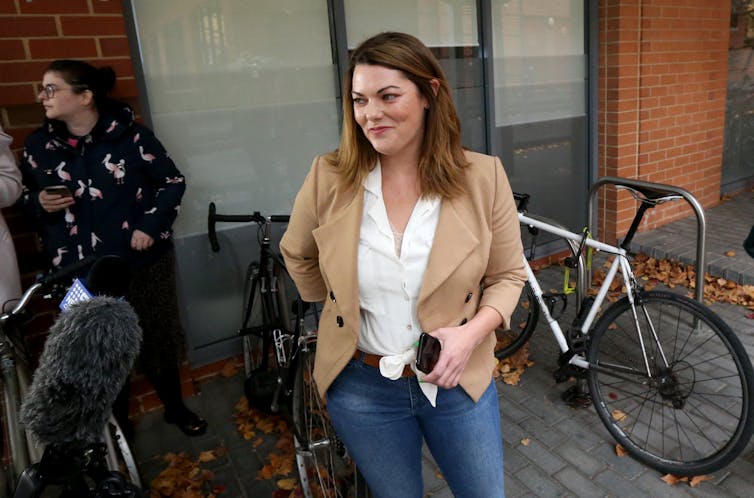 Green senator Sarah Hanson Young looks set to retain her Senate seat in South Australia.
Kelly Barnes/AAP
Green senator Sarah Hanson Young looks set to retain her Senate seat in South Australia.
Kelly Barnes/AAP
Read more: Labor's election loss was not a surprise if you take historical trends into account
Western Australia
Ian Cook, Senior Lecturer of Australian Politics at Murdoch University
Looking at the Western Australian results for the House of Representatives on the ABC website reminds you of the “red” (Republican) and “blue” (Democrat) states of US politics – although the meaning of the colours is more or less the opposite here.
And when you look at it, Western Australia is a blue, that is Liberal, state.
If, as most people expect, Anne Aly wins Cowan, Labor will continue to hold only five of the 16 lower house seats in WA. While most Liberal candidates in WA increased their margins, Liberal candidates in what looked like vulnerable Liberal-held seats either increased their margins or suffered only minor swings against them. (The Nationals still don’t hold a lower house seat in WA.)
Of the four Liberal-held seats everyone was watching, the Liberals’ now hold Halsuck by a margin of 4.6% (up from 2.1%), and Pearce by 6.8% (up from 3.6%). The Liberals’ margin fell in Swan from 3.6% to 1.7%, and in Stirling from 6.1% to 5.1%. But 5.1% is still a lot.
The upshot is that two of the four seats that were within Labor’s reach in 2019 are now close-to out of reach (Hasluck) or, subject to some disaster, completely out of reach (Pearce). The seat that was furthest out of reach (Stirling) is marginally closer to within reach, but is still a stretch for Labor. This leaves only one of the four seats that were within Labor’s reach still within its reach at the next election (Swan). (No Liberal-held seat has slipped into the marginal category.)
That’s going to make it hard to convince anyone that WA is crucial to an election result when there is only one seat in play in the state.
During elections to come, Western Australians will talk wistfully of that time when the those folk over East cared. When you couldn’t turn around, but to find one of the leaders or some other major party figure at your elbow, debating and throwing money around with abandon. Ah, those were the days…
Authors: Nick Economou, Senior Lecturer, School of Political and Social Inquiry, Monash University

















