

Cars in Australian cities are emitting less – but in the regions exhaust emissions are growing
- Written by Kai Li Lim, St Baker Fellow in Electric Mobility, The University of Queensland
Within five years, transport is expected to be Australia’s top source of greenhouse gas emissions. While renewables and storage are bringing down emissions from the electricity sector, emissions from transport are still growing. Our fleet of cars, trucks, diesel trains, planes and ships now emit almost 20% more than they did two decades ago.
In car-dependent Australia, switching to electric vehicles will be necessary. This is beginning to happen. Despite recent drops in battery-electric vehicle sales, the hybrid market is growing strongly.
But when we drilled down into the transport sector in our research, we found clear differences on emissions between our major cities and some regional areas. Broadly, city drivers are emitting less, while regions are emitting more.
Why? There are a number of reasons. City drivers are more likely to take up lower-emitting plug-in hybrids and battery electric vehicles with zero emissions. Rural and regional drivers drive many more kilometres than city drivers, and the electric charger network is scattered. Affordability is also a key consideration. It’s also only recently that the average range of electric cars and vehicles tipped over 400 kilometres per charge.
From January 1, the New Vehicle Efficiency Standard will come into force. One effect will be the arrival of more electric vehicle models and lowering ownership costs. But by itself, this won’t be enough to bridge the city-country gap.
We will need policies targeted at making electric vehicles viable in the regions. Without this, we risk failing to meet Australia’s emission cut targets of 43% by 2035 and net zero by 2050.

What did we find out?
In Australia, the overall transition to electric vehicles is proceeding in fits and starts. This year, sales of battery electric vehicles have dropped back, though plug-in hybrid vehicle sales have risen.
But cleaner options are being taken up faster in some areas than others.
To find out more, we analysed vehicle registration and emissions data across Australia between 2002 and 2020.
These data showed the average carbon emissions from new cars bought in capital cities are generally lower than the rest of the state.
Across this timeframe, we saw major changes in vehicle emissions by postcode.
Unfortunately, we had to limit our study to 2020 due to data availability. This means we could not cover the COVID pandemic and its aftermath in terms of how travel behaviour shifted. While we could not capture the very recent arrival of many more electric vehicle models, we developed projections based on better availability and affordability of electric vehicles.
Over our time period, we found significant falls in emissions per vehicle in major cities such as Greater Sydney (24% decline), while vehicle emissions grew in regions such as North Queensland (3.3%), the Northern Territory (about 4%) and southwest Western Australia (5%) between 2002-2020.
Why the difference? Here are 3 reasons
1: Suburban drivers are taking up low- and no-emission vehicles faster
Australians in the outer suburbs are the most likely to purchase plug-in hybrids and battery-electric vehicles due to better access to charging infrastructure, targeted incentives and a higher awareness of financial and environmental benefits.
2: Rural and regional residents drive more
Rural and regional drivers tend to travel longer distances, rely on larger vehicles such as utes and 4WDs and have limited access to electric vehicle charging networks. Affordability and range anxiety are also barriers in these regions.
3. City drivers turn over cars faster
Urban residents buy cars more often. This means they progressively replace older cars with newer models, which are often more fuel-efficient. Rural areas have slower turnover of their vehicles, meaning higher emissions cars stay on the roads longer.
This is why vehicle emissions in Greater Sydney showed the sharpest decline over the period, aligning with the national trend of lower emissions from new vehicles in metropolitan areas. By contrast, emissions in areas such as North Queensland and the Northern Territory rose, due to a higher dependency on larger vehicles and a lack of charging infrastructure.
Australian cars pollute much more than those in Europe. Across 29 European nations, the average is now 107 grams per kilometre (g/km).
In 2023, the average emissions intensity for all vehicles on Australian roads was 193 g/km. This includes the large fleet of older, highly emitting vehicles, more efficient newer cars and zero emission vehicles. Of the new cars sold in 2023, the average was 165 g/km.
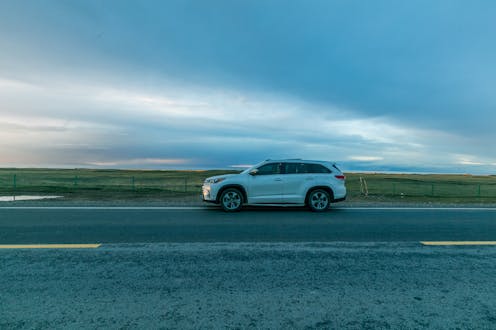
 Rural drivers often do long distances in Australia.
Chris Bucanac/Shutterstock
Rural drivers often do long distances in Australia.
Chris Bucanac/Shutterstock
Zero emissions from transport will take work
To track our progress in cutting emissions from vehicles, we need good data. Our research points to the importance of keeping comprehensive, nationwide datasets to track vehicle emissions.
These datasets are important because they allow policymakers to focus on specific areas. Our research could be used to tackle the reasons rural and regional Australians are not taking up low or zero emission transport.
For instance, electric vehicle chargers could be rolled out in regions where uptake is lowest. Roadshows and information sessions could help people feel more comfortable with a new technology and see how it might work for the distances they drive and the type of roads they drive on.
Authorities could also encourage markets for secondhand electric vehicles such as by shifting their fleet to electric, which would increase availability.
Tackling the city-country divide in electric vehicles would not only help reduce the cost of living for rural residents, but it would also encourage greater uptake of electric vehicles among city residents, who would feel more confident driving their cars beyond the city limits.
Authors: Kai Li Lim, St Baker Fellow in Electric Mobility, The University of Queensland

















