

twin stars trapped in galactic black hole orbit
- Written by: Luke Barnes, Lecturer in Physics, Western Sydney University
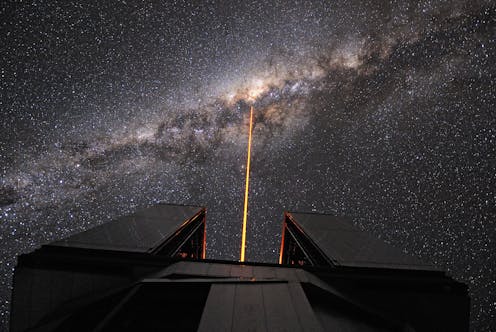
At the centre of the Milky Way is a supermassive black hole called Sagittarius A*. It is roughly 27,000 light years from Earth and 23.5 million kilometres in diameter.
In a world first, a team of astronomers led by Florian Peißker from the University of Cologne, Germany, have discovered a binary star system orbiting this black hole.
The system is known as D9. Its discovery, announced in a new paper published today in Nature Communications, sheds light on the extreme environment at the centre of our Milky Way galaxy.
It also helps explain a long-running cosmic mystery about why some stars hurtle through space much faster than others.
What is a binary star system?
A binary star system is simply two stars orbiting each other.
Our Sun is not part of a binary, which is a good thing: we wouldn’t want another star wandering through our Solar System. It would disrupt the orbit of the Earth; we’d fry or freeze.
Observations show about two thirds of the stars in the Milky Way are single stars, and the remainder are part of a binary or multiple star system. Larger stars are more likely to be paired.
Binary star systems are useful to astronomers because their motion contains a wealth of information. For example, the speed and distance of the orbits tell us about the masses of the stars.
For a single star, by contrast, we usually work out its mass from how bright it is.

A technically challenging discovery
Although scientists have previously predicted that binary star systems exist near supermassive black holes, they have never actually detected one.
This recent discovery was technically quite challenging. We can’t simply look at the system and see two stars, because it’s too far away. Rather, the astronomers used the European Southern Observatory’s Very Large Telescope to measure the shifting of the starlight – known as the Doppler effect. This showed that the stellar system’s light had a characteristic wobble, indicating an orbit.
But the team did much more than that.
Because binary stars contain a wealth of information, the astronomers could calculate that this particular system is approximately 2.7 million years old. That is, 2.7 million years ago, these stars first ignited.
They probably weren’t born in the black hole’s extreme surroundings, so unless they only recently wandered into this neighbourhood, they have lasted about a million years in their current environment.
This, in turn, tells us about the black hole’s ability to disrupt stars in its orbit. Black holes are mysterious beasts, but clues such as this are helping us unravel their nature.
 A20-year time lapse of stars orbiting the black hole at the centre of the galaxy.
ESO/MPE, CC BY-NC
A20-year time lapse of stars orbiting the black hole at the centre of the galaxy.
ESO/MPE, CC BY-NC
Circling a black hole
The situation the astronomers discovered is quite familiar.
Think of the Moon: it orbits the Earth, and the Earth and the Moon together orbit the Sun. Because gravity is an attractive force, it can pull multiple celestial objects into complicated orbits. The complexity of this scenario inspired the recent book and Netflix series, The Three Body Problem.
If they are complicated, could the whole thing drift apart? The Moon–Earth–Sun arrangement is stable because two of the three bodies – the Earth and Moon – are much closer together than the other body, the Sun. The Moon and Earth are close enough that, so far as the Sun is concerned, it’s effectively a two-body system, which is stable.
But if all three bodies interact, the system can come apart. It is even possible for two of the bodies to eject the third body entirely.
A visualisation of the instability of a three body system.Stars of unusual speed
This mechanism probably explains a cosmic mystery: hypervelocity stars.
Most stars in the night sky are in a typical, almost-circular orbit around the centre of our galaxy. Orbital speeds are about 200 kilometres per second: very fast on Earth, but nothing special in space.
However, since 2005 we have discovered about 20 hypervelocity stars, which are hurtling through our galaxy at more than 1,000 kilometres per second. How?
Our best current idea is that hypervelocity stars were once part of a binary system orbiting our supermassive black hole. In time, the stars got too close to the black hole, and a complicated orbit resulted. In the kerfuffle, with a black hole calling the shots, one of the stars got ejected. It escaped to the outer Milky Way, where we see it as a hypervelocity star.
Finding the hypervelocity factory
It’s an interesting theory.
Theoretical calculations show the mechanism works and the speeds are about right. Observations show many of the known hypervelocity stars appear to be shooting away from the galactic centre, which is another plus for the theory. But how else could we test this idea?
An obvious way is to look for binary stars around our supermassive black hole.
Astronomers have been keeping a close eye on our galactic centre for decades. It’s not too difficult to find in the night sky, as you can see from the image below.
 This map shows the location of Sagittarius A* in relation to Antares. The black hole is marked with a circle within the constellation of Sagittarius (The Archer).
Stellarium
This map shows the location of Sagittarius A* in relation to Antares. The black hole is marked with a circle within the constellation of Sagittarius (The Archer).
Stellarium
Here are two reliable methods to find Sagittarius A*. First, find Antares (bright and red), which is the centre of the back of Scorpio, and then follow the scorpion’s body to the tip of the tail, and that’s close-ish to the black hole. Alternatively, get a good night sky app on your phone; they’re amazing.
In the context of these theories, this recent discovery is very important. Astronomers found a binary star system around our supermassive black hole. An important piece of the hypervelocity puzzle falls into place.
Authors: Luke Barnes, Lecturer in Physics, Western Sydney University



















