

Could NZ’s two kākā subspecies actually be remnants of a more diverse species? Here’s why we need to know
- Written by: Michael Knapp, Associate Professor in Biological Anthropology, University of Otago
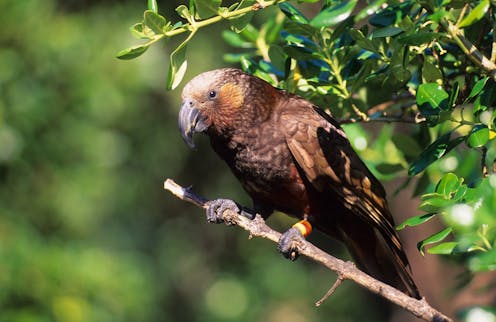
As many Wellingtonians will know, kākā can be trouble. New Zealand’s pesky forest parrots have expanded throughout New Zealand’s capital city since they were reintroduced 22 years ago and they are not averse to “modifying” people’s homes to build nests in roof spaces.
But mostly, they are the ones in trouble.
Kākā populations across Aotearoa New Zealand have declined significantly over the past two centuries, in particular after the introduction of European mammalian predators.
Their former New Zealand-wide range is now reduced to a few isolated populations supported by intensive conservation efforts by the Department of Conservation. Private organisations such as Project Janszoon also work to prevent further decline and facilitate the species’ recovery.
The most critical tool for protecting kākā is effective control of introduced predators in the areas where the parrots have persisted. This allows these kākā populations to grow and maintain genetic diversity.
An additional benefit is that large healthy populations provide birds for natural dispersal to areas where they have become locally extinct or rare. However, in some places, the time frames over which natural dispersal will repopulate areas where kākā once existed are longer than we would like.
In these cases, conservation translocations are used to re-establish kākā, facilitate gene flow, reduce the risk of inbreeding and increase genetic diversity.
Challenges of moving birds between sites
Kākā translocations come with their own challenges. There are two different subspecies, the North Island kākā and the South Island kākā. They differ in size and plumage colour and are treated separately when it comes to translocations. North Island birds will only be translocated between North Island sites and South Island birds only between South Island sites.
In the absence of knowledge about what causes and maintains the differences between the birds from each island, this conservative approach makes sense to preserve the uniqueness of the two subspecies. But it comes at the cost of significantly reducing the number of birds that can be translocated, and the number of sites they can be translocated to.
This in turn reduces the gene pool for mixing and therefore means the genetic diversity of future generations might be more restricted than it could otherwise be.
To address this problem, researchers have explored kākā genetics. Curiously, the largest New Zealand-wide population study so far, published a decade ago, found there was no clear genetic difference between North Island and South Island kākā.
The problem is that the kākā genome is like a big instruction manual, written with more than a billion letters. The study was limited to surveying a small fraction of this manual, looking at fewer than a dozen “paragraphs”. Key genetic differences between the two subspecies may have remained hidden.
Deciphering the kākā genome
More recently, our team conducted a much deeper study of the genetic differences between North Island and South Island kākā. Yet, even after looking at more than 100,000 “paragraphs” of the kākā genome, the results remained the same. There is no clear distinction between the two subspecies.
Nevertheless, it is too early to start mixing North Island and South Island birds. While we have not found a clear genetic difference between the subspecies, we still do not know what causes their different looks on a molecular level.
There are several paths forward. We have now sequenced complete genomes of ten North Island and ten South Island birds. By looking at the full genomes, we hope to finally identify the parts that uniquely distinguish the two subspecies (if there are any).
But there are other questions that are equally important. How far back in time do we see the sharp distinction between North Island and South Island birds?
Early European explorers such as Sir Walter Buller reported a much bigger diversity of kākā forms than we see today. In fact, Buller collected birds that looked like North Island kākā on the West Coast of the South Island.
Could it be that what we are seeing today is an artifact of population decline? Perhaps what we know as North Island and South Island kākā are simply the only surviving forms of a formerly more diverse species. Perhaps the lack of genetic difference between the subspecies indicates that some natural mixing is still happening on a small scale.
Mātauranga Māori might hold important answers. Kākā feathers have been valued by iwi from across the motu. Is there traditional knowledge on the diversity of kākā plumage in pre- and early European times? Were there birds that looked like a mixture between North and South Island birds?
If so, the present-day separation of subspecies would not actually be of natural origin. This would support the mixing of North and South Island populations, which might help to reinstate the original kākā diversity.
In the end, combining traditional knowledge and state-of-the-art molecular tools may hold the key to enhanced and more effective conservation of one of Aotearoa New Zealand’s most well-known and beloved birds.
This article was written in collaboration by Denise Martini, Michael Knapp and Kevin Parker.
Authors: Michael Knapp, Associate Professor in Biological Anthropology, University of Otago



















