

I’ve calculated Santa’s speed on Christmas Eve – and this is what it would do to Rudolph’s nose
- Written by: Laura Nicole Driessen, Postdoctoral Researcher in Radio Astronomy, University of Sydney
With billions of children around the world anxiously waiting for their presents, Father Christmas (or Santa) and his reindeer must be travelling at breakneck speeds to deliver them all in one night.
But did you know that light from an object travelling at high speeds changes colour? This is thanks to what’s called the Doppler effect – the way speed affects the length of waves, such as sound or light.
When light changes colour due to speed, we call it redshift or blueshift, depending on the direction. If we could catch the colour of Rudolph’s famous red nose with one of our telescopes, we could use the Doppler effect to measure the speed of Father Christmas.
Here’s how that might work – and why this effect is also a crucial tool in astronomy.
How far do Father Christmas and his reindeer need to travel?
Strap into your sleigh for some light Christmas maths. I’ve updated a method proposed in 1998 to work out how fast Rudolph and Father Christmas need to travel to deliver all the required presents (you can find my working here).
There are approximately 2 billion children under the age of 14 years in the world. Approximately 93% of countries observe Christmas in some way, so we’ll assume 93% of all children do.
We know Father Christmas only delivers presents to those who truly believe. If we assume the same percentage of believers by age group as found in the United States, that leaves us with approximately 690 million children.
With about 2.3 children per household worldwide, he has to visit roughly 300 million households.
Spreading those households evenly across 69 million square kilometres of habitable land area on Earth (taking oceans, deserts, Antarctica and mountains into account), Father Christmas has to travel 144 million kilometres on Christmas Eve. That’s nearly the same as the distance from Earth to the Sun.

Luckily, Father Christmas has time zones on his side, with 35 hours between dropping off the first and the last present.
Let’s say Father Christmas uses half his time to zip in and out of each household, which gives him 17.5 hours total or 0.2 milliseconds per household. He uses the other 17.5 hours for travelling between households.
My hypothesis is that he needs to travel at a whopping 8.2 million kilometres per hour, or 0.8% of the speed of light, to drop off all the presents.
How can we measure Father Christmas’ speed with Rudolph’s nose?
Let’s say we want to actually measure the speed of Father Christmas’ journey to see if it matches the hypothesis.
A standard speed camera wouldn’t do the trick. But we have telescopes on Earth that can measure the colour of something by using spectroscopy.
Father Christmas’ lead reindeer, Rudolph, has a famously ruby-red nose. If we could observe Father Christmas with telescopes, we could use the colour of Rudolph’s nose to measure his speed using the Doppler effect, which describes how speed affects wavelength. That’s because Rudolph’s nose wouldn’t look quite so red if he were travelling at high speeds.
What is the Doppler effect? A good example is the sound of an ambulance. When it goes past you on the street, its sound is higher pitched as it approaches, and lower pitched when it drives away. This is because as the ambulance travels towards you, the sound waves are compressed to a shorter wavelength, and a shorter wavelength means a higher pitch.
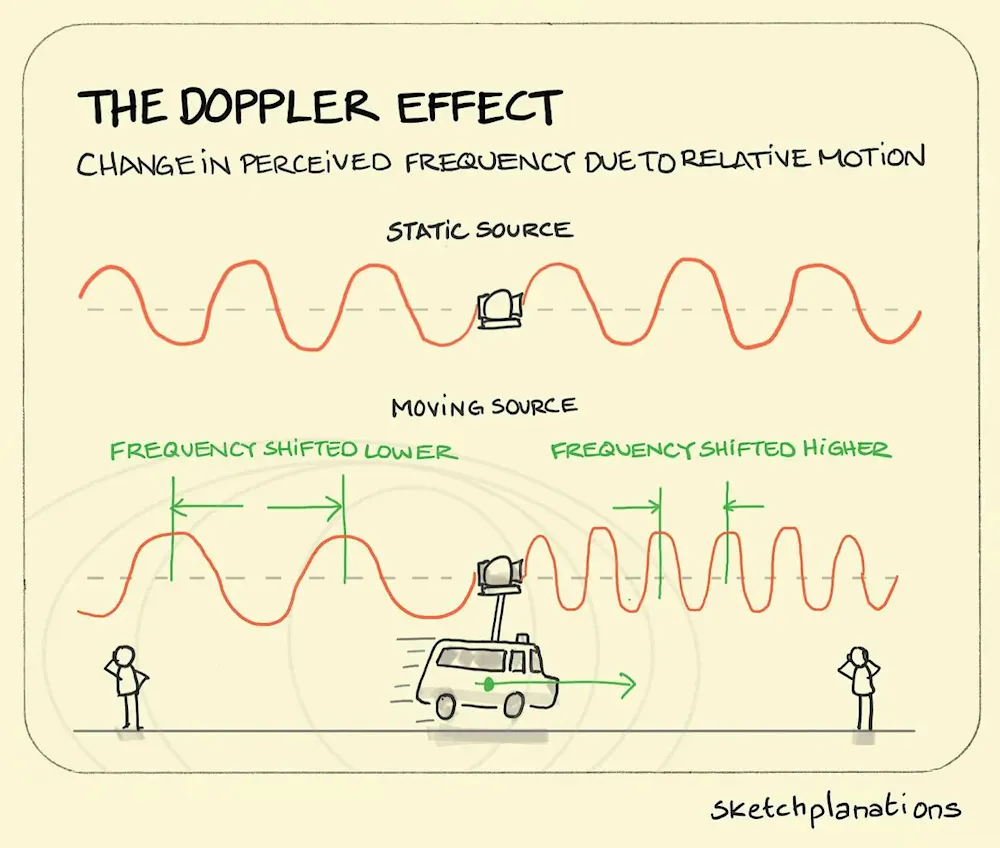 The Doppler effect is the change in frequency of a wave as its source moves relative to the observer.
sketchplanations, CC BY-NC
The same thing happens with light. If a source of light is travelling away from you, the wavelength is stretched out and becomes more red or “redshifted”. If the source of light is travelling towards you, the wavelength is compressed and the light becomes more blue or “blueshifted”.
Rudolph the redshifted reindeer
Red-coloured light has a wavelength of 694.3 nanometres when it’s “at rest”, which means it isn’t moving. That would be the measurement of a stationary Rudolph.
Let’s say Father Christmas would prefer to deliver presents fast, so he can relax with some milk and biscuits at the end of the night. He gets his reindeer to run much faster than I hypothesised, at 10% of the speed of light or 107 million kilometres per hour.
At this speed, Rudolph’s nose would be blueshifted to bright orange (624 nanometres) as he was flying towards your home.
And it would be redshifted to a very dark red (763 nanometres) as he was moving away. The darkest red human eyes can see is around 780 nanometres. At these speeds, Rudolph’s nose would be almost black.
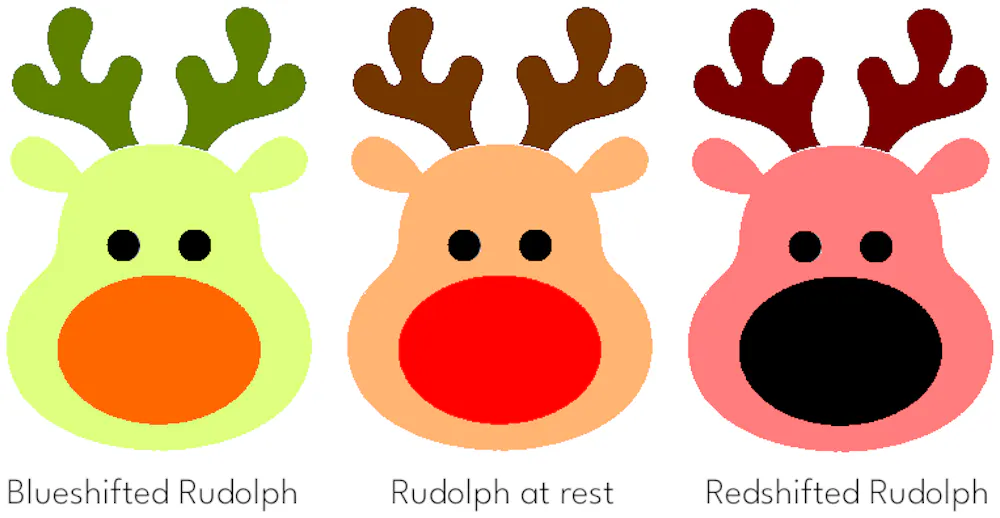 Blueshifted Rudolph, Rudolph at rest, and redshifted Rudolph. The blue and redshifted colours were calculated for Rudolph travelling at 10% of the speed of light. Brown is a tricky colour since it’s a de-saturated orange. So the blue and redshifted colours for Rudolph’s fur and antlers are approximations. When Rudolph’s nose is redshifted at that speed, his nose is such a dark red that it’s practically black.
Dr Laura Driessen
The Doppler effect has a role in astronomy
Astronomers use the Doppler effect to measure how things move in space. We can use it to see if a star is orbiting another star – what’s known as a binary system.
We can also use it to find exoplanets (planets orbiting stars other than our Sun) using a method called “radial velocity”. We can even use it to measure the distances to far away galaxies.
There are some things science just can’t explain, and one of those is the magic of Father Christmas. But if astronomers ever catch Rudolph with their telescopes, they’ll be sure to let everyone know.
Authors: Laura Nicole Driessen, Postdoctoral Researcher in Radio Astronomy, University of Sydney


















