

the patron saint of the internet who shaped knowledge for generations
- Written by: Darius von Guttner Sporzynski, Researcher, Historian, Australian Catholic University
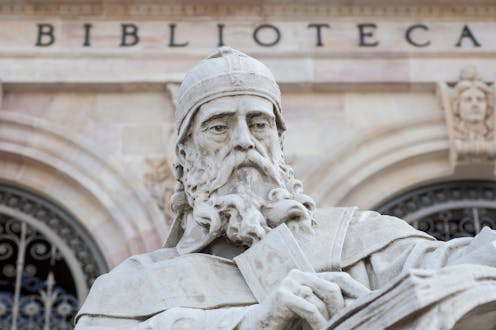
In a world where information flows freely, it’s easy to forget that, for centuries, knowledge was much harder to come by. Imagine living in a time when the internet didn’t exist, books were scarce, libraries were few, and most people couldn’t even read.
This was the world of Isidore of Seville, a man dedicated to gathering and sharing knowledge to be passed down for generations.
Thanks to his work, he was named the patron saint of the internet in 1997 by Pope John Paul II, recognising his impact on knowledge and communication.
Importantly, understanding Isidore’s life and work also helps us navigate the murky online world of lies – and find information we can trust.

Isidore’s world and the ‘Dark Ages’
Isidore was a bishop and scholar who lived in Seville in what is now Spain during a time we often call the “Dark Ages”, roughly 500–1000 AD. After the fall of the Roman Empire, much of Europe was in chaos – as if the lights had been turned off.
Political instability, war and disease disrupted learning and culture. Many people were illiterate, and many classical works from ancient Greece and Rome risked being lost forever.
In this world of limited access to learning, Isidore stood out. He wanted to make knowledge more accessible, especially to Christians.
He saw preserving and sharing information as essential to keeping civilisation alive and thriving. To do this, he wrote his most famous work, Etymologiae, which became a go-to book for centuries.
What was Etymologiae?
Think of Etymologiae as one of the first encyclopedias. An encyclopedia is a book that collects information on many topics, often arranged alphabetically, making it easy to find answers.
Isidore’s work covered everything from language, science and geography to theology, the study of God. His goal was to make ancient knowledge easier to find and understand. He wanted to save the best ideas of the past and bring them into his present time.
In Etymologiae, he drew from well-known classical authors such as Aristotle, Cicero and Pliny, alongside Christian writers such as Augustine and Jerome. This book became essential for medieval students and scholars because it saved so much knowledge from being lost.
Later, Isidore’s work was widely used in schools across Europe and helped many people learn about topics they might otherwise never know about. It laid a foundation for preserving ancient ideas through the Middle Ages and beyond.
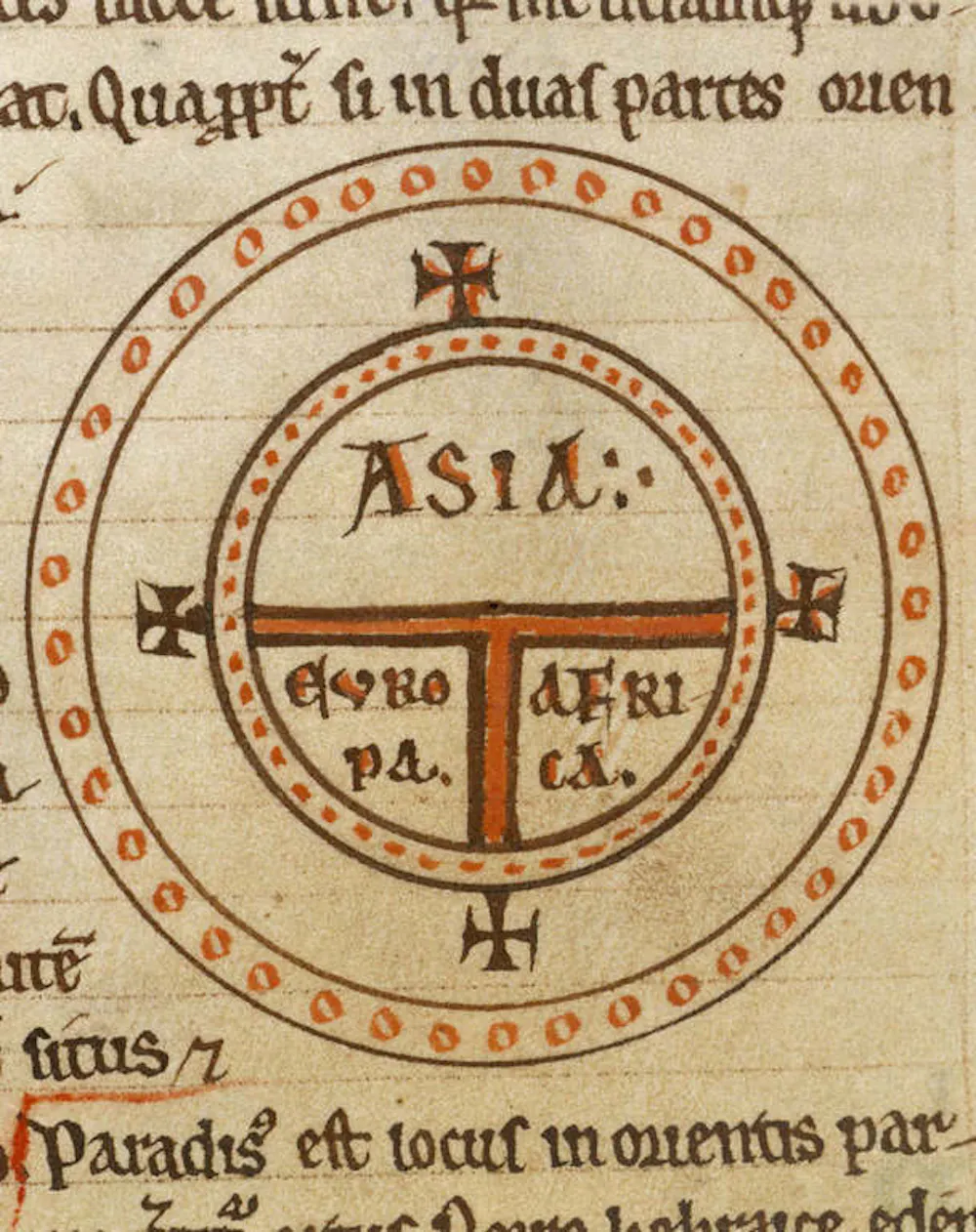 A T and O map – also known as Isidoran Map drawn by Isidore of Seville in 1472. The map represents world geography, showing Asia occupying the top whole top half of the globe.
Isidore of Seville
A T and O map – also known as Isidoran Map drawn by Isidore of Seville in 1472. The map represents world geography, showing Asia occupying the top whole top half of the globe.
Isidore of Seville
The power of language in Isidore’s work
For Isidore, words were powerful. He argued that understanding the origin, or etymology, of words gave people insight into the true meaning of things. This focus on language is why he called his book Etymologiae. He saw language as a bridge that connected people to knowledge.
But Isidore went beyond just defining words. He also explained concepts from nature, science and history, making sure people had a well-rounded understanding of the world.
In a time when superstitions and beliefs in supernatural forces often influenced people’s view of natural events, Isidore promoted a rational approach. He wanted people to know the facts about their world.
Isidore’s role in education and the church
Isidore wasn’t just a writer.
As a senior leader in the Christian Church, he played an important role in both religion and education. He set up “cathedral schools” for training future priests. These schools would later inspire the first European universities, where students could study a wide range of subjects.
For Isidore education was essential for everyone, not just the church’s leaders.
By promoting the seven “liberal arts” – subjects such as grammar, logic, rhetoric, geometry, arithmetic, astronomy and music – he helped create a model for what would eventually become medieval university education. His ideas about learning spread across Europe, inspiring others to value education as a path to both knowledge and faith.
The patron saint of the internet
So, how did Isidore, who lived 1,400 years ago, become the patron saint of the internet? His Etymologiae was, in many ways, the internet of his time – a collection of facts and explanations from various sources.
Just as the internet today connects us to all kinds of information, Isidore’s work aimed to make learning easier for people of his era.
In naming him the patron saint of the internet, the Catholic Church recognised Isidore’s efforts to collect, organise, and share knowledge. Like the internet, Etymologiae allowed ideas to flow across generations, even when people had limited access to books or formal education.
Isidore’s lasting legacy
Isidore’s influence didn’t end with his life. His ideas spread across Europe, especially during the Carolingian Renaissance of the eighth and ninth centuries – a time when scholars worked to revive learning and culture. Etymologiae became a popular text in monasteries and cathedral schools.
In later centuries, scholars relied on his work to understand classical literature, science and theology.
Today, Isidore’s dedication to knowledge serves as a reminder of the importance of preserving and sharing reliable information.
Just as Isidore saw his work as a way to preserve knowledge, we now live in an age of easy access to information. But not all of it is true.
He believed learning should guide us toward wise choices and serve a greater good.
Authors: Darius von Guttner Sporzynski, Researcher, Historian, Australian Catholic University



















