

how the humble fruit fly transformed 4 fields of research
- Written by: Ary Hoffmann, Professor, School of BioSciences and Bio21 Institute, The University of Melbourne
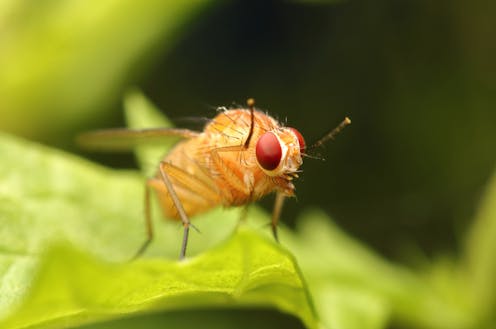
The common fruit fly (Drosophila melanogaster), more correctly called the vinegar fly, is a frequent visitor to ripe fruit in households around the world, where it often deposits eggs on rotting flesh without being noticed. We have probably all consumed different body parts of fruit flies – without any known ill effects.
But the fruit fly is much more than an annoying house guest.
In fact, Drosophila melanogaster has been one of the most important species for science for more than a century.
Were it not for these flies, some of the most significant scientific discoveries might never have been made.
The origin of the fruit fly
The species has its origins in the woodlands of south-central Africa, where it relied heavily on the marula fruit. This fruit was – and remains – part of the human diet in this region too, leading to fruit flies developing an association with human communities and settlements.
In time, this association would lead to fruit flies first spreading throughout Africa, then into Asia, Europe and – within the past few centuries – North and Central America and Australia.
It is important to distinguish Drosophila melanogaster and its close relatives from the larger and more colourful “true” fruit flies, several of which are found in Australia.
Also called tephritid flies, these attack fruit well before it rots. Millions of dollars have been spent (ultimately unsuccessfully) trying to keep them out of parts of Victoria and South Australia.
Drosophila flies do become hugely abundant in some places, with clouds emerging from heaps of rotting fruit in wineries, stone fruit orchards and banana plantations during harvest. However, these cases are unusual and the fly is rarely considered a pest species.

Inherently suited to science
While most non-pest insects receive little scientific attention, the fruit fly is an exception.
Some of the properties which make fruit flies such a popular research organism are inherent. They are small, easy to feed, have a very quick life cycle and can produce hundreds of offspring.
However, the findings of today’s Drosophila melanogaster researchers also owe a great deal to decades of genetic tool development.
These allow us to create almost any genetic variant we wish. For example, we can modify the sequence of a vinegar fly gene so that the protein it encodes becomes fluorescent. We can even take genes from other organisms and study their effects in fruit flies.
Combined, these factors help explain why the fruit fly has played a major role in four fields of research in particular.
1. Understanding genes
The fruit fly has a long history of use in genetics research and teaching.
It was in Drosophila melanogaster that genes were found to be bundled up in chromosomes, through crosses between red-eyed and mutant white-eyed flies. While this research was conducted more than a century ago, such crosses remain a powerful way of illustrating the principles of inheritance.
The fruit fly also remains a powerhouse for biological discovery. Its genome was sequenced in the 1990s. This was done in part as a trial run for assembly of the human genome, but also to allow for comparisons of genes across animals.
Many vinegar fly genes show clear relationships to specific human genes, including around 65% of genes associated with human diseases. This allows research into processes from embryonic development and disease progression to learning and ageing to be conducted in the vinegar fly.
2. Understanding tissue damage
Animals vary greatly in their capacity to regenerate damaged structures. For example, if you cut certain flatworms in half, both sections can regenerate the rest of the body.
While fascinating, these do not provide a good model for the more modest – but still crucial – human capacity for wound healing. Fruit flies, which like humans are composed of numerous complex tissues, have been crucial in mapping the molecular interactions involved in allowing cells to migrate and stitch together to repair tissue damage.
Perhaps surprisingly given their short lifespan (no more than a few months even under optimal conditions), fruit flies are also a favourite model for cancer research.
They offer alternatives to traditional cell-culture-based methods for evaluating the activity of chemotherapeutic drugs, which cannot reflect the complexities of how a tumour interacts with surrounding tissues, and are especially popular in screening for effective combinations of chemotherapeutic treatments.
 Fruit flies are small, easy to feed, have a very quick life cycle and can produce hundreds of offspring. This makes them an ideal research organism.
Sundry Photography/Shutterstock
Fruit flies are small, easy to feed, have a very quick life cycle and can produce hundreds of offspring. This makes them an ideal research organism.
Sundry Photography/Shutterstock
3. Understanding disease control
Beyond providing tools and biological understanding applicable to medicine and biology, Drosophila melanogaster has contributed directly to disease control.
Specifically, Wolbachia bacteria isolated from this species are being used to suppress the transmission of dengue disease and other human viral diseases transmitted by mosquitoes.
A strain of Wolbachia living inside the tissues of fruit flies and passed from mother to offspring was transferred through microinjection to Aedes mosquitoes.
The Wolbachia bacteria interact with viruses in such a way as to prevent viral build-up in the salivary gland of the mosquitoes.
This work has already prevented many cases of dengue transmission in northern Australia and in many countries overseas.
4. Understanding evolution
Finally, fruit flies provide useful experimental systems for investigating evolution, particularly in the context of threatened species conservation.
This work has established the value of maintaining genetic variation in threatened species to preserve their ability to evolve and counter the effects of disease and climate change. Fruit fly populations in the field are currently being tracked to see if the species is adapting to the warmer and drier conditions we are experiencing.
So this summer, look carefully at your fruit bowl and see if you can spot a small yellow-brown insect flying around it.
Then remember all the ways Drosophila melanogaster has contributed to our well-being. Perhaps admire it rather than reaching for that can of fly spray.
Authors: Ary Hoffmann, Professor, School of BioSciences and Bio21 Institute, The University of Melbourne

















