

Monarch butterflies are in decline in NZ and Australia – they need your help to track where they gather
- Written by: Myron Zalucki, Professor in Biological Sciences, The University of Queensland
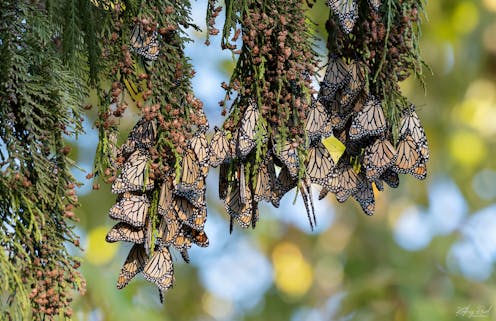
Monarch butterflies (Danaus plexippus) appear to be declining not just in North America but also in Australiasia. Could this be a consequence of global change, including climate change, the intensification of agriculture, and urbanisation?
We need more citizen scientists to monitor what is really going on.
Insect populations, even species that seemed impervious, are in decline globally. Monarch butterflies exemplify the problem. Once a very common species, numbers have declined dramatically in North America, engendering keen public interest in restoring populations.
The monarch butterfly is an iconic species. It is usually the species people recall when drawing a butterfly and observations are shared frequently on the online social network iNaturalist.
This is partly because monarch images are used in advertising, but the butterflies are also a species of choice for school biology classes and television documentaries on animal migration.
Monarchs in the southern hemisphere
The monarch butterfly’s ancestral home in North America is noted for an annual mass migration and spectacular overwintering of adults in fir forests in a few locations in Mexico, at densities of 50 million per hectare, and at multiple sites in Southern California. These sites are monitored to track the decline.
What is not as well known is that this butterfly greatly extended its range, spreading across the Pacific in the mid-1800s to reach Australia and New Zealand by riding on storms that blew in from New Caledonia.
The species is now part of the roadside scene in these countries and was once known as “the wanderer” – reflecting its propensity to fly across the landscape in search of milkweed plants (known as swan plants in New Zealand). In both countries, monarchs lay eggs on introduced milkweed species for their caterpillars to feed and develop. They take up the plant’s toxins as part of their own defence.
Interestingly, in their expanded range in the southern hemisphere, monarchs have adapted their migration patterns to suit local conditions. They have established overwinter sites – places where large numbers of adults congregate on trees throughout winter.
Need for citizen science
In Australia, the late entomologist Courtenay Smithers organised people to report these sites and participate in a mark-recapture programme. Essentially, this involves attaching a small unique identifying tag to the wing, noting the age and condition of the butterfly and the date and location of capture.
If the same individual is then recaptured sometime later and the information shared, it provides valuable data on survival and the distance and direction it moved, and even population size. This volunteer tagging programme enabled many aspects of the monarch’s ecology in Australia to be documented, but it was discontinued a few years ago.
Moths and Butterflies Australasia now hosts the butterfly database and has become an umbrella group for encouraging everyone with a mobile phone to get involved and report and record sightings.
A similar programme is run in New Zealand by the Moths and Butterflies of New Zealand Trust. Monarch overwintering sites and local breeding populations have been documented over the years. Alas, these data sets have been short term and haphazard.
What is intriguing is that populations appear to have declined in Australia and New Zealand, perhaps reflecting climate variability, expanding cities gobbling up local breeding habitats, and the intensification of agriculture.
What we need is reliable long-term data on adult numbers. Hence the call to reinvigorate interest in mark-recapture and reporting. We need the help of people who love the outdoors and love the monarch butterfly to become citizen scientists.
The Moths and Butterflies of New Zealand Trust is asking individuals, groups and schools to tag monarch butterflies late in the autumn when the butterflies head for their overwintering habitat. This is a great project for schools, involving students in real science and addressing an environmental issue.
Each tag has a unique code. A computer system calculates the distance the monarch has flown and the time it took to get there. This information can then be collated with weather data to get a clearer picture of what is happening.
We hope people will spot tagged monarchs in their gardens and record where the butterfly was sighted, together with its tag number.
The author wishes to thank Washington State University entomologist David James and Moths and Butterflies of New Zealand trustee Jacqui Knight for their input, and Australian National University ecologist Michael Braby for comments.
Authors: Myron Zalucki, Professor in Biological Sciences, The University of Queensland


















