

Australia’s political history is full of gaffes. Here are some of best (or worst)
- Written by: Frank Bongiorno, Professor of History, ANU College of Arts and Social Sciences, Australian National University
The Oxford English Dictionary defines a gaffe as a “blunder, an instance of clumsy stupidity, a ‘faux pas’.” It evokes a sense of triviality rather than high seriousness. If one’s clumsiness results in the outbreak of war, it would not usually be considered a mere gaffe.
Nor are gaffes ordinarily seen to result from the unworthy impulses of spite or cruelty. No one would call Robodebt a gaffe. It was far worse than that. Gaffes normally imply absentmindedness rather than deliberation.
So, what are the gaffes that have been most significant in Australian political history? What are the blunders that have mattered?
Bungled from the start
The Commonwealth of Australia was founded on a blunder.
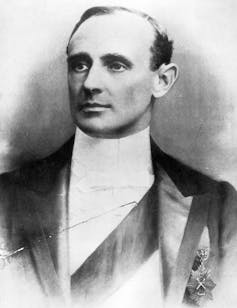
The governor-general of the day, Lord Hopetoun, commissioned William Lyne as the first prime minister of Australia. Hopetoun had only recently arrived in Australia, and as there would be no federal election until March 1901, an interim government needed to be formed in the meantime.

Lyne had recently become premier of New South Wales, the most populous of the colonies. To a newcomer unversed in local politics, making him prime minister seemed like a good idea.
But Lyne had been a longstanding opponent of federation of the colonies and was deeply unpopular with those who had worked for years to bring it about. Leading politicians, such as Edmund Barton, refused to serve in his cabinet.
Lyne returned his commission. The episode has been called the Hopetoun Blunder.
Words defying logic
Gaffes, however, often tend to be more about words than actions.
One of the most memorable to have occurred in the Australian parliament was on October 19 1955. Herbert Vere Evatt was leader of the opposition and had overseen – and helped trigger – a split in the Labor Party.
Entangled in that crisis was the defection the previous year of Soviet spies Vladimir and Evdokia Petrov, and Evatt’s clumsy handling of the matter.
 Herbert Vere Evatt (right) stretched the limits of credulity.
State Library of New South Wales
Herbert Vere Evatt (right) stretched the limits of credulity.
State Library of New South Wales
Early in a speech delivered to the House of Representatives, Evatt reported he had written to the Soviet foreign minister, Vyacheslav Molotov, who had assured him the documents Petrov had taken from the Soviet embassy in Canberra had been forged under the “instructions of persons interested in the deterioration of the Soviet-Australian relations and in discrediting their political opponents”. One of the documents in question implicated Evatt’s staffers in passing information to the Soviets.
It seemed incredible an Australian political leader would write to a Soviet politician in such terms. What did he expect Molotov to say? That the documents delivered by a man who had betrayed the Soviet Union, and which disclosed the existence of Soviet espionage in Australia, were authentic?
Evatt’s speech was greeted with grim faces from those behind him, and raucous laughter from the opposition benches and Labor defectors. One of those who had split from Labor, Stan Keon, wanted to know if the letter had been addressed “Dear Boss”. Another from the government benches interjected “he’s nuts”.
Most so-called gaffes do not have such serious reverberations. They sound silly and reflect poorly on whoever made them, but the political cycle quickly moves on.
In this case, Evatt’s gaffe mattered. It destroyed what remained of his credibility and prompted some to question not only his judgement but also his sanity.
Following a closely fought election in 1954, it provided an opening for Robert Menzies to call an early election in 1955, which he won in a landslide. It paved the way for another 17 years of Coalition rule.
On cakes and recessions
It is hard to think of any gaffe in recent Australian political history that mattered quite as much.
John Hewson undoubtedly committed a gaffe during the 1993 election campaign in a television interview with Mike Willesee, when he was asked how his proposed Goods and Services Tax would apply to a cake.
Hewson’s answer weaved this way and that – in a manner that complicated rather than simplified. He probably would have lost the election anyway, but it didn’t help.
In other instances, a gaffe subsequently acquires importance because it comes to stand for some larger story about the times or the person who committed it.
Paul Keating’s remark at a 1990 media conference announcing the country had entered a recession was accompanied by the memorable remark “this is the recession Australia had to have”.
It looked like a gaffe. It smelt like a gaffe. It clung to Keating as a clumsy attempt by an arrogant politician to absolve himself of responsibility for the sad state of the economy.
Yet, in the eyes of many commentators a few years on, it didn’t look quite so bad.
A recession was inevitable following the boom in asset prices of the 1980s. Almost all developed economies had one in the early 1990s.
An effect of the recession is that it brought inflation down to the levels achieved by countries such as the United States and United Kingdom in the early 1980s, which became the foundation for several decades of high economic performance by Australia.
 Paul Keating’s ‘recession we had to have’ remark is burnt into the collective consciousness.
IMDB/ABC
Paul Keating’s ‘recession we had to have’ remark is burnt into the collective consciousness.
IMDB/ABC
I do not share this rosy view: the recession had catastrophic economic and social effects. But the combination of events is a reminder that what might look like a bad gaffe in one context can look rather different in another.
Keating’s 1986 remark in a radio interview with John Laws that unless the country turned around its balance-of-payments problems, it would become a “banana republic”, also looked like a gaffe.
Prime Minister Bob Hawke was deeply unhappy with what Keating had said, but in retrospect, it provided the government with cover for imposing greater economic discipline on the public.
Labor won the 1987 election that followed, just as Keating’s “recession” gaffe turned out to be a milestone on his way to the prime ministership and victory in 1993.
Symptoms of larger problems
More recently, Scott Morrison’s 2019 “I don’t hold the hose, mate” comment during the Black Summer bushfires merely seemed a bit clumsy, and much less of a big deal than his having taken a holiday in Hawaii when so much of the country was on fire. At worst, it reflected a lack of judgement about the seriousness of the situation back in Australia.
In the years that followed, it came to mean more, becoming for critics emblematic of his prime ministership.
His remark that COVID vaccination was “not a race” acted in tandem with the earlier statement.
Together they seemed to epitomise a complacent leader unwilling to lead. Labor made hay with this material as the 2022 election approached.
The search for gaffes can be a trivialising. As we enter another election season, we can expect the media to spend at least as much time on the hunt for gaffes as they do on policy substance.
Burned in 2022, Albanese will be swotting up on the Reserve Bank cash rate and the present level of unemployment to the second decimal point in preparation for his own Hard Quiz-style ordeal.
He will probably get them right, too. But that will tell us precisely nothing about whether his government deserves a second term and, if it gets one, whether it will make anything of it.
Authors: Frank Bongiorno, Professor of History, ANU College of Arts and Social Sciences, Australian National University
?highlight=WyJob2xpZGF5Il0&media=https://www.modernaustralian.com/https://images.theconversation.com/files/638033/original/file-20241212-17-t36m9g.jpg?ixlib=rb-4.1.0&q=45&auto=format&w=237&fit=clip&description=Australia’s%20political%20history%20is%20full%20of%20gaffes.%20Here%20are%20some%20of%20best%20(or%20worst) "Pin It")

















