

The UN says Australia violated human rights law, but it’s unlikely to change the way we treat refugees
- Written by: Sarah Moulds, Associate Professor in Law, University of South Australia
The United Nations Human Rights Committee has ruled that Australia breached international human rights law by detaining a group of young asylum seekers in immigration detention in Nauru.
The committee found the asylum seekers were subject to prison-like conditions, potentially indefinitely, and without knowing what was going to happen to them in the future. This, the committee found, was in breach of their human rights.
It also found that although the “cruel and degrading” treatment happened in Nauru, Australia was responsible. This was because Australia was in “effective control” of the detention facilities and authorised the transfer and detention of the asylum seekers.
Human rights advocates have been making these points for many years, but they often go unheard by governments of all persuasions. Will this ruling in the UN be any different?
What did Australia do?
This case is connected to Australia’s off-shore detention policies. Under these policies, asylum seekers who try to come to Australia by boat are intercepted and sent to Nauru.
In the case assessed by the committee, a group of 24 asylum seekers from Iraq, Iran, Afghanistan, Pakistan, Sri Lanka and Myanmar were intercepted while trying to reach Australia in 2013. They were aged between 14 and 17 years at the time.
The group were detained in processing facilities in Nauru and experienced serious health problems. These included depression, kidney problems, memory issues and weight loss.
They were also exposed to extreme temperatures, denied privacy and had limited legal rights to have their detention reviewed.
The group tried to challenge their detention under Australian law without success.
Because Australia has signed up to international human rights treaties and protocols, the asylum seekers were able to lodge a complaint with the UN Human Rights Committee.
The committee agreed the conditions in Nauru amounted to “cruel, inhumane or degrading treatment” and “arbitrary detention” in breach of the detainees’ rights under the International Covenant on Civil and Political Rights.
The key legal question for the UN committee was whether Australia was responsible for these rights breaches, even though they took place outside of Australia.
It decided yes, Australia was responsible.
Australia had intercepted the asylum seekers and used Australian law to decide to transfer them to Nauru.
The detention facilities in Nauru were also built and funded by Australia, and Australia had control over service delivery contracts and staffing.

Further, Australia trained Nauruan officials to assess asylum seekers’ claims for refugee status.
This led the committee to find that Australia had “effective control” over the detention facilities in Nauru, and should be held responsible for any human rights breaches that happened there.
It found that countries cannot avoid responsibility under international human rights law by transferring and detaining asylum seekers outside their territory.
The committee has asked the Australian government to provide compensation to the asylum seekers and ensure similar violations do not recur. The government is yet to respond.
What does this mean for the world?
This decision will sound a warning for any country wanting to copy Australia’s offshore processing policies to deal with irregular migration.
The decision also makes clear that countries that have signed up to human rights treaties cannot outsource their responsibilities by sending asylum seekers to other places.
This is in line with existing international law principles that say countries owe protection to anyone within their “power or effective control”, even if they are not within the country’s territory.
The UN committee has also said the enjoyment of human rights is not limited to citizens of countries that have signed the treaty. They must be available to all people, including asylum seekers and refugees, who may find themselves subject to the power and control of a country.
As UN Human Rights Committee member Mahjoub El Haib said:
the outsourcing of operations does not absolve states of accountability. Offshore detention facilities are not human-rights free zones for the state party, which remains bound by the provisions of the covenant.
Will anything change in Australia?
The UN Human Rights Council’s complaints procedure was set up to address violations of human rights and fundamental freedoms occurring in any part of the world.
However, its decisions are not enforceable in the same way that decisions of courts or tribunals are. The government cannot be forced to change its immigration laws or pay compensation to the asylum seekers.
But this doesn’t mean the decision has no impact.
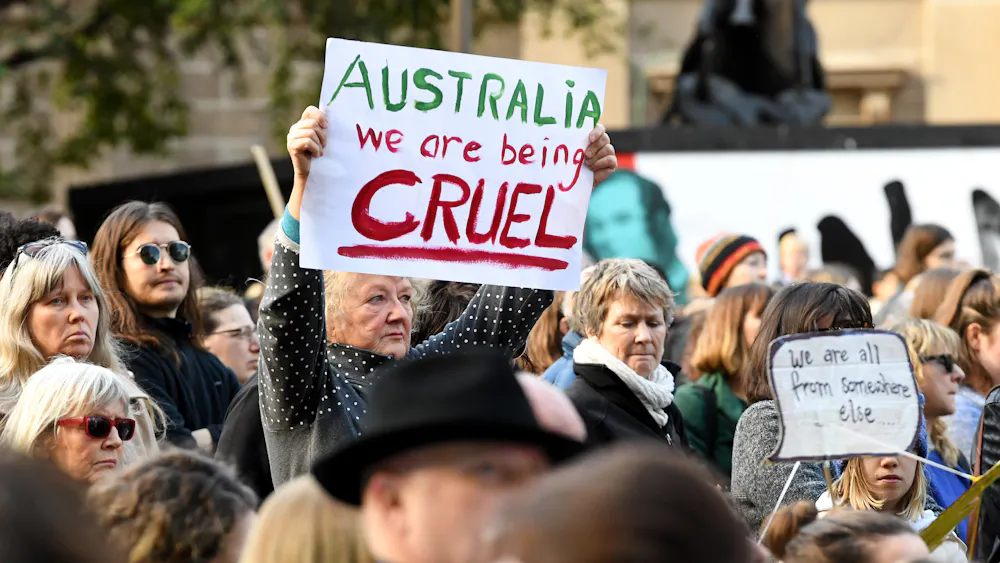 Human rights advocates have long opposed Australia’s offshore processing policies.
James Ross/AAP
Human rights advocates have long opposed Australia’s offshore processing policies.
James Ross/AAP
As a member of the UN, and a country that relies on other features of the UN treaty system, Australia has plenty of political, economic and security reasons to maintain its status as a “good international citizen”.
By signing on to these treaties, Australia has made a commitment to treat people humanely and with dignity. It’s hard to reconcile this with the conditions of detention described in this ruling.
Decisions in the UN can also be used by Australian courts when interpreting and applying Australian laws, although the findings of UN bodies cannot replace the laws made by Australian parliaments.
There have been cases of compensation being awarded to asylum seekers harmed on Nauru where a legal duty of care was found to be owed. This may prompt calls for policy or law reform in this area.
However, Australia’s migration laws have also recently been amended to remove any civil liability for harm caused to those detained in immigration detention.
In other words, detainees can’t sue the government for any harm they endure.
This is compounded by the sensitive political climate surrounding any changes to immigration policy in Australia.
Combined, this poses challenges for lawyers and advocates hoping for new rights or remedies for asylum seekers detained offshore. And, indeed, for anyone wanting to see Australia’s laws and polices align with fundamental human rights principles.
Authors: Sarah Moulds, Associate Professor in Law, University of South Australia


















