

Israel and Hamas have agreed to a ceasefire. It doesn’t guarantee a peaceful end to a devastating war
- Written by Marika Sosnowski, Postdoctoral research fellow, The University of Melbourne
After 467 days of violence, a ceasefire agreement between Hamas and Israel has been reached and will come into effect on Sunday, pending Israeli government approval.
This agreement will not end the war or bring about peace. Ceasefires are not a panacea for the war, trauma, displacement, hunger and death Israelis and Palestinians have borne before and since October 7, and will no doubt continue to bear, long after.
While this is not the end of the story, this ceasefire does mark the start of a new chapter for Palestinians, particularly those in Gaza, and Israelis.
What do we know about the deal?
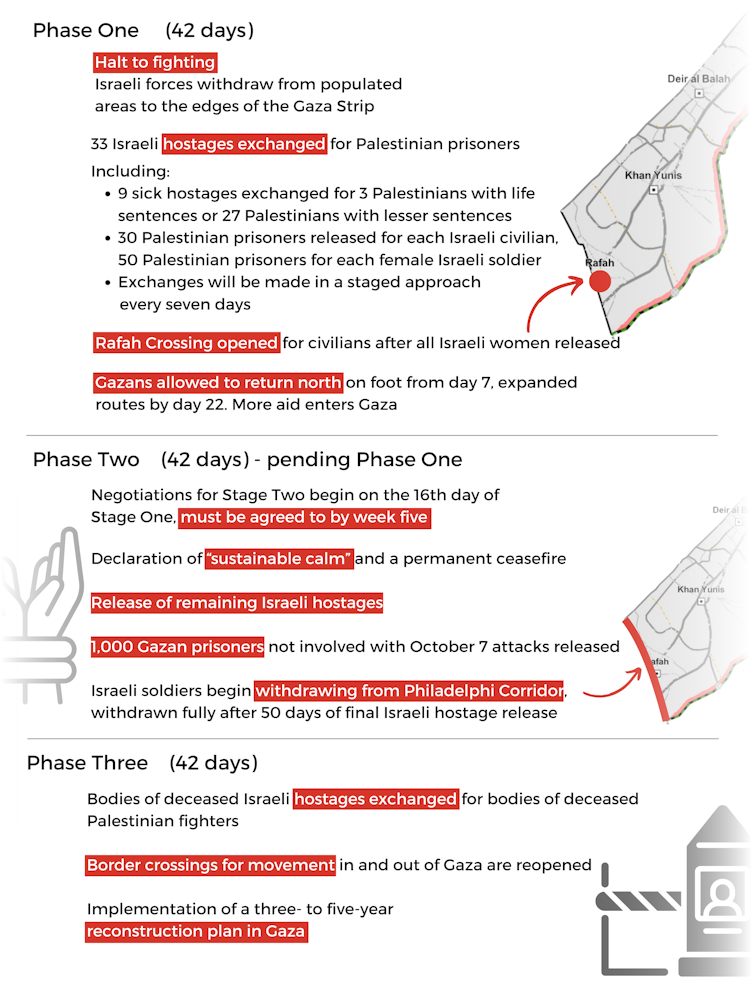
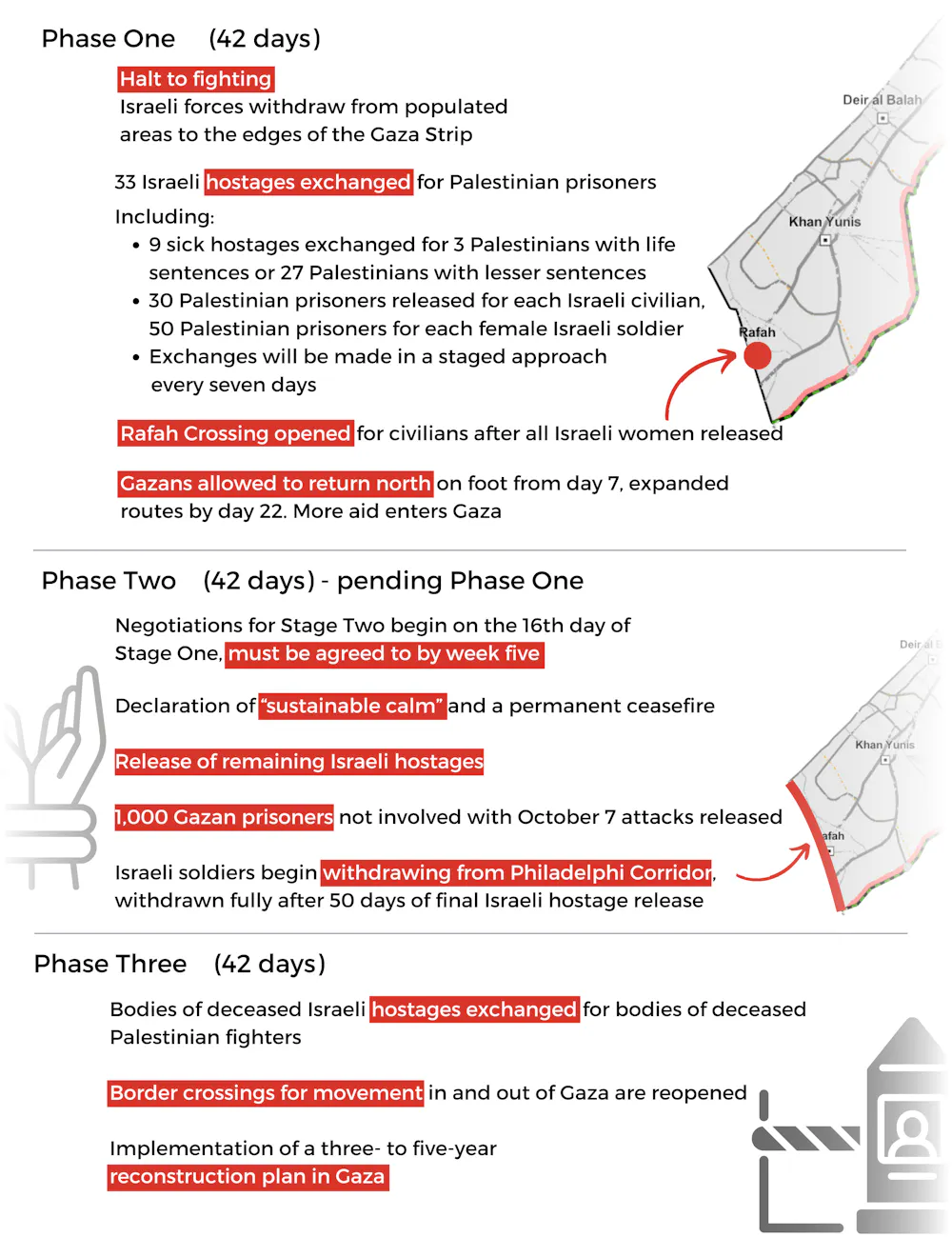
The terms of this ceasefire, at least for the first phase, are detailed, setting the stage for its effective implementation.
In structure and content, this ceasefire closely resembles numerous others that have been proposed over the past year, including the 7+2 day truce agreed in November 2023.
Unlike that truce, however, this agreement is envisaged to last longer, having three distinct phases, each lasting 42 days (6 weeks).
As US President Joe Biden said, this agreement “is the exact framework of the deal I proposed in May”.
During the first phase, there will be a temporary suspension of military operations by Israel and Hamas, as well as the withdrawal of Israeli forces east towards the border between Israel and Gaza and away from densely populated areas.
There will also be a temporary suspension of air activity (for military and reconnaissance purposes) in the Gaza Strip, particularly when hostages are released.
This happened during the November 2023 truce too, offering Palestinians much-needed respite from bombardment as well as assurances to Hamas that Israel is not using drones to surveil and intuit how many hostages it might still hold, where it is keeping hostages, and how and where it is moving them to.
Also, from the first day the agreement comes into effect, large quantities of humanitarian aid, relief materials and fuel will be allowed to enter Gaza.
The fuel is necessary for the operation of Gaza’s power plant and sanitation systems, and for heavy machinery to clear and remove rubble.
This will begin the long task of rebuilding the strip’s decimated infrastructure, including hospitals, clinics and bakeries (the main food source for Gazans).
A type of ‘strangle contract’
Arguably, the power dynamics between Israel and Hamas when this agreement was negotiated were highly asymmetrical. Over the past 15 months, Israel has shown it has far superior military strength to Hamas.
Also, until now, Israel was arguably largely prepared to ignore the one political card Hamas held: the release of the hostages the group took on October 7.
As such, the terms of the agreement can potentially be seen as a type of strangle contract that one party, (in this case Israel) has forced on the other because of the immense power imbalance.
Over the past 12 months, Hamas has agreed to the text of a ceasefire a number of times only to have the terms altered by Israel and no agreement reached.
Hamas has tried to alter the ceasefire’s terms too.
But because of the power differential, it has been relatively unsuccessful in pressuring Israel to agree to its demands.
To reach a deal, Hamas has forsaken its two main demands: full withdrawal of Israeli troops from the Gaza Strip and a permanent ceasefire.
This agreement has three phases. In the first phase, Israel will potentially release thousands of Palestinian prisoners in exchange for 33 hostages. Fewer than 60 hostages are thought to be left alive.
But it is telling that in the past, Israel has simply arrested other Palestinians or re-arrested many of those released under similar deals.
These type of strangle contracts happened during the Syrian civil war too. There, they were branded as reconciliation agreements.
These were effectively ceasefire agreements forced on rebel-held communities by the Assad regime and Russia after they had besieged, bombarded and starved them, sometimes for many years. The asymmetrical power relations of the parties to these agreements left communities with little to no bargaining power regarding their terms and implementation.
What we don’t know
On the 16th day after the agreement comes into force, indirect negotiations between the two sides will begin regarding the next phase of the agreement. This new phase is envisaged to include the release of more hostages and prisoners and the continuation of the ceasefire.
However, there are currently no written assurances the ceasefire will continue beyond the first phase if there is no agreement reached for the second phase.
For similar deals that were previously on the table, Israeli Prime Minister Benjamin Netanyahu made clear he would continue the war to destroy Hamas after the initial phase.
 Israeli Prime Minister Benjamin Netanyahu has previously not wanted to cease fighting completely.
MAYA ALLERUZZO / POOL/EPA
Israeli Prime Minister Benjamin Netanyahu has previously not wanted to cease fighting completely.
MAYA ALLERUZZO / POOL/EPA
Further, the ceasefire agreement specifies that Israeli troops will withdraw east towards the border between Gaza and Israel. One of Hamas’s original demands for a ceasefire with Israel was that Israeli troops withdraw from Gaza completely.
While it has since jettisoned that requirement, the ceasefire terms suggest that Israeli forces will remain in a buffer zone along the border more permanently. They may potentially also stay longer in the Philadelphi Corridor and along the Netzarim Axis.
In a territory only 40 kilometres long and between five and 13 kilometres wide, any continuing Israeli military presence on this Palestinian land means it cannot be used for civilian life, including for homes or farmland. This makes an already densely populated Gaza Strip even more so, as well as negating the rights of Palestinian land holders in these areas.
We also do not know how this ceasefire will affect Israel’s calculus in the West Bank, or in Lebanon and its fragile ceasefire with Hezbollah. In Lebanon, attacks continue to happen daily with both sides accusing each other of violating the agreement. The first phase of that ceasefire agreement, lasting 60 days, is scheduled to end on 26 January 2025.
What comes next?
While ceasefires are not technically legally binding, they can perhaps best be thought of as a type of contract between warring parties.
This ceasefire, at least for the first phase, has detailed terms, including maps, that the parties have taken time (some would say too much time) to agree on.
This makes the agreement more likely to be implemented as both sides can more easily be held to what they have agreed by external parties, including the ceasefire’s guarantors, Qatar, Egypt and the US.
Vaguer terms, like those we have seen in the ceasefire between Israel and Hezbollah in Lebanon, the 2016 Cessation of Hostilities in Syria or with the Taliban in Pakistan give the parties more room to manoeuvre and potentially the ability to blame the other side for violating the agreement.
The war between Hamas and Israel is of course not over. This ceasefire simply marks the start of a new phase.
It’s a welcome relief and the least-worst option humans have so far devised to stop the violence of war for a period of time.
But with more than 1,000 Israelis and 46,000 Palestinians dead, many more homeless, the Gaza Strip decimated and potentially millions with some sort of trauma, even if there is a halt in the violence, this is certainly not peace.
Palestinians and Israelis, if not the world, will be living with the implications of the past 467 days for many years to come.
Authors: Marika Sosnowski, Postdoctoral research fellow, The University of Melbourne

















