

Growth pains and gridlock come to Hobart, and building more roads is not the best way out
- Written by: Emma Pharo, Senior Lecturer, Geography and Environmental Studies, University of Tasmania
Hobart is a city with growing pains. As Australia’s second-oldest city, it might be likened to an octogenarian suddenly experiencing a teenage “growth spurt”. Growth is occurring both in visitor numbers and new residents.
The March 3 state election has drawn attention to several growth-related issues, including housing affordability, rental vacancies and traffic congestion. These issues are not new for many Australian cities, or indeed for cities globally. But in Hobart they are almost as surprising as the city’s midwinter 2017 nude swim.
 The 2017 Dark Mofo nude swim attracted a record number of participants.
Dark Mofo
The 2017 Dark Mofo nude swim attracted a record number of participants.
Dark Mofo
A highly car-dependent city
While Hobart is perceived as a walkable city, it is among Australia’s most car-dependent. A 2010 survey of Hobart’s households showed that 89% of people’s travel was as a car driver or passenger.
For some Hobart residents, being able to drive anywhere is seen as a right. This attitude was neatly summed up in a Metro Tasmania survey where one respondent said:
Tasmanians would drive to the toilet if they could.
But the increase in Hobart’s traffic over the past few years is no joke. The city’s morning and afternoon peak hours increasingly dominate the local news. It’s now anyone’s guess how long the once eight-minute cross-town trip might take.
Residents are concerned not just about inconvenience or lost productivity. Hobart’s outlying low-density suburbs are poorly serviced by public transport. They are predominantly home to residents who are highly dependent upon their cars for work, trips for healthcare, social activities and recreation. For residents living in some of the most comparatively disadvantaged suburbs in the nation, this situation is highly inequitable.
Poor land use planning partly to blame
While Hobart’s growth can’t compare with Melbourne or Sydney, the city has a long history of concerns about traffic. This congestion is partly attributable to its urban form and partly to poor planning.
The central business district, where most jobs are located, occupies a narrow area of land wedged between steep terrain and the Derwent River. Only a few main roads carry daily commuter traffic. If one becomes blocked by, for example, a crash, this can cause traffic jams that extend to the outlying suburbs.
Second, the city sprawls outwards in corridors along the Derwent River and towards the international airport. Post-war suburban development is highly car-dependent; the city’s last passenger rail line was closed in 1978.
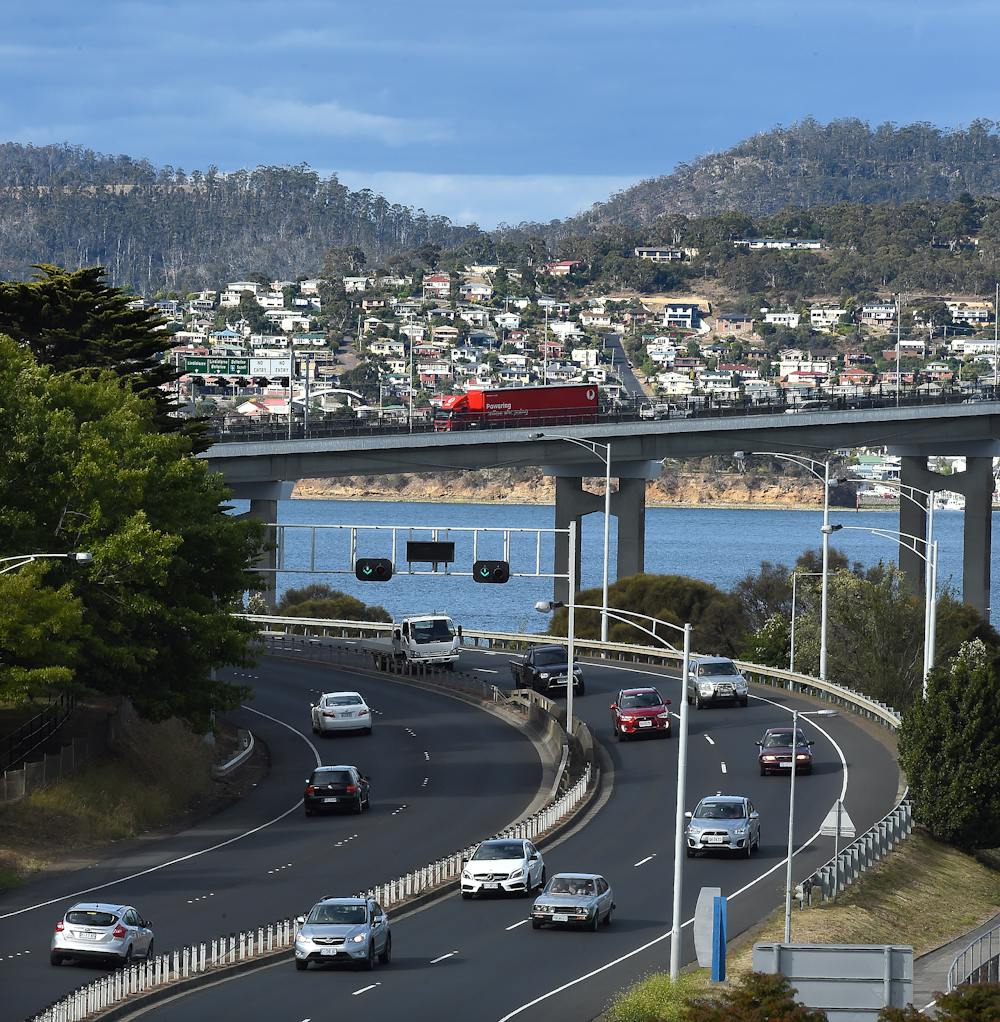 Just a few years ago, drivers could get around the city in minutes. Now it’s anyone’s guess how long the trip might take.
Dave Hunt/AAP
Just a few years ago, drivers could get around the city in minutes. Now it’s anyone’s guess how long the trip might take.
Dave Hunt/AAP
Transport has become a hot-button issue for ordinary residents and politicians alike in this state election campaign. But planning responses thus far have been piecemeal and superficial, such as moving a few car parks and synchronising traffic lights.
Some election promises are “throwbacks” to the road-building ideology of the 1950s. More lanes ultimately lead to more congestion. International experiences from cities like Los Angeles show that adding more lanes to roads only creates congestion.
Other proposals accord with modern city planning and represent quite a radical step up in transport planning for Hobart.
Read more: Sidelining planners makes for poorer urban policy, and future generations will pay the price
Key steps to fix the transport system
Solutions to fix Hobart’s transport problems are necessarily medium to long term. To succeed, these should follow several transport planning principles:
Prioritise the movement of people. This means removing private car parking in favour of pedestrian malls and reusing some road lanes as dedicated bus lanes. Reducing the width of some road lanes can also accommodate more pedestrians and cyclists.
Integrate transport and land use planning. This means creating new suburban and infill housing near existing public transit services. Planning schemes should allow medium density and mixed use development in appropriate places, to encourage walking and transit use. It should be possible to use public transport to make daily trips for education, shopping, entertainment, healthcare and the like.
Price road space appropriately. This might occur by adopting Victoria’s SmartRoads system. SmartRoads manages competing interests for limited road space by deciding which modes have priority on which roads. It recognises the increasing importance of public transport, walking and cycling. Congestion pricing in London, Stockholm and Singapore follows this principle.
Create a multi–mode public transport system. Light rail, buses and ferries should all play a role in moving people around Hobart. The ticketing system should be integrated and allow free transfers between modes.
Reduce the demand. Some employment functions could be moved out of the CBD to suburban sites. And road users might be able to stagger use, by starting work at different times, choosing different routes and car-pooling.
To fix Hobart’s traffic congestion woes these proven principles need to be followed. Reasons for doing this include reducing carbon emissions, health imperatives and economic efficiency.
With five major councils in the Greater Hobart area and a Southern Tasmanian Councils Authority that has no funding or staff, the state government needs to step in and co-ordinate a range of actions. There is no better time to start than with a freshly elected government on March 4.
Authors: Emma Pharo, Senior Lecturer, Geography and Environmental Studies, University of Tasmania


















