

5 years after COVID began, outstanding fines mean marginalised Australians are still paying the highest price
- Written by: Shelley J. Walker, Postdoctoral Research Fellow in Justice Health, National Drug Research Institute, Curtin University
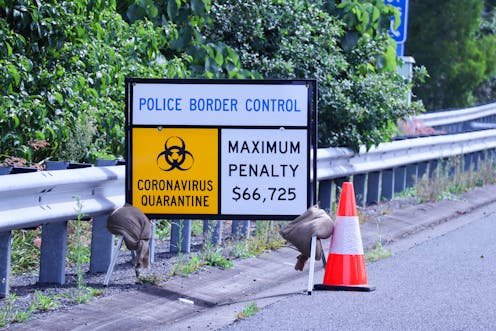
January 25 marked five years since the first COVID case was recorded in Australia.
Many of us have tried to move on quickly from the pandemic, putting lockdowns and restrictions far behind us.
But for some Australians, this hasn’t been possible. Among the pandemic’s lingering impacts is the burden of outstanding fines, issued for breaking COVID restrictions.
These often hit disadvantaged groups the hardest, who were more likely to be fined and less able to pay. Five years down the track, marginalised communities are still feeling the impact of these penalties.
Our new research involved surveys and in-depth interviews with people who used drugs during the pandemic. They reported feeling targeted by police and even harassed while trying to access drug treatments – and years later, many still have fines they’re unable to pay.
Thousands of unpaid fines
During the pandemic, police issued millions of dollars’ worth of fines to people who broke restrictions. More than 50,000 fines were issued in Victoria and around 62,000 in New South Wales .
Fines ranged from A$200 for not wearing a face mask to nearly $5,000 for breaking rules about gatherings.
Fines were a public health measure aimed at stopping the virus spreading.
But for some people already struggling with financial and social problems, including those who use drugs, it compounded their difficulties.
Studies have found some groups were fined much more often than others, including people from Sudanese and South Sudanese backgrounds, Aboriginal people and children experiencing disadvantage.
While they were intended as public health measures, the fines reveal deeper patterns about targeted policing.
Following calls by community legal services and human rights groups and updated legal advice, the NSW government withdrew all outstanding COVID fines at the end of 2024.
This is not the case in Victoria. In June 2023, around 30,000 fines were outstanding in Victoria, and to our knowledge the situation hasn’t changed since then.
Feeling targeted
We know that people who use drugs already face increased police scrutiny in general, due to the criminalisation of drug use.
We conduct two long-term studies with people who use drugs in Victoria, which involves participating in an annual survey.
During the pandemic we asked additional questions about people’s interactions with police. Between March 2020 and May 2022, 1,130 participants responded to our survey.
Our new research found one in ten reported being stopped by police.
A third of these received at least one COVID-related fine – mostly for breaking curfews, failing to wear a face mask or breaching travel restrictions – a rate we calculated as nearly three times higher than the general population.
However, this is a crude estimate, as accurate data on the numbers of fines in the general population is not publicly available.
Of those who received fines, most were unemployed, more than a quarter were in unstable housing or homeless, and more than half had been to prison.
We also did in-depth interviews with 76 participants. Many told us they felt the pandemic gave police an “excuse” to target them, leading to serious and lasting effects on their lives.
Fined while accessing services
Interactions with police were described as fraught with discrimination and harassment. Participants reported being stopped, searched and fined while trying to go about their daily lives. This may be partly because their circumstances meant they were more likely to be using public spaces – and therefore were more visible to police.
Daniel, aged 41, was fined $1,652 for breaching COVID rules he told us he didn’t understand. He said:
it was so obvious they were looking for drugs – it felt like they were doing everything they could to find a reason to fine us.
For people who use drugs, accessing harm-reduction services and drug treatment programs (such as methadone to replace opioids) is vital to their health. Some participants told us they were fined while doing so, despite carrying medical exemptions.
Natasha, aged 39, was homeless. She said she was fined while travelling to a needle and syringe program, despite being within the permitted travel zone.
Police issued her a fine for leaving the home for non-essential purposes. Natasha found the situation absurd, asking “how can you be (fined for being) outside if you sleep outside?”
Ryan, aged 45, was fined $1,800 while collecting methadone. He described the encounter as “humiliating” and unnecessary, saying police appeared more interested in finding drugs than enforcing public health measures.
The financial and emotional toll
In our study, the financial burden of COVID fines was devastating.
Most could not afford to pay fines or lacked the confidence to navigate appeals processes to contest them, leading to further entanglement with the criminal legal system.
For example, Sally, who received multiple fines while collecting her methadone during the pandemic, said:
at the end of the day, they’re government authority and I’m a nobody – the chances of me winning would be slim to none.
As a result, unpaid fines for some reportedly led to court orders, some were arrested, and a few even reported serving prison time.
The emotional toll was equally severe, with feelings of being targeted and harassed by police further eroding their trust in public institutions.
The Conversation contacted Victoria Police about our study, noting participants thought police were using the pandemic as an excuse to target them.
In response, a police spokesperson said: “At the time officers were performing duties on behalf of the Chief Health Officer’s direction.”
The burden can be lifted
Public health responses should be designed to protect people, not punish them. As we move forward, it is crucial to address the lasting impacts of COVID fines.
All Australian governments should follow the lead of NSW and waive all remaining fines to alleviate the financial and emotional burden on vulnerable populations.
*Names have been changed.
Authors: Shelley J. Walker, Postdoctoral Research Fellow in Justice Health, National Drug Research Institute, Curtin University


















