

Yes, energy prices are hurting the food sector. But burning more fossil fuels is not the answer
- Written by: Vivienne Reiner, PhD Candidate, Integrated Sustainability Analysis group, University of Sydney
Months out from a federal election, the industry lobby is gearing up in opposition to the Albanese government’s renewable energy targets. In a salvo on Monday, food distributors urged the government to increase fossil fuel production, as a way to purportedly tackle high energy prices.
It was followed by comments on Tuesday by the Australian Chamber of Commerce and Industry, which also called for fast-tracking of gas expansion to avoid price spikes and blackouts.
Unfortunately, however, these approaches miss the point. They are a short-sighted response to what is, in large part, a climate-induced problem.
In fact, evidence suggests burning more coal and gas will only make things worse for many industries, including the food sector.
More fossil fuels = more industry disruption
The industry group Independent Food Distributors Australia claims Labor’s energy policies are driving up costs for businesses and, in turn, consumers.
In comments published in The Australian, the group’s chief executive Richard Forbes said the phase-out of coal-fired energy was too fast and the government’s renewable energy target was too ambitious. The newspaper claimed business owners instead want Labor to support new gas plants and support upgrades to existing coal plants.
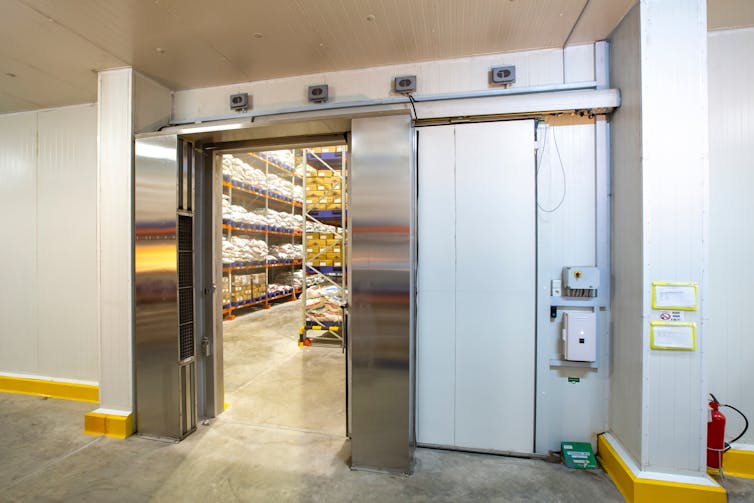
The group represents food manufacturers, suppliers and distributors supporting the food service industry. Its members largely comprise food distribution warehouses operating large refrigerators and freezers.
First, it’s important to ask whether a focus on renewable energy can be blamed for Australia’s high energy prices. The answer is largely no.
That aside, would expanding fossil fuel production ultimately be a boon to food distributors? Evidence suggests it would not.
A study published in 2022, led by my colleagues at the University of Sydney, found that almost one-fifth of total emissions from global food systems were produced by transport and supporting services, such as distribution warehouses. This was equivalent to about 6% of the world’s greenhouse gas emissions.
Of course, greenhouse gas emissions are warming the climate and leading to worse and more frequent natural disasters. And, as another University of Sydney study showed, these disasters have extensive repercussions for the food industry.
It found the disruptions would be hardest felt by the fruit, vegetable and livestock sectors, however effects flowed to other sectors such as transport services. Overall, people in rural areas and those from a low-socioeconomic background were most vulnerable, both to food and nutrition impacts, as well as losses in employment and income.
What’s more, research I led into the economic impact of Australia’s 2019–20 bushfires also reveals the vulnerability of the food ecosystem. The 2024 study, which focused on tourism, found employment and income losses were greatest in the hospitality and transport sectors respectively. Restaurants, cafes and accommodation providers were disproportionately hit by job losses resulting from reduced consumption, including less food being consumed out of home.
So what does all this mean? Clearly, expanding polluting energy generation to reduce food distribution costs in the short term will not, ultimately, secure the sector’s future.
Making food distribution more sustainable
Having said all this, Australia’s high energy prices are undoubtedly a stress point for many Australian businesses. So how can the food sector tackle the problem?
Energy requirements (and therefore costs and emissions) differ according to the type of food. Fruits and vegetables, for example, are likely to require a temperature-controlled environment. This generates about double the emissions produced by growing the crops themselves.
Growing and distributing crops that can be transported at ambient temperatures would reduce energy use. This is particularly important given refrigeration needs are likely to increase as the planet warms.
In terms of broader food movements, 94% of domestic transport happens by road. So, there is a strong case for investing in electric trucks to help guard against energy price hikes.
The weight of food freight has also been correlated with energy use. Cereals – along with fruit and vegetables, flour and sugar beet/cane – are among the food types transported at high tonnages.
As my colleagues have noted, there are huge energy savings to be gained if the global population ate more locally produced food, and if food businesses used cleaner production and distribution methods, such as natural refrigerants.
Looking ahead
Global food systems are crucial to human wellbeing. It’s in everyone’s interests to keep them functioning well and protected from climate-fuelled hazards.
The choices now facing the food-distribution sector represent one of many tradeoffs Australia must make during its transition to a low-carbon future.
Will we continue the polluting, business-as-usual approach or will we embrace Australia’s natural advantages in renewable energy, and protect the planet that supports us?
When it comes to food distribution, will Australia expand gas and coal production as a purported answer to lower energy costs in the short term – or will we move swiftly to decarbonise the sector and buy more local, sustainable food?
Authors: Vivienne Reiner, PhD Candidate, Integrated Sustainability Analysis group, University of Sydney


















