

education divide explains the Coalition's upset victory
- Written by: Adrian Beaumont, Honorary Associate, School of Mathematics and Statistics, University of Melbourne
At the May 18 election, the size of the lower house was expanded from 150 to 151 seats. The Coalition parties won 77 seats (up one since the 2016 election), Labor 68 (down one) and the crossbench six (up one). The Coalition government holds a three-seat majority.
Owing to redistributions and the loss of Wentworth to independent Kerryn Phelps at an October 2018 byelection, the Coalition notionally had 73 seats before the election, a one-seat advantage over Labor. Using this measure, the Coalition gained a net four seats in the election.
The Coalition gained the Queensland seats of Herbert and Longman, the Tasmanian seats of Braddon and Bass, and the New South Wales seat of Lindsay. Labor’s only offsetting gain was the NSW seat of Gilmore. Corangamite and Dunkley are not counted as Labor gains as they were redistributed into notional Labor seats.
Four of the six pre-election crossbenchers easily held their seats – Adam Bandt (Melbourne), Andrew Wilkie (Clark), Rebekha Sharkie (Mayo) and Bob Katter (Kennedy). The Liberals narrowly regained Wentworth from Phelps, but independent Zali Steggall thrashed Tony Abbott 57%-43% in Warringah. In Indi, independent Helen Haines succeeded retiring independent Cathy McGowan, defeating the Liberals by 51.4%-48.6%.
Read more: Scott Morrison hails 'miracle' as Coalition snatches unexpected victory
The Coalition easily defeated independent challengers in Cowper and Farrer.
While Bandt was re-elected, the Greens went backwards in their other inner-Melbourne target seats of Wills and Cooper. Only in Kooyong did the Greens manage to beat Labor into second.
The final primary votes were 41.4% Coalition (down 0.6%), 33.3% Labor (down 1.4%), 10.4% Greens (up 0.2%), 3.4% United Australia Party (UAP) and 3.1% One Nation (up 1.8%).
The final two-party vote was 51.5% for the Coalition to 48.5% for Labor, a 1.2% swing in the Coalition’s favour from the 2016 election. It is the first pro-government swing since the 2004 election.
It was expected the Coalition would do better once the 15 “non-classic” seats were included; these are seats where the final two candidates were not Coalition and Labor. However, 11 of these seats swung to Labor, including a 9.0% swing in Warringah and a 7.9% swing in Wentworth. Eight non-classics were inner-city electorates that tended to swing to Labor.
The table below shows the number of seats in each state and territory, the Coalition’s number of seats, the Coalition’s percentage of seats, the gains for the Coalition compared to the redistribution, the Coalition’s two-party vote, the swing to the Coalition in two-party terms, and the number of Labor seats.
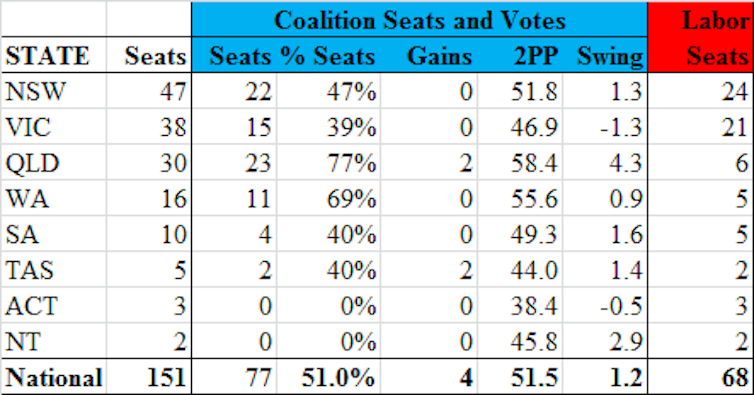 Final seats won and votes cast in the House for each state and nationally.
Four of the six states recorded swings to the Coalition in the range from 0.9% to 1.6%. Victoria was the only state that swung to Labor, by 1.3%. Queensland had a 4.3% swing to the Coalition, far larger than any other state. Labor did well to win a majority of NSW seats despite losing the two-party vote convincingly.
Official turnout in the election was 91.9%, up 0.9% from 2016. Analyst Ben Raue says 96.8% of eligible voters were enrolled, the highest ever. That means effective turnout was 89.0% of the population, up 2.6%.
Education divide explains Coalition’s win
Not only did Steggall thump Abbott in Warringah, the electorate’s 9.0% swing to Labor on a two-party basis was the largest swing to Labor in the country. Abbott’s two-party vote percentage of 52.1% was by far the lowest for a conservative candidate against Labor since Warringah’s creation in 1922; the next lowest was 59.5% in 2007.
While Abbott did badly, other divisive Coalition MPs performed well. Barnaby Joyce won 54.8% of the primary vote in New England and gained a 1.2% two-party swing against Labor. Peter Dutton had a 3.0% two-party swing to him in Dickson, and George Christensen had a massive 11.2% two-party swing to him in Dawson, the second-largest for the Coalition nationally.
According to the 2016 census, 42% of those aged 16 and over in Warringah had at least a bachelor’s degree, compared with 22% in Australia overall. Just 13.5% had at least a bachelor’s degree in New England, 19% in Dickson and 12% in Dawson.
In Victoria, which swung to Labor, 24.3% of the population had at least a bachelor’s degree in 2016, the highest of any state in the nation.
The Grattan Institute has charted swings to Labor and the Coalition, taking into account wealth and tertiary education. Only polling booths in the top-income quintile swung to Labor; the other four income quintiles swung to the Coalition.
Areas with low levels of tertiary education swung strongly to the Coalition in NSW and Queensland, but less so in Victoria. There were solid swings to Labor in areas with high levels of tertiary education.
Some of the swings are explained by contrary swings in 2016, when the Coalition under Malcolm Turnbull performed relatively worse in lower-educated areas and better in higher-educated areas. However, Queensland’s 58.4% two-party vote for the Coalition was 1.4% better than at the 2013 election, even though the national result is 2.0% worse. The large swings to the Coalition in regional Queensland are probably partly due to the Adani coal mine issue.
Morrison’s appeal to lower-educated voters
Since becoming prime minister, Scott Morrison’s Newspoll ratings have been roughly neutral, with about as many people saying they are satisfied with him as those dissatisfied. After Morrison became leader, I suggested on my personal website that the Coalition would struggle with educated voters, and this occurred in the election. However, Morrison’s appeal to those with a lower level of education more than compensated.
In my opinion, the most important reason for the Coalition’s upset victory was that Morrison was both liked and trusted by lower-educated voters, while they neither liked nor trusted Labor leader Bill Shorten.
Earlier this month, The Guardian published a long report on the social media “death tax” scare campaign. While this and other Coalition scare campaigns may have had an impact on the result, they did so by playing into lower-educated voters’ distrust of Shorten. Had these voters trusted Shorten, such scare campaigns would have had less influence.
Read more: Labor's election loss was not a surprise if you take historical trends into account
Labor also ran scare campaign ads attacking Morrison for deals with Clive Palmer and Pauline Hanson. But I believe these ads failed to resonate because lower-educated voters liked Morrison better.
I think Morrison won support from the lower-educated because they are sceptical of “inner-city elites”. The Coalition leader emphasised his non-elite attributes during the campaign, such as by playing sport and going to church. Turnbull was perceived as a member of the elite, which could explain swings to Labor in lower-educated areas in 2016.
Parallels can be drawn to the 2017 election in the UK. Labour performed far better than expected in the election, reducing the Conservatives to a minority government when they were expected to win easily. Labour had adopted a pro-Brexit position, which may have sent a message to lower-educated voters that they could support the party.
This offers an option for Australian Labor to try to win back support from lower-educated voters: adopt a hardline immigration policy. Votes that Labor would lose to the Greens by doing this would likely be returned as preferences.
See also my similar article on how Donald Trump won the US 2016 presidential election.
The problem with the polls
The table below shows all national polls released in the final week compared to the election result. A poll estimate within 1% of the actual result is in bold.
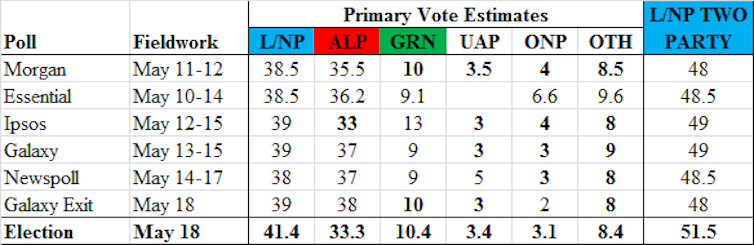 Federal polls compared with election results, 2019.
Author provided
Federal polls compared with election results, 2019.
Author provided
The polls did well on the One Nation and UAP votes, and were a little low on the Greens. The major source of error was that Labor’s vote was overstated and the Coalition’s was understated. Only Ipsos had Labor’s vote right, but it overstated the Greens vote by about three points – a common occurrence for Ipsos.
No poll since July 2018 had given the Coalition a primary vote of at least 40%. In the election, the Coalition parties received 41.4% of the vote.
As I said in my post-election write-up, it is likely that polls oversampled educated voters.
Read more: Coalition wins election but Abbott loses Warringah, plus how the polls got it so wrong
Seat polls during the campaign were almost all from YouGov Galaxy, which conducts Newspoll. The Poll Bludger says these polls were, like the national polls, biased against the Coalition.
Analyst Peter Brent has calculated the two-party vote for all election-day and early votes. The gap between election day and early votes increased to 5.0% in 2019 from 4.6% in 2016. This does not imply that polls missed because of a dramatic late swing to the Coalition in the final days; it is much more likely the polls have been wrong for a long time.
Boris Johnson very likely to be Britain’s next PM, and left wins Danish election
I wrote for The Poll Bludger on June 14 that, after winning the support of 114 of the 313 Conservative MPs in the first round of voting, Boris Johnson is virtually assured of becoming the next British PM. Polls suggest he will boost the Conservative vote.
I also wrote on my personal website on June 6 about the left’s win in the Danish election. Also covered: a new Israeli election, the German Greens’ surge, and the left gaining a seat in the May 4 Tasmanian upper house periodical elections.
Authors: Adrian Beaumont, Honorary Associate, School of Mathematics and Statistics, University of Melbourne

















