

A fierce tussle over a Northern Territory river reveals Australia’s stark choice on water justice
- Written by: Quentin Grafton, Australian Laureate Professor of Economics, Crawford School of Public Policy, Australian National University
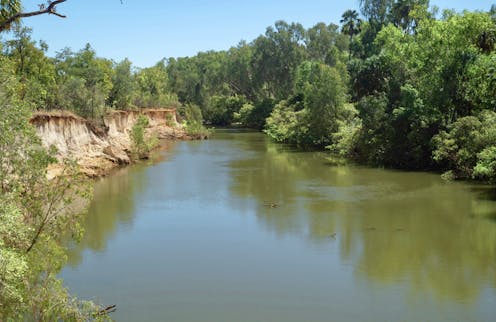
Water is now a contested resource around the world. Nowhere is this more evident than in the fight playing out over the Northern Territory’s Roper River – one of the last free-flowing rivers in Australia, nurtured by the enduring presence of First Nations custodians.
The territory government recently doubled water extraction allowances from the aquifer that feeds the Roper River, making billions of litres available to irrigators, for free. The change risks permanent damage not just to the river but to world-famous springs and sacred sites fundamentally important to Traditional Owners.
Australia has a very poor track record on maintaining healthy river systems, and on respecting First Nations rights to access and use water.
The Roper River represents a chance to change course on decades of water policy failure. It also shows we must transform how Australia’s water is valued, who uses it, and who decides how vital rivers should be managed.
What’s happening on the Roper River?
The Roper River runs east for 400 kilometres from the Katherine region to the Gulf of Carpentaria.
First Nations people comprise 73% of the population in the Roper River area. Amid socioeconomic challenges, Country sustains them as it has done for 65,000 years. It is integral to maintaining cultural knowledge, as well as ceremonial practices, environmental care and traditional food systems. Traditional Owners’ rights are recognised through Aboriginal freehold land and native title across the area.
Irrigated crops including melons, mangoes and cotton are grown over a small part of the river catchment.
In a string of recent decisions – mainly the designation of regional “water allocation plans” – the territory government has vastly increased potential extraction from underground aquifers. This could allow agriculture and other industries to expand.
The Mataranka plan, which applies to the Roper River, now allows irrigators to double the amount of water extracted from an underground aquifer crucial to the river’s dry-season flows. These new extraction amounts would fill 25,000 Olympic swimming pools a year. The groundwater also feeds thermal springs at Mataranka – a sacred site and tourism drawcard.
The decision came despite staunch opposition from Traditional Owners. As Northern Land Council chair Matthew Ryan told SBS:
Both the previous and the current NT Government have ignored the voices of Traditional Owners, who have repeatedly said that the health and viability of the Roper River and the springs at Mataranka are at great risk.
Water is life. It is our most valuable resource and Traditional Owners have an obligation to take care of the land and areas of cultural significance.
The Baaka: a sad story of degradation
Sadly, this story is not new to Australia. We need only look to the Baaka (Lower Darling River) in New South Wales as a cautionary tale.
More than a century of water extraction has left the river and its wetlands degraded. This was demonstrated in 2023 when up to 30 million fish died due to low levels of dissolved oxygen, caused by, among other factors, too much water extracted upstream.
The ecological damage has harmed the health and wellbeing of river communities – especially Traditional Owners such as the Barkandji people, who have long relied on the river for sustenance.
The problem is getting worse. As research late last year showed, an investment of more than A$8 billion to date has failed to prevent a stark decline in the health of the Murray-Darling Basin river system.
Martuwarra: another river in peril
Martuwarra, or the Fitzroy River, runs through Western Australia’s Kimberley region. It is the state’s largest Aboriginal Cultural Heritage site and is on the national heritage list. Evidence indicates human occupation along the Martuwarra for at least 35,000 years.
Traditional knowledge indicates climate change – among other harms – is threatening the Martuwarra. Ecological and ground water systems are drying up, making traditional food and medicine harder to find.
This harms Indigenous custodians reliant on the Martuwarra for their lifeways and livelihoods.
But there is hope. The Indigenous-led Martuwarra Fitzroy River Council has united West Kimberley people, First Peoples and others, along with stakeholders. It seeks to foster joint decision-making on planning and management to take full account of the social, cultural, spiritual and environmental impacts of water allocation across the catchment.
This world-leading example shows what can be achieved when Traditional Owners and their partners unite to defend nature, water and Country as sources of life, not just resources to be exploited.
Finding answers
Many of the world’s largest rivers are suffering from neglect and destruction. Last month, on the world’s inaugural Water Justice Day, people around the globe fighting for water justice came together in Canberra.
Community members, researchers, Elders, advocates and decision-makers gathered to share stories from Argentina, Australia, India, Kenya, Brazil and Mexico.
Each tale described people working together to push back against water injustice, whether it involved unequal access, theft, dispossession, pollution or post-truth claims about water.
Participants also watched the premiere screening of the short film EveryOne, EveryWhere, EveryWhen. It highlights what is at stake for Australia’s living rivers – Baaka, Roper and Martuwarra – and tells of the struggle to bring justice to these rivers and their people.
A trailer for the film EveryOne, EveryWhere, EveryWhen.A fork in the river
Clearly, the time for water reform is now. So what does this mean in practice?
First, the precautionary principle must be deeply embedded in all government decisions. This means the potential for serious environmental damage must be properly considered, and actions taken to avoid it, even when science is not certain.
Second, permission from First Peoples should be obtained for any activity affecting their land or waters, following the principles of “free, prior and informed consent”.
And finally, both Indigenous knowledge and Western science must be brought together to plan, monitor and regulate all water extraction, to ensure our precious rivers are managed for both the present and the future.
Australians face a stark choice.
We can keep gifting valuable water resources to powerful commercial interests, while ignoring the warning signs our rivers are sending.
Or we can follow First Nations leaders and listen to what Country is telling us: to safeguard water for everyone, including non-human kin, to secure a liveable and thriving future for all.
In response to issues raised in this article, the NT’s Minister for Lands, Planning and Environment, Joshua Burgoyne, said the Mataranka water allocation plan provides certainty to the environment and the community and supports regional economic development.
He said the plan was “precautionary, evidenced based, and developed with considered involvement from local community representatives” including Traditional Owners, and preserves more than 90% of dry season flows to the Roper River.
Authors: Quentin Grafton, Australian Laureate Professor of Economics, Crawford School of Public Policy, Australian National University


















