

The best of both worlds? How Australia’s unique democracy evolved
- Written by: James Walter, Emeritus Professor of Political Science, Monash University
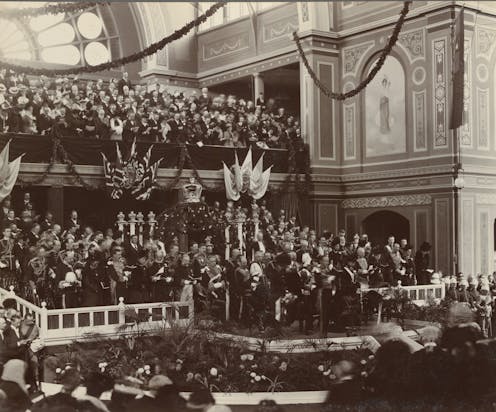
We are social beings. So, within every group, decisions must be made about how to live together, preserving wellbeing and relations with others. Historically, those decisions were made by tribal leaders, or monarchs and their courts. Yet the ancient states of Greece, needing collective commitment to the battles in which they engaged, realised it would be generated by giving the people, the demos, a voice in what had to be done. From this issued the idea of “democracy”: a particular form of social organisation in which citizens participate in the decisions that affect them.
Small communities can practise direct democracy: people meet and decide, or vote, on decisions concerning them all. In large modern societies, it operates instead as representative democracy within nation-states: citizens elect representatives to act for them in a forum where collective policies are determined.

Settler democracy
The settler state was established at the high point of “the age of revolution”, when battles against monarchical control (the American Revolution) and hereditary elites (the French revolution) spurred the adoption of this new form of democracy: government “of the people, by the people and for the people” on one hand, and “liberty, equality and fraternity” on the other.
Yet the first European settlements were convict colonies, repositories for the criminal, marginal and unwanted from Britain. Among them were convicts who had been transported because of their advocacy of the new politics, readers of Thomas Paine’s Rights of Man. In conjunction, as the source of essential labour in the new colonies, convicts had leverage to assume roles and demand rights never granted to their ilk in Britain. Their persistent demands seeded colonial democracy.
Since liberal precepts carried here by successive waves of settlers faced none of the barriers of an established ruling class, such ideas flourished in Australia. As more radical exponents of social liberalism arrived, such as the Chartists who had fought for working class political and civil rights, they played a leading role in events such as the Eureka rebellion, the emergence of mass union movements, and the foundation of the Australian Labor Party (ALP).

By the late 19th century, “new liberals” were arguing that freedom could not be assured unless the state intervened to solve problems – poverty, unemployment, lack of education – that disadvantaged individuals could not solve for themselves.
In Australia, some among the emerging middle class (small businessmen, entrepreneurs, journalists and professionals), seized on such views in forming loose reformist alliances with the labour movement to forestall the conservative inclinations of the big landholders who dominated colonial upper houses. The result: Australian colonies took the lead in developing progressive democratic measures: allowing all men to vote, payment of parliamentarians, the secret ballot and in South Australia and Western Australia votes for women.
A ‘talent for bureaucracy’
Australia was a striking incarnation of modern social organisation. It was historically perhaps the most developed instance of the harnessing of democracy with bureaucracy, for two reasons.
First, its settlement and development were documented in detail. Instructions to and reports from colonial governors, the manifests of convict ships, the documentation of immigrant arrivals — all were resources for those managing colonial development.
Second, as population increased, colonial governments needed to raise loans from the mother country to develop the infrastructure necessary for private enterprise to flourish. Public officials became the essential intermediaries in what Noel Butlin called “colonial socialism”. Alan Davies saw these historical contingencies as the origin of an Australian “talent for bureaucracy”.
The influence of these progressive ideas and a “colonial socialism” encouraged in Australia a particular form of liberal polity, one less fervently individualistic than the United States. The dark side of settler liberalism was that its commitment to individualistic liberal freedom rendered it blind to collective forms of social relations, and to the consequences of colonisation for First Nations.
The federal experiment
Negotiation between the colonies in the late 19th century aimed to unify the disparate colonial settlements. It was driven both by lofty ambitions — to create a nation with a common purpose — and by a series of anxieties. A capacity for defence against the other imperial powers making claims in the Pacific; concern to maintain racial purity and protect British civilisation in the antipodes; and worries about promoting economic recovery given class fragmentation following a depression and strikes in the 1890s.
It was brought about through a series of conventions largely comprising colonial politicians. Together they hammered out a constitutional contract to satisfy their interests, driven by lawyers, carefully designating which powers were to be transferred to the Commonwealth, and which were retained by the states. It was, despite the absence of a formal bureaucracy, a profoundly bureaucratic process.
The compact at which they arrived retained British parliamentarianism. It mandated the formation of majority government with fiscal power in the House of Representatives, but borrowed from the United States in establishing a states house of review – the Senate.
 The results of the 1899 referendum show it was successful, meaning Australia could become a federation.
National Library of Australia
The results of the 1899 referendum show it was successful, meaning Australia could become a federation.
National Library of Australia
The American adoption of a Bill of Rights was proposed but not accepted: British parliamentarism was thought sufficient to ensure the rights of “freeborn Britons”. Liberal preoccupation with checks and balances on government was evident in the constitution of the Senate, in which all states (formerly colonies) have equal representation regardless of population size. More restrictive still was the stipulation that referendums to change the constitution required the support of a majority of people in a majority of states to succeed.
The new federal parliament moved quickly to safeguard “White Australia” with the Immigration Restriction Act 1901. This set a dictation test (in European languages) for immigrants designed to exclude those of non-European origin. There was contention over women’s suffrage, but women had the vote in South Australia and a constitutional clause stipulated that rights already granted in any colony should be accepted federally. Women’s voting rights were recognised in the Commonwealth Franchise Act 1902. Not so the rights of Indigenous peoples, however, who were deemed not to meet the standard of “civilisation” necessary to vote.
Bureaucracy and democracy
The major battles in the first decade of federation were between developing anti-Labor parties representing two faces of liberalism: those convinced freedom was sustained by state intervention when necessary (Protectionists) and those believing freedom was secured by limiting the ability of others to interfere in individual choice (the Free Trade Party).
Initially the baton passed rapidly to and fro between Protectionist and Free-Trade governments. But adroit management by the Protectionist leader, Alfred Deakin, facilitated the election (with Protectionist support) of the first (albeit short-lived) national Labor government in the world. It also ensured that Protectionists’ ambitions governed “the Australian settlement”: tariff protection, White Australia, wage arbitration and targeted welfare overseen by an educated governing class.
The social liberalism of the Australian settlement encouraged further electoral innovation. Preferential voting was introduced in 1918. Compulsory voting was enacted federally in 1924, having been introduced in Queensland in 1915. Other states soon followed. This was foundational to the citizens’ bargain: the state as responsible for collective wellbeing, with citizens obliged to engage seriously with democratic government. It necessitated voter registration, and electoral rolls, administered under state and federal franchise acts. Eventually national electoral rolls were developed, administered within Commonwealth departments, then in an Australian Electoral Office (1973) and ultimately by an independent statutory authority, the Australian Electoral Commission (1984).
 Compulsory voting for federal elections means polling places are set up far and wide.
National Archives of Australia
Compulsory voting for federal elections means polling places are set up far and wide.
National Archives of Australia
It was not politicians or political agencies but Commonwealth public servants charged with achieving voting equivalence who initially determined electoral boundaries. Later the AEC took that role, along with the supervision of elections from the 1980s. This forestalled the gerrymandering that cruelled equality of representation in other jurisdictions.
Many of these measures were unique to Australia. And the heroes in their achievement? Bureaucrats. The interaction of progressive politicians, committed public servants and community activists was also integral to the transition from “White Australia” race-based “homogeneity” to civic identity and multiculturalism in the 1960s and 1970s; the introduction of voting rights for First Nations at state and then federal level and the 1967 referendum that recognised them as citizens; Indigenous land rights; and the incremental elaboration of health insurance, educational accessibility and civic entitlements. It was not perfect, and much remains to be done, especially in addressing the damage, trauma and continuing marginalisation inflicted on Indigenous communities by settler liberalism.
Democracy in question?
In the 1980s, governments of both stripes adopted an international current of thought driven by economists and technocrats — neoliberal economics — as a counter to “stagflation”: high inflation, low growth and high unemployment. What now was needed was more efficiency, to be achieved by opening markets to competition and rolling back state action: social democracy had failed. The state’s role should be limited to oversight, “steering, not rowing”, with provision of infrastructure and services to be outsourced to private enterprise.
For 30 years, it produced the prosperity reformers had promised. But the rewards were distributed unevenly, with riches accruing to an ever-smaller proportion of the population. Individual precarity was by imputation a failure of effort rather than of market failure, structural disadvantage or the “creative destruction” expected of unbridled capitalism.
As one prime minister argued, “if you have a go, you’ll get a go”. It took no account of the communities destroyed as their jobs vanished and new enterprise failed to arrive.
Surveys suggest the public was never persuaded, and the democratic impact was apparent. Party disengagement ensued. The major parties of the 20th century, in which the need to reach agreement among many voices ensured that extreme positions were rare, were reduced to rumps of committed partisans whose views were typically not representative of the people they served.
Partisan polarisation made achieving policy consensus increasingly difficult. The public service was hollowed out as functions were outsourced, consultants were brought in, organisational knowledge was lost, and governments repeatedly legislated to induce compliance rather than frank and fearless advice.
The result was policy stasis and startling national scandals when the damage of ingenious schemes by consultants to reduce entitlements and shift risk from service providers to their clients was revealed.
High levels of trust in politicians and public officials plummeted, and with this belief in liberal democracy itself was eroded. When a COVID pandemic induced governments to act, invest and cooperate in public provision, and in 2022 a Labor government was elected promising to be responsible, consultative and collaborative, polls bounced back.
Was the Australian tradition of social democracy resurgent? Support for change was soon shown to be tenuous. The bitter campaign against the Albanese government’s initiation of a referendum giving First Nations a constitutional “Voice” on policies affecting them showed how easily the politics of partisan division, race, resentment and negative campaigning can be mobilised to defeat democracy’s promise of fair life chances.
This is an edited extract from How Australian Democracy Works, a new collection of essays from The Conversation on all aspects of the country’s political landscape.
Authors: James Walter, Emeritus Professor of Political Science, Monash University
Read more https://theconversation.com/the-best-of-both-worlds-how-australias-unique-democracy-evolved-230952



















