

what NZ’s forgotten homegrown school computer can teach us about state-led innovation
- Written by: Mark Rickerby, Lecturer, School of Product Design, University of Canterbury
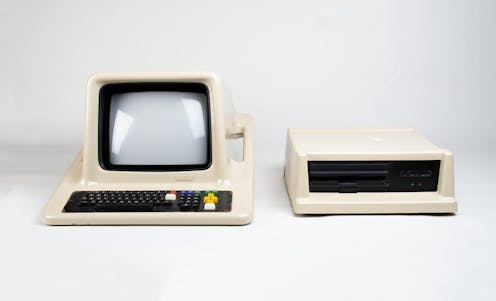
Some 45 years ago, a team of staff and students at Wellington Polytechnic designed and built a desktop computer with an operating system customised for the needs of New Zealand schools.
The Poly-1 was far ahead of international competition, but New Zealand failed to capitalise on the opportunity. At the time, public investment in a new knowledge-based industry ran counter to both “Think Big” industrial policy and the emerging neoliberal agenda in government.
As New Zealand looks to scale up investment in artificial intelligence (AI) and advanced technologies, the story of the Poly-1 has enduring lessons about research and innovation policy – and the importance of multidisciplinary collaboration.
Leading the world
The Poly-1 was designed in 1980 as a learning device and teacher support tool. It was advanced for its time with colour graphics and powerful processors. It incorporated a networking feature, enabling up to 32 workstations across multiple sites to communicate over a real-time connection.
Its tough, rounded fibreglass case with carry handles and integrated keyboard was ergonomically designed to handle the rigours of classroom use. A range of bold colour options were meant to make it more relatable for children.
Fifty working prototypes were built in less than a year. A large group of volunteer teachers worked over the summer break to integrate course content and ensure it was ready for use in classrooms.
In 1981, the Department of Education signed a NZ$10 million purchase agreement for 1,000 units per year over a five year period.
The Poly-1 went into production under Polycorp, a joint venture with Lower Hutt-based Progeni. Manufacturing was backed by the state-owned Development Finance Corporation venture capital fund.
Polycorp was poised for scale with a field-tested product and unique distributed learning model. Wide deployment in classrooms would position New Zealand as leading the world in maths education and applied computing.
Blocking innovators and boosting importers
Voicing outrage at this use of public funds, corporate lobbyists began publicly attacking “bureaucrats and boffins”. Privately, they put pressure on ministers sympathetic to a nascent deregulation agenda. They argued only the market could properly decide which computers were used.
In 1982, then prime minister Robert Muldoon’s cabinet scuttled the deal, halting higher volume production and discarding two years of work.
The beneficiary of the broken contract was Apple, which targeted New Zealand as its first education market outside the United States. It gave away free Apple II computers to schools, then followed up by offering larger volumes to the Department of Education at below cost.
The Apple computers were unsupported by curriculum resources, lacked teacher training and were soon obsolete.
By the mid 1980s, the rollout of computers in classrooms stalled as the Fourth Labour Government prioritised administrative reforms in education. Schools were left on their own to deal with hawkish IT vendors and distributors.
Missed opportunities
Relying on an underdeveloped market to serve the growing demand for computers in education led to anti-competitive practices and a devaluing of the teaching expertise behind the software and services.
It’s unlikely the Poly-1 would have survived through the early 1990s as cheap IBM-compatible clones became widespread. But its ultimate end was a consequence of finance rather than technology.
The collapse of the government-owned Development Finance Corporation in a complex tangle of failed property investments left Progeni directly exposed as a debtor to the BNZ, which was also teetering on the edge of collapse.
In late 1989, Progeni was forced into receivership by the bank, which asset-stripped the company and sold it at a nominal value.
Innovation is interdisciplinary
The current government has recently announced major structural changes to New Zealand’s research and innovation system, including a new Public Research Organisation focused on advanced technology.
Institutional reform is much needed and long overdue, but significant challenges remain. A narrow focus on science and technology driving economic growth is not enough. More attention to detail is needed to bridge from current capacity to a desired future state.
The Poly-1 required collaboration with industrial designers and teachers to become market-ready – and the same is true today.
Successfully commercialising research in AI and other advanced technologies requires contributions from experts across design, social science, arts and business.
Like personal computers in 1980, AI is a new category with contested meanings. This has an impact on policy and the reception of new products.
Discussions about state-led innovation often default to arguments about picking winners. But direct support for industries and firms is only part of the broader picture.
In order to see economic and public benefits of investment in AI, the government has a role to play in coordinating interdisciplinary efforts across sectors. This requires visions for the future that are a practical response to the needs of individuals, businesses and communities.
Countries like New Zealand have so far been consumers rather than producers of current generation AI. Changing this balance requires willingness to learn from past mistakes to support leadership in both innovation and regulation. Poly-1 still has lessons to teach us.
Authors: Mark Rickerby, Lecturer, School of Product Design, University of Canterbury


















