

how demography is used for political gain
- Written by: Liz Allen, Demographer, POLIS Centre for Social Policy Research, Australian National University
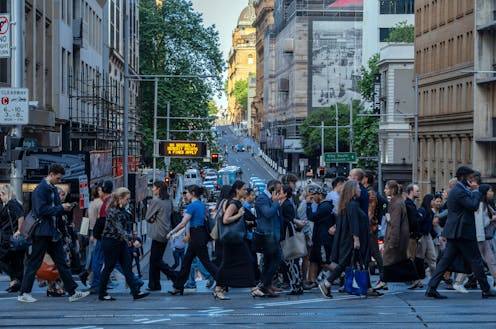
Population is far from the seemingly innocuous and bland topic of “people”. We’re not just talking people. We’re talking the very foundation of society, culture, and economy … and it’s deeply fraught. It’s also an effective political point scorer.
Population scrutiny waxes and wanes in Australian populist and political discourse, much like many nations across the globe. Canada, the United States, Germany, New Zealand and the United Kingdom are all grappling with population issues.
But when we talk population, it’s pretty safe to read immigration. It’s immigration that has most of the world talking, because growth for many is dominated by international movements, not local growth.

In the 1940s, Australia held an inquiry into falling birth rates, and following the second world war Australians were called on to populate or perish. During the 1940s inquiry, women were invited to make submissions reflecting how difficult motherhood was and how unsupported they were: "You men in easy chairs say ‘populate or perish’. Well, I have populated and I have perished – with no blankets.”
Many Australians now won’t achieve their desired family size because contemporary life is simply not conducive to having children. Having no or fewer children is now a forced outcome for a growing number of Australians. The barriers to having a child are now insurmountable for far too many. Housing affordability, gender inequality, financial insecurity and climate change make for an unstable and uncertain future.
Young Australians are carrying the burden of the nation’s future and the burden is simply too much. They have seen the generational bargain crumble and are being denied a future because of the failings of politics past.
Permanent versus net overseas migration
Among the many nuances missing from the population debate is the difference in the terminology used to refer to immigration. From a planning point of view, permanent migration is discussed; from a population perspective, net overseas migration applies. The difference between the two is stark and used in a smoke and mirrors way to hide reality or harm an opponent.
Government has much control over permanent migration, little control over net overseas migration.
Permanent migration refers to the cap of permanent visas granted. The permanent migration program is reviewed annually by the Department of Home Affairs with input from select experts, peak bodies, and government.
Permanent migration has fluctuated over the past ten years, reflecting political point scoring. Under Tony Abbott’s government in 2014-15, permanent migration was just under 190,000. The permanent migration remained in the 180,000s until declining to over 160,000 in 2017-18 under Scott Morrison. Morrison also reduced permanent migration further to around 144,000 in 2021-22. In its final year, the Morrison government flagged increasing the planning level for permanent migration to 190,000. Planning levels under the Anthony Albanese government were 195,000 and 190,000 in 2022-23 and 2023-24 respectively.
The permanent migration program ceiling is set to decline by 5,000 places to 185,000 in 2024-25 under Albanese.
Opposition Leader Peter Dutton has also announced his party would reduce permanent numbers to 140,000, seemingly linking housing affordability to permanent migration. Dutton has also said his party would cut net overseas migration (NOM) but has since backtracked on his plan, possibly because he realised it couldn’t be done.
Net overseas migration feeds into population estimates and is the balance of incoming minus outgoing migration. NOM is comprised of temporary and permanent migration and includes refugees, students, working holiday makers, and even Australian and New Zealand citizens.
A cut to the permanent migration program is unlikely to affect net overseas migration numbers. NOM is set to return to recent historical average even without reduced permanent numbers. Most people granted permanency are already in the country. What will occur with a reduced migration program is increased temporariness. Increased temporariness has the potential to erode social cohesion, harming migrants and Australian society overall.
Just like births, populist tactics are used when talking immigration for quick political point scoring. It works, but is it good for people?
Turning on ourselves
Demography is often used against the population in a peculiar ploy to win political points.
Take gender. Fewer birth means less expenditure on paid parental leave and superannuation for those receiving parental leave. Announcing increased paid parental leave benefits and superannuation while knowing births are set to be fewer is political genius. Chalmers announced exactly this in the 2024 budget.
The government says it’s doing more for women and mothers, but what it’s actually doing is a whole lot of nothing. There is no substantive examination of why women are saying no to motherhood. Demographic insights have enabled an effective political sleight of hand to give the illusion of doing something when actually not doing much at all.
Blaming population growth for the housing crisis is another stroke of political mastery. Talking tough on population (immigration) while promoting and relying on immigration is a tale as old as Australia’s ageing population. When in opposition the talk is tough; when in government, actions speak louder than words. Governments and oppositions, no matter the political leaning, make promises and then realise immigration is the economic safety raft keep the economy afloat.
Chalmers talked tough on immigration in his 2024 budget speech, pointing the finger of blame towards immigration for all manner of things,
[…] we’re addressing the pressures caused by population growth, with net overseas migration next year now expected to be half what it was last year.
But the government can’t take the credit for lowering NOM – nothing they did lowered the artificially high rates of NOM Australia saw post COVID border reopening. Yes, the Albanese government has introduced changes to build integrity into the migration system, but NOM figures were set to decline anyway. It comes down to the way it is calculated.
Border closures in Australia saw NOM fall to -88,000 in 2020-21. That’s negative nearly 90,000 people.
This was the first such decline outside wartime in Australia’s recorded history. A big deal. Temporary migrants, including students, left Australia prematurely at the onset and peak of COVID-related measures. Morrison, prime minister at the time, told international students and temporary visa holders to “go home”, while saying those with critical skills could stay and contribute: “For those backpackers in Australia who are nurses or doctors, or have other critical skills that can really help us during this crisis, then there will be opportunities for them”. Expendability of migrants echoed in this statement.
What happened with the NOM during COVID closed borders was essentially a calculation reset. Higher than expected numbers of people left Australia prematurely. Students, especially, left Australia prior to their studies finishing. This resulted in greater outgoings of NOM than the recent average. NOM restarted the moment borders reopened, but because so many brought forward their exit the number of incomers weren’t balanced by the usual outflow of people.
Taking a longer view of NOM prior to and since COVID-related measures shows smoother growth than popular media suggests. But nuance is hard to articulate in small soundbites, especially when the language of otherness is so enticing.
Creating the ‘other’
The language of otherness is used extensively in the population (immigration) narrative. Dutton played population bingo with his use of the word “foreign” in his 2024 budget reply speech referring to students, ending investment, and interference. Dutton also blamed migrants for road congestion and pressure on local services. His speech was a populist symphony.
When in opposition, members of the now government also made disparaging comments about migrants. For example, Kristina Keneally wrote an opinion piece suggesting migrants were taking jobs from locals.
Fear about population is easily manufactured, and once created enables a fix the playmaker can resolve. Much like a David Copperfield magic special. The trouble with these tactics is in the enormous diversity in Australia – we risk turning on ourselves and eroding already fraying social cohesion.
Shaping Australia
Our preoccupation with population largely reflects the central place people and demography hold in the economy and very function of the nation. But we appear to have lost our heads, instead problematising the very heart of what makes us Australian: the people.
Demography is a slow-moving train, and based on past and current trends population science can somewhat predict the future. The populist playbook results in population (namely immigration) used for political point scoring, to the detriment of the people, particularly the young.
Australia is by no means perfect. There is much work to be done to fix the multiple crises the nation is confronted with – housing affordability, financial insecurity, gender inequality, and climate change. A sensible approach to population and immigration is needed to ensure living standards don’t go backwards. Migrants help us weather the demographic headwinds.
Rather than use population for political gain, we need instead to harness the power of demography to solve our way out of the gigantic mess we’re in. The key is ensuring young people have a future worth living.
This is an edited extract from How Australian Democracy Works, a new collection of essays from The Conversation on all aspects of the country’s political landscape.
Authors: Liz Allen, Demographer, POLIS Centre for Social Policy Research, Australian National University
Read more https://theconversation.com/population-panic-how-demography-is-used-for-political-gain-230409


















