

All the signs point to our big cities' need for democratic, metro-scale governance
- Written by: Jago Dodson, Professor of Urban Policy and Director, Centre for Urban Research, RMIT University
Infrastructure Australia has called for metropolitan-scale governance of Australia’s largest cities. The new report by the Commonwealth’s statutory infrastructure agency, which sought to scope out the prospects for Sydney and Melbourne over the next 25 years, identifies integrated governance and leadership as keys to success.
The report notes state governments’ role in metropolitan planning and infrastructure provision, and local governments’ role in planning policy implementation and local services. It argues, though, that our fast-growing cities are at risk of fragmented governance and disjointed infrastructure provision by local councils.
Read more: Metropolitan governance is the missing link in Australia's reform agenda
Larger governing entities, Infrastructure Australia suggests, can employ staff with higher-order skills. The result is more efficient infrastructure delivery and operation and better strategic planning. The agency argues that such entities can more readily partner with state and federal agencies in metropolitan and regional planning.
In support of its claims, the report cites OECD studies that linked higher productivity to reduced governance fragmentation. The principal measure of this is the number of local governments within a city (Melbourne and Sydney have 30 or more councils each).
Infrastructure Australia sensibly avoids prescribing a governance model. Instead it offers exemplars of integrated governance elsewhere.
These models include the Greater London Authority, which sits above London’s municipalities, the Auckland Council, formed in 2010 from seven local and one regional authorities, and the City of Brisbane, formed in 1924 from a mix of 20 shires and boroughs. Although it is not directly endorsed, the recently established Greater Sydney Commission is noted as a step towards greater integration.
Scholars and practitioners have for some decades called for governance reforms for Australia’s large cities to enable democratically founded planning. What insights might such thinking offer?
Read more: Our cities need city-scale government – here's what it should look like
How did our cities get to this point?
The first step is to understand history. Both Sydney and Melbourne have in the past enjoyed the integration and oversight of metropolitan agencies.
The County of Cumberland, for example, produced Sydney’s first metropolitan plan in 1948. The Melbourne Metropolitan Board of Works (MMBW) played a very strong role in that city’s development. Arguably, each city’s roads agency strongly influenced post-war development via freeway building.
Metropolitan agencies can tend towards technocratic managerialism if they lack democratic foundation. The County of Cumberland drew delegates from local councils, but was replaced by a state planning agency under ministerial control in 1964. The MMBW was originally composed of local council delegates, with ministerial appointees added later, but fell to changing public sector philosophies in the 1980s. Its functions were replaced by a mix of water authorities and a state department of planning under ministerial direction.
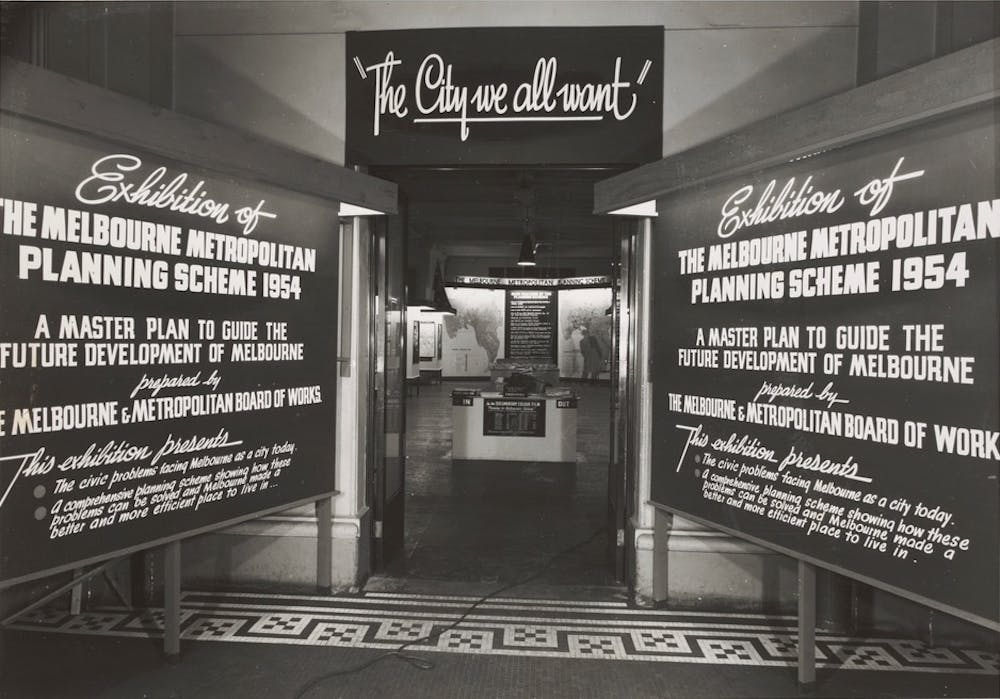 The Melbourne Metropolitan Board of Works undertook citywide planning with public input, as with this 1953 exhibition of the Metropolitan Planning Scheme.
State Library of Victoria
The Melbourne Metropolitan Board of Works undertook citywide planning with public input, as with this 1953 exhibition of the Metropolitan Planning Scheme.
State Library of Victoria
The lack of metropolitan democracy in recent decades has meant state political decision-making has dominated planning in Sydney and Melbourne. Planning ministers wield extensive power to write metropolitan plans and rule on major development applications. The 2002 Melbourne 2030 Metropolitan Strategy is infamous for continuing freeway-based urban development despite the extensive public consultation it undertook revealing much greater preference for public transport.
While the state-centralised model of planning governance offers some democratic oversight – the minister can be removed at state election time – it also leaves planning open to capture by powerful donor interests, such as private developers or infrastructure proponents. This problem is heightened when state treasuries encourage “market-led” proposals for major projects.
Ministerial politicisation also turns planning into a partisan contest. The result is a succession of plans, often vacuous in content, that are jettisoned by each new minister. The city becomes overlain with a palimpsest of differing strategies in short succession. There is little prospect of establishing long-term coherence.
Worse, in response to perceived political advantage at election time, infrastructure projects may be announced out of sequence or out of plan, adding to the incoherence. Melbourne, for example, lacks a transport plan as mandated by statute. Instead, both sides of politics have imposed multiple major transport projects without properly considering their strategic purpose or alternatives.
Politicisation also means fundamental urban questions are avoided. Transport planning is an example, where improving urban productivity demands a shift from roads to public transport, yet ministers are typically captive to the road lobby.
Even where independent infrastructure agencies advise on planning strategy, ministers readily ignore their recommendations. And with a state minister ruling over a metropolitan polity, there is a mismatch of democratic geography.
The quest for a better model
So what might metropolitan governance look like that avoids the flaws of the technocratic model while ensuring both adequate democratic participation and limits on the prospects of political capture? What principles might an integrated governance model adhere to?
Given the pressures and stresses facing cities, there is an urgent need to inscribe principles of democracy, sustainability and equity within governance arrangements. A new planning authority model is necessary that sits between the overarching state legislative framing and local administration and services. It should aim for a metropolitan governing body to enable effective representative decision-making about urban strategy and investment.
As I have argued previously (with Brendan Gleeson and Marcus Spiller), the case for an independent “commission” model is compelling, but so is the opportunity to improve urban democracy. The question of whether a metropolitan body draws representation from local municipalities, or has its own electoral jurisdictions and mechanisms, deserves greater deliberation.
Read more: Towards a collaborative city: the case for a Melbourne Metropolitan Commission
The Greater London Authority operates on the basis of electoral structures separate from both national government and local municipalities. The Auckland Council is also separated from national government and runs via a representative local ward structure. Metro Vancouver is a federated authority of 21 municipalities, one electoral area and one Indigenous body that plans and delivers regional-scale services.
 As mayor, Sadiq Khan represents the whole London metropolitan area, not just one local council.
See Li/CrowdSpark/AAP
As mayor, Sadiq Khan represents the whole London metropolitan area, not just one local council.
See Li/CrowdSpark/AAP
For Australian cities, a combination of local representation (via an electoral college or an additional tier of political representation) seems viable.
The question of a mayor is also highly pertinent. Auckland, London and Brisbane each directly elect a metropolitan mayor who provides leadership across the entire city. This creates a high degree of democratic accountability at the metropolitan level, while providing a focal point for city-to-city conversations. That is not the case with the Sydney or Melbourne lord mayors, who represent a single municipality.
Recognise Indigenous sovereignty
Another fundamental consideration in metropolitan governance is Aboriginal sovereignty. In no part of Australia was this sovereignty voluntarily ceded. Any metropolitan governance arrangements should recognise unceded Aboriginal sovereignty.
Again, there are models for this overseas. Vancouver’s regional district provides for local indigenous input. The Auckland Council includes an independent statutory board that advises on Maori issues.
In Australia, Victoria recently instituted joint governance of the Birrarung (Yarra) catchment covering much of Melbourne. Thus, the basic principle of Aboriginal input to urban governance is recognised in policy. Aboriginal metropolitan representation accompanies a treaty, perhaps under which rent is paid for the urban occupation of country, with proceeds to support Aboriginal advancement.
What about the state and federal roles?
What role might the state government then play in metropolitan governance? The state should set the legislative context, so planning law is democratic, inclusive and sustainable. It should also enable financing arrangements for urban infrastructure.
Finally, the role of national government remains relevant. As a signatory to the UN’s Sustainable Development Goals (SDGs) and the New Urban Agenda (NUA), the Australian government has accepted a role in framing national urban policy.
Read more: What can the New Urban Agenda and Sustainable Development Goals do for cities?
The government released a national urban policy in 2011, but seems to have forgotten it. Reversion to ad-hoc City Deals is not enough.
There is a clear role for the federal government to frame Australia’s urban responsibilities under the Sustainable Development Goals and New Urban Agenda and to collaborate with state and metropolitan governments on implementation.
Australia’s large and growing cities need more democratic, sustainable and inclusive urban governance. To achieve this we must move to representative arrangements that enable our cities to determine their futures as metropolitan polities.
Read more: New name, new look for latest national urban policy, but same old problem
Authors: Jago Dodson, Professor of Urban Policy and Director, Centre for Urban Research, RMIT University


















