

With Whyalla steelworks forced into administration, Australia has crucial decisions to make on the future of its steel industry
- Written by: Geoffrey Brooks, Professor of Engineering, Swinburne University of Technology
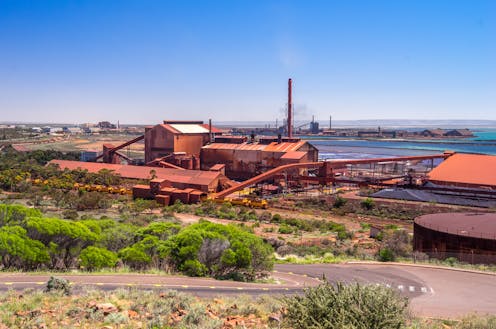
Whyalla is a proud steel town. The steelworks physically dominates the townscape, and most jobs in the town are either directly at the steelworks or heavily reliant on it.
In recent months, however, the steelworks have lurched from one setback to another, from serious technical problems that forced shutdowns to rising debts owed to suppliers and the state government.
On Wednesday, the South Australian government forced Whyalla steelworks into administration. To do so, it quickly passed amendments to the Whyalla Steelworks Act. Current owner GFG Alliance will no longer operate the site.
For me, someone intimately involved in the steel industry, the news that the steelworks has been put into administration is not a shock. This has been coming for some time.
On Thursday, Prime Minister Anthony Albanese unveiled a A$2.4 billion rescue package.
A portion of this money will be used to address immediate debt issues and keep the plant afloat. But $1.9 billion has been earmarked for major, long-term infrastructure upgrades under a new owner.
The next steps will be crucial if this vital component of Australia’s manufacturing infrastructure – and heart of the town of Whyalla – is to survive.
How we got here
Whyalla’s steelworks was founded by BHP and opened in 1941, originally concentrating on ship building. It later transitioned to producing structural and rail products during the 1970s and ‘80s.
After the steel division was spun out of BHP in 2000, the steelworks operated under the OneSteel banner, which was renamed Arrium in 2012.
The plant has been in decline for a couple of decades. Its products have had difficulty competing against overseas imports and there have been issues with the scale of production and costs.
GFG Alliance took over Whyalla’s struggling steelworks in 2017, to great fanfare and optimism.
GFG is led by Indian-born British billionaire Sanjeev Gupta, who owns steel plants across the world. Until recently, he was a relatively unknown figure in the steel industry, but rapidly built up a steel empire after buying his first major steel plant in the UK in 2013.
Gupta’s business practices have recently drawn close scrutiny from regulators in the UK, particularly the financing arrangements for several of his businesses. GFG’s largest lender, Greensill Capital, collapsed in 2021.

A failure to turn things around
Upon purchasing the plant in 2017, GFG promised to invest in upgrading the equipment and move the steelworks towards “green” steel production.
But these investments never materialised, and the operations have continued to lose money. There have also been significant operational issues over the past year, resulting in months of no production.
These challenges have been compounded by what appears to be poor management of key equipment in the plant, particularly the blast furnace.
Keeping blast furnaces running smoothly is one most important technical issues facing any steelmaker.
A string of recent breakdowns, resulting in major production shutdowns in 2024, does not reflect well on GFG.
On Wednesday, SA Premier Peter Malinauskas said the state government had been forced to step in, given debts of more than $300 million owed by GFG and reports workers weren’t being paid.
Still a valuable asset
The town of Whyalla will be watching the outcome of the state and federal governments’ rescue plan with bated breath. If it’s not to be GFG, who should be trusted with taking over and running the steelworks?
In such times, it is worth pointing out some of the key advantages of the plant that could make it an attractive asset to prospective owners.
Whyalla has good port facilities, a major iron ore deposit (Middleback Range) nearby, and abundant renewable energy.
It also has an experienced and trained workforce, with established product lines that are in demand (particularly rail steel).
Bluescope has been touted as one potential new owner. But there is also likely to be foreign interest, given the potential for linking steel production to renewable energy in Whyalla.
Taking Whyalla into the future
The current scale of the Whyalla steelworks, about 1.2 million tonnes of raw steel per year, is simply too small to be competitive. It is operating in a market where plants producing more than 3 million tonnes per year are common.
The plant’s product range could be broadened and raised in value by investing in key steelmaking equipment.
The general shift towards green production routes also presents opportunities for Whyalla. The local abundance of solar energy is likely to be a significant advantage for the plant’s future.
However, converting from the plant from its current coal-based technology to non-coal based technology (such as hydrogen ironmaking) will take significant investment and technical skill.
Opportunities for Australia
Could Australia simply let the steelworks shut down and import its rail steel instead?
That would draw parallels with Australia’s car manufacturing sector, which the government ultimately allowed to collapse. But I believe this position is unlikely to attract much support.
For one, there would be an enormous human cost to the people of Whyalla. The town of 20,000 people would be economically devastated by the plant’s closure.
There’s also a fear such a move would further weaken Australia’s ability to generate long-term wealth. Historically, the steel industry has been an important generator of long-term jobs and national wealth.
And it would certainly be demoralising for our manufacturing sector. Australia has plentiful ore, energy and a huge railway network. We should be able to run a sustainable steel plant specialising in rail and structural steel.
All these challenges need investment and strong technical leadership. The decisions taken by the state and federal government in the next few months will be vital for Whyalla’s future.
Authors: Geoffrey Brooks, Professor of Engineering, Swinburne University of Technology


















