

Labor and the Coalition have pledged to raise GP bulk billing. Here’s what the Medicare boost means for patients
- Written by: Stephen Duckett, Honorary Enterprise Professor, School of Population and Global Health, and Department of General Practice and Primary Care, The University of Melbourne
Labor yesterday foreshadowed a major Medicare change to address the falling rate of bulk billing, with an A$8.5 billion election announcement. The government said it would increase incentive payments for GPs to bulk bill all patients, from November 1 2025.
Today the Coalition said it would match Labor’s Medicare investment dollar-for-dollar.
Medicare was designed as a universal scheme to eliminate financial barriers to access to health care. The contemporary slogan is that you only need your Medicare card, not your bank card, to see your doctor.
But fewer than half of Australians are always bulk billed when the see a doctor. So how did we get into this situation? And what could these changes mean for access to care?
Read more: Albanese pledge: nine in ten GP visits bulk billed by 2030, in $8.5 billion Medicare injection
Why bulk billing has been declining
Until changes introduced by then Health Minister Tony Abbott in 2003, Medicare was the same for everyone.
But in response to declining rates of GP bulk billing at the time, the then Coalition government backed away from Medicare’s universality and introduced targeted bulk billing incentives for pensioners and health-care card-holders, children, people in rural and remote Australia and, in a political fix to appease then Tasmanian independent Senator Brian Harradine, all Tasmanians.
Fast-forward to 2014 and then Health Minister Peter Dutton introduced legislation as part of the budget for a compulsory copayment for GP consultations – a proposal that did not survive six months and failed in the Senate. A smaller optional payment also failed to get approval.
But the idea of getting Australians to pay out of pocket to see a GP survived. It was introduced by stealth by freezing GP rebates, rather than adjusting them to inflation. This slowly forced GPs to introduce patient co-payments as their costs increased and their rebates didn’t.
By the time Labor was elected, bulk billing was said to be in freefall.
Labor’s first response was to restore the indexation of rebates, so they increase increase in line with inflation in November of each year.
It then tripled the bulk billing incentive. This meant GPs received a greater rebate when they didn’t charge patients an out-of-pocket fee.
But the new incentive was not enough to cover the gap between rebate and fees in metropolitan areas.
What proportion of Australians are now bulk billed?
Only about 48% of people have the security of “always” being bulk billed when they see a GP. A further 24% are “usually” bulk billed.
Bulk billing rates are highest in poorer areas – South West Sydney has an “always” rate of 81%, almost quadruple the rate in the ACT (23%), which has Australia’s lowest “always” rate.
The always bulk billed rate – excluding special COVID items which required bulk billing – has dropped from about 64% in 2021–22.
The rate of bulk billing as a percentage of all visits to the GP, rather than people, is much higher. Around 78% of all attendances (aka visits) in the second half of 2024 were bulk billed. The higher rate is because more frequent users, such as older Australians, are bulk billed at a higher rate than younger people.
What does the new bulk billing package include?
The initiative announced yesterday includes three positive changes.
First, it again increases the bulk billing incentive.
It also introduces an additional bonus for general practices which achieve 100% billing.
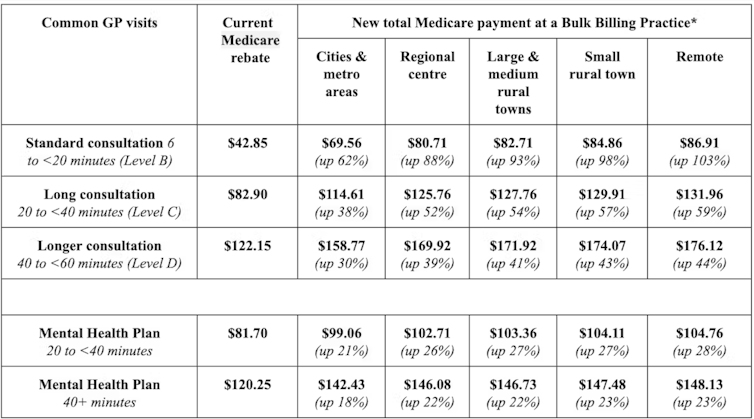
The new combined Medicare rebate in metropolitan areas for a standard bulk billed visit to the GP is A$69.56 when both changes are applied. This is $27 above the current rebate of $42.85 (without any bulk billing incentive).
The current average out-of-pocket payment when a service is not bulk billed is $46. So there will still be a gap, but the difference between bulk billing and not is now significantly smaller.
The government expects a major uplift – to 90% of visits bulk billed – as a result.
State government payroll taxes, also encourage bulk billing, by not requiring GPs to pay payroll tax on consultations that are bulk billed. This will provide a further incentive to increase the bulk billing rate.
The second positive change is that the new initiatives are for everyone. This ends the two-tiered incentive the Coalition introduced in 2003 and restores Medicare as a truly universal scheme.
Australia will now rejoin all other high-income countries (other than the United States) in having health funding underpinned by universality.
Third is the introduction of a 12.5% “practice payment” bonus for practices that bulk bill all patients.
This starts the necessary transition from a reliance on fee-for-service payments as the main payment type for general practice.
A “practice payment” is more holistic and better suited to a world where more people have multiple chronic disease which require care for the whole person, rather than episodic care. It signals payments need to be redesigned for that new reality.
Over time, this could fund and encourage multi-disciplinary teams of GPs, nurses and allied health professionals such as psychologists and physiotherapists – rather than patients always seeing a GP.
The downsides
The main risk practices face in contemplating these changes is the fear of how long this new scheme will last. A previous Coalition government showed it was prepared to use a rebate freeze to achieve its policy of a shift away from Medicare as a universal scheme.
The best way of reducing that risk would be to build in indexation of the rebate, and the incentive, into legislation.
The Royal Australian College of GPs says not everyone will be bulk billed because rebates are still too low to cover the cost of care.
This is true, as the gap between the prevailing metro bulk billed fee and the new rebate plus incentive will be about $20. But the aim is to increase bulk billing to 90% not 100% – and that is probably achievable.
Bottom line
The new arrangements will likely reverse the decline in the rates of bulk billing. The government can reasonably expect a bulk billing rate of around 90% of visits in the future.
For consumers facing cost-of-living pressures, it will be a very welcome change. There will be more 100%-bulk-billing practices and patients will no longer face a lottery based on a doctor’s or receptionist’s mood or whim about whether they will be bulk billed.
Yesterday’s announcement and the Coalition’s backing is a watershed, benefiting patients and general practices.
Labor is playing to its strengths and it will hope to reverse its current polling trends with this announcement.
The Coalition obviously hopes to negate the impact of a popular announcement by matching it. What will weigh in voters’ minds, though, is whether today’s Coalition announcement will be delivered after the election. The Coalition has a long history – dating back to Malcolm Fraser – of promising one thing about health policy before an election and reversing it after the vote, and this will probably fuel a “Mediscare” campaign by Labor.
Authors: Stephen Duckett, Honorary Enterprise Professor, School of Population and Global Health, and Department of General Practice and Primary Care, The University of Melbourne


















