

Modern Australian
Men's Weekly

.

Trump is reviving a tariff strategy from America’s ‘Gilded Age’. It didn’t end well last time

  • Written by Garritt C. Van Dyk, Senior Lecturer in History, University of Waikato
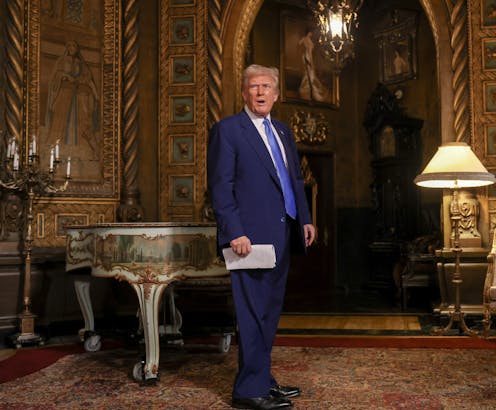
Trump is reviving a tariff strategy from America’s ‘Gilded Age’. It didn’t end well last time

A White House fact sheet about Donald Trump’s recently announced “Fair and Reciprocal Plan” on trade described it as “the art of the international deal” – a reference to Trump’s 1987 business book, The Art of the Deal.

It was a classic piece of self-marketing from the president, but whether his latest tariff proposal will really turn out to be artful is very much open to question.

In fact, the United States’ long history of “reciprocity” in tariffs and trade suggests ordinary Americans could be in for a bumpy ride.

In essence, Trump is reviving a strategy used in the US more than a century ago to protect developing domestic industries. This time, according to the president, reciprocal tariffs aim “to correct longstanding imbalances in international trade and ensure fairness across the board”.

The plan targets trade relationships with other countries where the US does not receive reciprocal treatment. And it echoes the policies of the 25th US president, William McKinley, who presided over an aggressive reciprocal tariff regime in the late 19th century.

McKinley was president from 1897 until he was assassinated in 1901. And while Trump greatly admires his business acumen, McKinley’s economic legacy also reads like a cautionary tale.

Not a simple equation

From the current US perspective, “reciprocity” refers to symmetrical tariffs. Trump’s plan targets unequal rates, such as the European Union’s 10% tariff on US cars, compared with the 2.5% US tariff on European automobiles.

The EU’s 10% rate represents its “most-favoured-nation” tariff, which applies to all its favoured-nation trading partners (with certain exceptions).

While this looks like a clear lack of reciprocity, it’s not that simple. The US also applies a 25% tariff on EU utility vehicles (pickup trucks).

This is significant because of the popularity of pickups in the US – a 2024 survey found 47% of Americans owned one. Until last year, the Ford F150 had been the bestselling “car” in the US for 42 years in a row.

This is just one example of how differences in tariffs can be more complex than they appear at first glance.

A history of reciprocal tariffs

This cycle of higher and lower tariffs has gone on for well over a century. From 1861 to 1930, the US Congress maintained control over trade tariffs, with levels as high as 50% to protect developing industries.

But in 1934, Congress passed the Reciprocal Trade Agreements Act, giving President Franklin D. Roosevelt authority to negotiate reciprocal tariff reductions with individual nations to stimulate global trade during the Great Depression.

These tariff reductions continued after World War II with the development of the World Trade Organization and US tariff levels declining to 5%. Economist Douglas Irwin refers to this period as the “reciprocity period” of nations lowering barriers to international trade.

The last time “reciprocity” was used to refer to the opposite process of raising tariffs was in 1890, under the Tariff Act, often just called the McKinley Tariff. It is this era Trump harked back to in his inaugural address:

President McKinley made our country very rich through tariffs and through talent – he was a natural businessman.

William McKinley. Getty Images

Before he became president, McKinley was head of the House of Representatives’ Ways and Means Committee. He proposed an average increase in tariffs on all imports, rising from 38% to 49.5% to “secure reciprocal trade”.

The new law was designed to protect the tinplate industry with a tariff of 70%, and “to reduce the revenue and equalize duties on imports”.

At the time, the US was running large surpluses from tariff revenues, which was threatening economic growth. This sounds counterintuitive these days, but surpluses were a problem because the US dollar was backed by gold at a fixed price (the gold standard).

Because the amount of money in circulation – and state spending – were limited to the amount of gold held by the government, surplus funds had to be kept in the Treasury reserves. This reduced the money supply and led to lower growth, less investment and tighter credit.

Republicans thought higher tariffs would reduce imported goods and therefore tariff revenues. Instead, income from the higher tariffs more than compensated for import reductions, and the surpluses increased.

Consumer prices rose, farm prices dropped, and the resulting voter backlash saw the Republicans lose control of Congress at the 1890 midterm elections. There was a financial panic in 1893, followed by a recession that lasted until 1896.

A new ‘Gilded Age’

This period in late 19th-century US history is often referred to as the “Gilded Age”, from the title of an 1873 book by Charles Dudley Wright and Mark Twain.

The book was a satire of political corruption and unscrupulous businessmen who benefited from political favours. The title reflects the reality of the era – superficially prosperous but not truly golden. A thin veneer of technological progress, innovation and wealth concealed widespread corruption, scandals and income inequality. But aside from the obvious historical parallels, it is overly optimistic to expect a plan from 1890 to succeed in a complex global trade environment that relies on interdependent supply chains to function. McKinley’s flawed strategy sought protection for a few industries, but also aimed to reduce revenue for a government running large surpluses. However, Trump’s new tariffs are meant to raise revenue to pay off the US$36.5 trillion national debt, as well as to enforce reciprocal trade terms. Trump began his second term with a declaration that “the golden age of America begins right now”. As in 1890, however, the risk remains that a handful of wealthy industrialists will benefit from increased protection, while ordinary citizens will pay higher prices. Less the “art of the deal”, then, than a possible dealbreaker. In which case, Trump may yet be remembered less for a new golden age than for a Gilded Age 2.0. Authors: Garritt C. Van Dyk, Senior Lecturer in History, University of Waikato

Read more https://theconversation.com/trump-is-reviving-a-tariff-strategy-from-americas-gilded-age-it-didnt-end-well-last-time-250389

Short Term Loans in Australia: Practical Insights for Borrowers and Finance Professionals

Short term loans play a crucial role in Australia’s personal finance landscape. They are designed to cover short-term expenses, unexpected bills, ...

Best EPD Consultants in Australia

Environmental Product Declarations (EPDs) play an increasingly important role in the Australian construction, manufacturing, and infrastructure sect...

I/O Controller And Its Role In Modern Industrial Automation

Industrial automation relies on a range of advanced technologies to ensure precision, speed, and reliability in day-to-day operations. Among these t...

Hydraulic Systems And Their Importance In Modern Industry

A hydraulic system plays a vital role in powering machinery, controlling movement, and delivering high-force performance across countless industrial...

Why Australian Businesses Are Having a Second Think About Digital Growth

Running a business these days is a whole lot different to how it was even a few short years ago. Customers are better informed, there's more competi...

Restaurants Risk Compliance Issues Amid Commercial Plumber Shortage

As demand for housing, roads and facilities increases, so does the demand for trade workers. According to Infrastructure Australia, the construction i...

The Importance Of A Professional Medical Fitout Melbourne For Modern Healthcare Facilities

Healthcare environments must operate with precision, efficiency, and a strong focus on patient comfort. A well-planned medical fitout Melbourne hel...

Top Safety and Comfort Features to Consider in Family Off Road Caravans

Exploring Australia’s coastline, bush tracks or outback locations is far more enjoyable when travelling in a caravan designed for both comfort and...

“Logistical Nightmare” – Rural and Remote Communities Supply Chain Nightmares

Australia’s road logistics need major reform to counteract the supply chain issues that are hitting rural and regional communities hard. With 80% of...

The Importance Of Quality Bait Boards For Boats To Enhance Fishing Efficiency And Comfort

Fishing enthusiasts understand that having the right equipment on board makes every trip smoother and more enjoyable. One essential accessory for an...

The Essential Safety Gear Every Tradesman Needs

Across industries like construction, electrical work, plumbing, carpentry, and welding, workers face hazards every single day. For tradesmen, having...

Best POS System Features That Boost Customer Experience

Source: Unsplash Starting and scaling a retail business is unlikely possible without an effective Point of Sale (POS) system. It is the tech heartbe...

Understanding SMSF Setup Online and Why More Australians Are Choosing Digital Fund Establishment

liManaging your own superannuation gives you greater control over investments, retirement planning, and long-term financial decision-making. As inte...

Double Carport: Complete Guide to Design, Cost, and Installation

A double carport provides practical, cost-effective protection for two vehicles whilst adding value and functionality to your property. Whether you're...

How External Blinds and Awnings Improve Comfort, Privacy, and Energy Efficiency

Outdoor comfort and protection are essential for homes and commercial properties, especially in regions with strong sunlight, high UV exposure, and ...

Worksite Comfort Upgrades That Boost Team Productivity

Jobsite productivity doesn’t depend solely on tools, training, or scheduling. It also hinges on something often overlooked: worker comfort. When e...

NDIS Occupational Therapy: Your Complete Guide to Accessing Support and Services

Occupational therapy plays a crucial role in helping NDIS participants achieve their goals and improve their daily living skills. For people with disa...

How to Start Trading Futures in Australia: Markets, Margin and Regulation

Futures trading has become increasingly popular among Australian traders seeking opportunities across global commodities, indices, currencies and ener...
















