

Google AI


Modern Australian

In We Do Not Part, Han Kang faces unbearable historical traumas with sorrow and compassion

  • Written by: Jen Webb, Distinguished Professor of Creative Practice, Faculty of Arts and Design, University of Canberra
In We Do Not Part, Han Kang faces unbearable historical traumas with sorrow and compassion

It’s daunting to review a novel written by someone who, in 2024, received the Nobel Prize in Literature. The prize was awarded for Han Kang’s “intense poetic prose that confronts historical traumas and exposes the fragility of human life”: a description that applies equally to this newly translated work.

Review: We Do Not Part – Han Kang, translated by E. Yaewon and Paige Aniyah Morris (Hamish Hamilton)

We Do Not Part tells the story of Kyungha, a writer of 20th-century South Korean history, and her longterm friend Inseon, a documentary filmmaker and photographer. Both women are increasingly choosing isolation over the busy professional and social lives they had lived.

Kyungha has pretty much withdrawn from her professional life. She is suffering from depression and anxiety, restless nights and exhausted solitary days. She is losing contact with those she loves.

Inseon had moved from Seoul to the remote island of Jeju several years earlier to care for her ageing mother. After her mother’s death, she chose to remain on the island and switch from screen-based work to furniture-making.

The novel is told in three parts. The long first section, titled Bird, opens with a dream sequence. It goes on to recount a comparatively linear narrative of past and present. The shorter middle part, Night, is a deep dive into the horrors of history. The ending, Flame, is very short, told in fragments. The novel ends with what seems to be a dream, where the two women light a candle in the dark, in the depths of snow. The dream that opens the novel is of “thousands of black tree trunks jutted from the earth […] Stooped and listing, they gave the impression of a thousand men, women and haggard children huddling in the snow”. Trees that represent people; children who are haggard: these are worryingly bleak images. In the distorted reality of the dreamworld, Kyungha wonders: “Was this a graveyard? […] Are those gravestones?” The dream moves on, and she finds that she is walking through water. First her feet are wet, then she is ankle-deep, and then the “graves” are underwater, being washed away by the sea, and she alone must try to preserve any that can be saved. This sets the stage for all that is to come: evidence of massacres, nature turned into a stage for terrible events, a bone-chilling awareness of sorrow. Dream project This might sound like an unpromising entry point for a novel, but let me assure readers that the story offers real rewards. I was a touch undone by the first chapters, but the beauty of the prose kept me going. The thoughtful, engaging portraits of the generosity, integrity and courage of the two key characters, too, provided an appealing path on which to follow the narrative. In the early chapters, Kyungha presents as a person suffering from PTSD. She has been flirting with death for some time. What is keeping her alive is that she can’t find a way to write what she believes to be “a proper letter of farewell, a true leavetaking”. The elements and circumstances seem to conspire against her peace. Through the novel’s first chapters, Kyungha is surviving a hot humid summer. All she is able to do is shower, shred the drafts of her farewell letters, and lie on the floor imagining snow. She has been brought to this point as a result of her researching and writing about a massacre in a place she names G— (perhaps Gwangju, the site of a massacre in May 1980, which Han Kang addressed in her 2014 novel Human Acts). Kyungha’s account of how she is – barely – managing day-to-day life reads like a textbook case of vicarious trauma. She speculates that translating the dream-image into an art work might break its grip. Kyungha approaches Inseon, who has a long record of producing interesting if financially unviable projects. Inseon agrees to collaborate with her on this dream project. But four years go by without them ever managing to synchronise their schedules or begin the work. Then, after some months of silence, a text from Inseon pings into Kyungha’s phone. It asks her to come to a Seoul hospital. Inseon is there, being treated for an accident involving an electric saw. She has turned to her old friend to ask Kyungha to travel to Jeju and save her budgie, who will otherwise die of thirst.
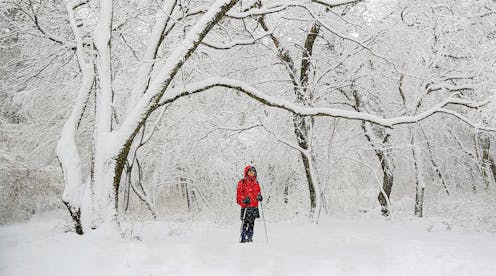
Han Kang’s novels engage compassionately with the problem of violence. Lee Jin-man/AAP

A quest

The novel then enters what can loosely be read as a quest narrative. It is now mid-winter and a wild snowstorm is on the way. Inseon’s home is in a village a long way from the airport, and snow is threatening to shut down the roads.

Nonetheless, Kyungha agrees to take up the quest. She finds herself in an unfamiliar location with a looming frightening weather event and no practical knowledge about how to reach Inseon’s home. As she struggles to reach the destination, she finds herself spiralling like the snow in this winter storm.

There is neither precision or even clarity here: much as the story leaps back through decades, then feels its way back to now, Kyungha stumbles through a landscape that she cannot map and plunges precipitately off the paths. Snowdrifts obscure the roads and “snowflakes resembling a flock of tens of thousands of birds appear like a mirage and sweep over the sea”.

Scratched, bruised and almost frozen, Kyungha finds herself at Inseon’s door, where she is completely isolated: “when I looked back,” she says, “the lone path that bore my deep footprints lay in silence.”

And there she remains, trapped by the weather, haunted by the stories of those she had interviewed for her book on the G– massacre. Stories of running from bullets, bodies being piled up, hiding for years in forests and caves: all the unendurable things that people nonetheless endured.

The wounds of history

The second part of the novel begins with a version of the initial dream of the sea and tree trunks that are metaphors of the dead. Kyungha wakes from this dream to find herself in a sort of ontological uncertainty. Inseon has (impossibly) joined her at the cottage. Kyungha can’t determine whether this is another dream, or if Inseon has died and is visiting her as a spirit, or if she herself has died is only imagining that she is alive and present.

What is not in doubt, though, is the historical record. Kyungha finds that she is not the only person who has been researching state-sanctioned massacres. Inseon, too, has been busy investigating what is known as the April 3rd uprising and the long massacre that followed from 1947 to 1954.

This massacre was organised and undertaken by the US military and the new Republic of Korea, based on the flawed notion that the Jeju islanders were communists. It resulted in the deaths of around 30,000 people.

Citizens of Jeju awaiting execution, May 1948. Public domain, via Wikimedia Commons

Nietzsche warned that “if you gaze long enough into an abyss, the abyss will gaze back into you”. Han Kang’s version of this idea is, as she writes in We Do Not Part, that “looking squarely at the injury made it all the more excruciating”.

Here it is Inseon’s nightmares that dominate: this is where her family and people died and where their traces remain. But both women are carriers of nightmare stories. Both stagger under the weight. They have both looked squarely at the excruciating injuries of state-sanctioned murder and they carry the wounds of those histories.

This is an issue Han Kang has been tracing through her novels. Her stories engage, one way or another, with the problem of violence. As she writes in Human Acts, she sees the tendency to “uniform brutality” as something “imprinted in our genetic code”.

But she also notes, in her Nobel Lecture, that we humans “simultaneously stand opposite such overwhelming violence”. Yes, we do terrible things, but we also do generous and compassionate things. We live simultaneously in the scarred world of human history and in the less-damaged natural world.

We Do Not Part portrays massacres and trauma, contrasted with trees and sea water, walks in forests and glorious hymns to snow. It is a novel that depicts a beautiful world, one worth living in, and for. It is a novel that looks, perhaps too squarely, at recent history, while finding consolation in small acts of kindness and community, and in the assurance that, however we understand the phrase, we do not part.

Authors: Jen Webb, Distinguished Professor of Creative Practice, Faculty of Arts and Design, University of Canberra


Read more https://theconversation.com/in-we-do-not-part-han-kang-faces-unbearable-historical-traumas-with-sorrow-and-compassion-247443

Pool and Deck Design: How to Plan the Perfect Outdoor Living Space for Your Sydney Home

For many Australians, the backyard is where life happens. Summer barbecues, weekend swims and long evenings outdoors are all part of the lifestyle, ...

Is Solar Pool Heating Worth It? What Sydney Homeowners Should Know

There's nothing quite like a backyard pool on a hot Sydney day. But once autumn rolls in, many pools sit unused for months because the water is simp...

Planning a Luxury House Move: A Week-by-Week Timeline for Prestige Sydney Homes

Selling or buying a prestige home is a major milestone. Whether it's a waterfront residence in Birchgrove, a grand Federation home in Haberfield or ...

Downsizing or Upgrading Your Caravan? Here's How to Sell It Without the Hassle

Selling a caravan can feel like a major task, especially when you are unsure about its value, paperwork, or how to find a buyer. Whether you are dow...

The Best Overseas Adventure Holidays for Australians Who Love the Outdoors

Australia offers no shortage of incredible outdoor experiences, but sometimes the best way to satisfy your sense of adventure is to head overseas. A...

Cape Town Wine Shuttle: Winelands Tasting & Tours

Embark on an unforgettable journey through the picturesque Cape Winelands, where world-class wines and breathtaking scenery await. Our Cape Town Win...

Why Giant Rats Tail Grass Keeps Coming Back After Spraying

Giant Rats Tail Grass (GRT) is one of the most frustrating pasture weeds for farmers and lifestyle property owners. You spray an infested area, see th...

When Custom Cardboard Boxes Make Sense for Your Business

Custom cardboard boxes can be useful when a standard carton does not fit a product, packing method or presentation requirement particularly well. A ...

Virtual Livestock Fencing and GPS Tracking: Improving Visibility Across Cattle Properties

What Virtual Livestock Fencing Means for Modern Cattle Management Managing cattle across extensive properties requires more than knowing where anim...

Sydney Pawnbrokers Explained: How Hocking Your Car Actually Works

Sometimes you need cash, and you need it soon. If you own a car, you may already have a way to get it. That's what people mean when they say they've...

Moving Interstate from the Gold Coast to Brisbane (or Back)? What Removalists Wish You Knew First

Have you talked to anyone who’s done the move? They say the same thing: the drive up the M1 is the easy part. It's everything around it that catches...

Why the Spring School Holidays Are a Great Time to Visit Coffs Harbour

The spring school holidays are a good time to spend a few days on the Coffs Coast. The weather is starting to warm up, there is plenty to do outdoor...

What to Do When an Older Car Is No Longer Worth Keeping in Melbourne

Ever looked at another repair quote and wondered whether your old car is still worth the trouble? It is a common turning point for Melbourne motoris...

Your Baby's First Year: A Local Guide to Feeding, Sleep, and When to Get Extra Support

Ask ten parents in a Brisbane mothers' group how their baby is feeding or sleeping, and expect ten different answers.  Someone's baby sleeps throug...

Kitchen and Laundry Makeover Ideas That Don't Require a Full Renovation

Full kitchen renos are expensive — and most people don't actually need one.  They need the kitchen to stop looking like it's stuck in 2009, or they...

How Technology Is Reshaping the Modern Australian Commercial Kitchen

The commercial kitchen has always been shaped by technology. Refrigeration changed how ingredients could be stored, modern ventilation transformed k...

The Number on a Roller Blind Fabric That Nobody Explains

Somewhere in the fabric book, next to the colour name, there is a percentage. Three per cent. Five per cent. Ten per cent. Nobody explains it, most c...

What’s Trending in Men’s Jewellery This Father’s Day!

Finding a Father’s Day gift that feels personal, stylish and genuinely wearable is not always easy. While socks and novelty mugs have traditionally ...















