

Australia could look to New Zealand to increase the number of Indigenous academics and students
- Written by: Dominic O'Sullivan, Associate Professor of Political Science, Charles Sturt University
This article is part of a series exploring ideas for reforming higher education in Australia. We asked academics to analyse overseas models, innovative ways forward in a digital world, and ideas we may not have considered.
Higher education policy is contested. Economic imperatives may be seen as ends in themselves, but there are bigger questions: what is higher education for, whose interests should it serve and how might conflicting interests be balanced?
Nowhere are these questions more morally pressing than in the role universities might play in Indigenous people’s education and research.
Culture counts
The United Nations’ Declaration on the Rights of Indigenous Peoples insists:
Indigenous individuals…have the right to all levels and forms of education of the State without discrimination.
The Declaration contextualises this objective as embodying:
the right to the dignity and diversity of their cultures, traditions, histories and aspirations which shall be appropriately reflected in education and public information.
Culture counts in education. Culture influences the things people wish to teach and research. It frames the expertise they bring to the academy. Institutions concerned with universal knowledge and free intellectual inquiry should have no difficulty contributing to these objectives.
Universities are supposed to advance everybody’s ideas and aspirations. However, in practical terms, these ideals struggle for influence in the modern university.
As universities become more exclusively vocationally focused they are more likely to have predetermined views of whose knowledge counts. A cultural gap that should not be present may be created for Indigenous students.
Read more: Why many high-achieving Indigenous students are shunning university
Indigenous student support programmes, such as the Indigenous Tutorial Assistance Scheme, help narrow the cultural gap. Scholarships help with financial obstacles to study. Flexible course structures help people to fit study around the complexities of everyday life. Yet, Australian universities aspire to better.
Increase the number of Indigenous students
Universities Australia has set significant targets to increase Indigenous student enrolments. Indigenous Australians represent 2.7% of the national population and 1.6% of university enrolments.
Universities Australia proposes measures to increase the rate of Indigenous enrolment growth by at least 50% more than the general population and, ideally, by 100%. But this is a long term objective without a definite time frame.
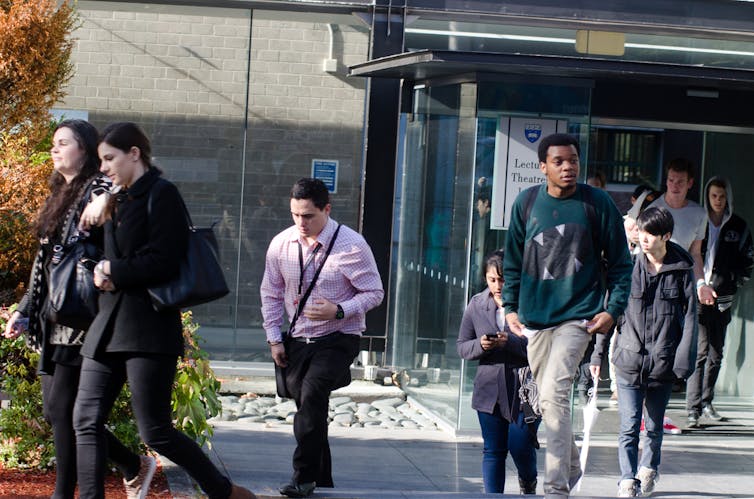 Increasing the number of Indigenous students is important, because some become Indigenous academics.
Shutterstock
Increasing the number of Indigenous students is important, because some become Indigenous academics.
Shutterstock
As the Indigenous population is disproportionately of an age where qualifications are most commonly attained, there is an important economic imperative to maintain efforts to keep Indigenous enrolments growing. This is because there is a strong correlation between qualifications and capacity for meaningful self-determination.
In New Zealand, Maori graduates have similar employment opportunities, incomes and levels of civic engagement to all other graduates. Five years after graduating, Maori doctoral graduates earn more than non-Maori graduates.
Graduation eliminates the gap in people’s capacity for self-determination. Not everybody is equally likely to go to university. Even so, in New Zealand, Maori enrolments increased by 16% between 2008 and 2017. Postgraduate enrolments increased 19% over the same period.
Reasons for this including a greater number of Maori achieving the requisite school qualifications, a disproportionate number of Maori being of school leaving age and significant financial support from some iwi [tribes] for their students.
Increase the number of Indigenous academics
Indigenous graduates are important because some become Indigenous academics. Maori academics contribute to better public policy.
The internationally acclaimed Te Kotahitanga teacher professional development project is illustrative. It is the product of a strong Maori academy. Its “by Maori, for Maori, for all” inspiration makes it an important statement of Maori self-determination.
In 2002, Nga Pae o te Maramatanga, the national Centre of Research Excellence for Maori Development and Advancement, set a goal of raising the number of Maori with a PhD or a PhD in progress to 500 within five years. The goal was achieved in four.
Critical mass is harder to achieve in Australia
The national Maori and Indigenous student support programme made an important contribution by ensuring culturally framed mentoring and support. The purpose was to create a critical mass of Maori scholars to ensure Maori contributions to all disciplines.
In Australia, there are just 400 Indigenous academics in the country’s 41 universities. There is no critical mass.
Read more: To really close the gap we need more Indigenous university graduates
Increasing the critical mass in Maori scholarship is important for eliminating the cultural gap – to create a higher education system that is genuinely for everybody. The system is more diverse than Australia’s. It contributes significantly to linguistic and cultural revitalisation and includes more than one institution founded on Indigenous ways of teaching and learning.
Although for Maori students, family, both positively and negatively, is the most important determinant of success, cultural validation by the university is also influential. Graduation ceremonies on the marae provide an important contrast with Australia’s school prize-giving style.
Maori comprise 15% of the national population. They share a common language in a geographically more contained area. Critical mass is easier to achieve.
Australia needs to work considerably harder to achieve comparable results. The effective reintroduction of enrolment caps is an obstacle. It contrasts with New Zealand’s newly introduced fee free policy developed, partly, to stop declining enrolments.
A broader focus
Finding the best policy settings is difficult and complex, but culture does count in New Zealand universities.
Higher education policy in Australia might broaden its focus. It might allow Indigenous people greater opportunity to contribute to answering those questions of what universities are for and whose interests should they serve.
Authors: Dominic O'Sullivan, Associate Professor of Political Science, Charles Sturt University


















