

Scientists have discovered a 3 billion-year-old beach buried on Mars
- Written by: Aaron J. Cavosie, Senior lecturer, School of Earth and Planetary Sciences, Curtin University
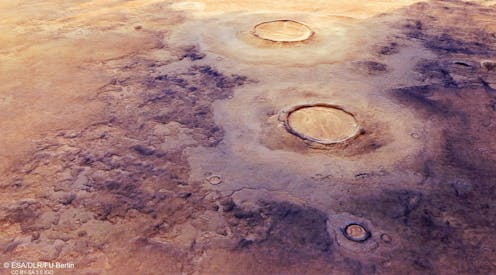
In the 1970s, images from the NASA Mariner 9 orbiter revealed water-sculpted surfaces on Mars. This settled the once-controversial question of whether water ever rippled over the red planet.
Since then, more and more evidence has emerged that water once played a large role on our planetary neighbour.
For example, Martian meteorites record evidence for water back to 4.5 billion years ago. On the young side of the timescale, impact craters formed over the past few years show the presence of ice under the surface today.
Today the hot topics focus on when water appeared, how much was there, and how long it lasted. Perhaps the most burning of all Mars water-related topics nowadays is: were there ever oceans?
A new study published in PNAS today has made quite a splash. The study involved a team of Chinese and American scientists led by Jianhui Li from Guangzhou University in China, and was based on work done by the China National Space Administration’s Mars rover Zhurong.
Data from Zhurong provide an unprecedented look into rocks buried near a proposed shoreline billions of years old. The researchers claim to have found beach deposits from an ancient Martian ocean.

Blue water on a red planet
Rovers exploring Mars study many aspects of the planet, including the geology, soil and atmosphere. They’re often looking for any evidence of water. That’s in part because water is a vital factor for determining if Mars ever supported life.
Sedimentary rocks are often a particular focus of investigations, because they can contain evidence of water – and therefore life – on Mars.
For example, the NASA Perseverance rover is currently searching for life in a delta deposit. Deltas are triangular regions often found where rivers flow into larger bodies of water, depositing large amounts of sediment. Examples on Earth include the Mississippi delta in the United States and the Nile delta in Egypt.
The delta the Perseverance rover is exploring is located within the roughly 45km wide Jezero impact crater, believed to be the site of an ancient lake.
Zhurong had its sights set on a very different body of water – the vestiges of an ancient ocean located in the northern hemisphere of Mars.

The god of fire
The Zhurong rover is named after a mythical god of fire.
It was launched by the Chinese National Space Administration in 2020 and was active on Mars from 2021 to 2022. Zhurong landed within Utopia Planitia, a vast expanse and the largest impact basin on Mars which stretches some 3,300km in diameter.
Zhurong is investigating an area near a series of ridges – described as paleoshorelines – that extend for thousands of kilometres across Mars. The paleoshorelines have previously been interpreted as the remnants of a global ocean that encircled the northern third of Mars.
However, there are differing views among scientists about this, and more observations are needed.
On Earth, the geologic record of oceans is distinctive. Modern oceans are only a few hundreds of millions of years old. Yet the global rock record is riddled with deposits made by many older oceans, some several billions of years old.
 This diagram shows how a series of beach deposits would have formed at the Zhurong landing site in the distant past on Mars.
Hai Liu/Guangzhou University
This diagram shows how a series of beach deposits would have formed at the Zhurong landing site in the distant past on Mars.
Hai Liu/Guangzhou University
What lies beneath
To determine if rocks in Utopia Planitia are consistent with having been deposited by an ocean, the rover collected data along a 1.3km measured line known as a transect at the margin of the basin. The transect was oriented perpendicular to the paleoshoreline. The goal was to work out what rock types are there, and what story they tell.
The Zhurong rover used a technique called ground penetrating radar, which probed down to 100 metres below the surface. The data revealed many characteristics of the buried rocks, including their orientation.
Rocks imaged along the transect contained many reflective layers that are visible by ground penetrating radar down to at least 30 metres. All the layers also dip shallowly into the basin, away from the paleoshoreline. This geometry exactly reflects how sediments are deposited into oceans on Earth.
The ground penetrating radar also measured how much the rocks are affected by an electrical field. The results showed the rocks are more likely to be sedimentary and are not volcanic flows, which can also form layers.
The study compared Zhurong data gathered from Utopia Planitia with ground penetrating radar data for different sedimentary environments on Earth.
The result of the comparison is clear – the rocks Zhurong imaged are a match for coastal sediments deposited along the margin of an ocean.
Zhurong found a beach.
 Photograph of frosted terrain on Utopia Planitia, taken by the Viking 2 lander in 1979.
NASA/JPL
Photograph of frosted terrain on Utopia Planitia, taken by the Viking 2 lander in 1979.
NASA/JPL
A wet Mars
The Noachian period of Martian history, from 4.1 to 3.7 billion years ago, is the poster child for a wet Mars. There is abundant evidence from orbital images of valley networks and mineral maps that the surface of Noachian Mars had surface water.
However, there is less evidence for surface water during the Hesperian period, from 3.7 to 3 billion years ago. Stunning orbital images of large outflow channels in Hesperian land forms, including an area of canyons known as Kasei Valles, are believed to have formed from catastrophic releases of ground water, rather than standing water.
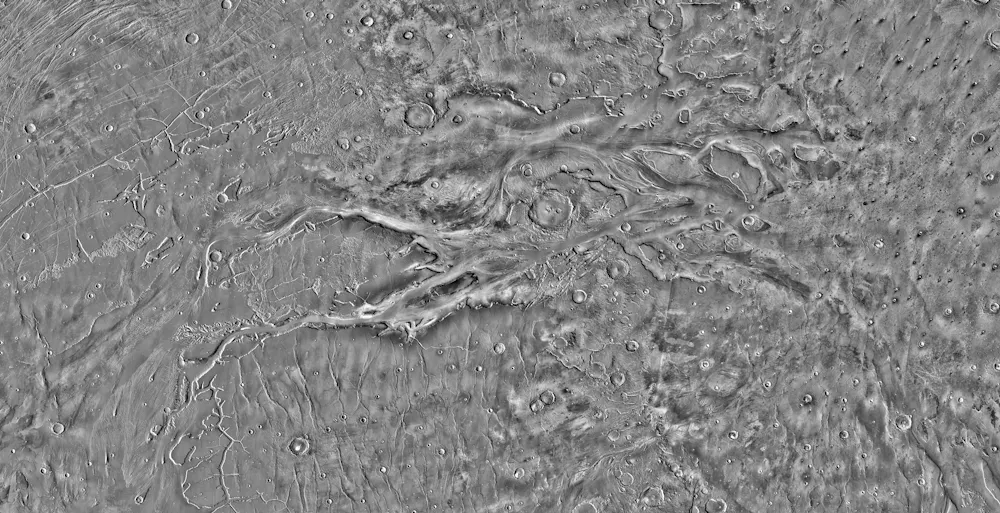 Infrared image mosaic showing Kasei Valles, a large system of outflow channels on Mars, and its surroundings.
By NASA / JPL-Caltech / Arizona State University
Infrared image mosaic showing Kasei Valles, a large system of outflow channels on Mars, and its surroundings.
By NASA / JPL-Caltech / Arizona State University
From this view, Mars appears to have cooled down and dried up by Hesperian time.
However, the Zhurong rover findings of coastal deposits formed in an ocean may indicate that surface water was stable on Mars longer than previously recognised. It may have lasted into the Late Hesperian period.
This may mean that habitable environments, around an ocean, extended to more recent times.
Authors: Aaron J. Cavosie, Senior lecturer, School of Earth and Planetary Sciences, Curtin University


















