

New report slaps an official price tag on Australia’s precious natural assets
- Written by: John Hawkins, Senior Lecturer, Canberra School of Politics, Economics and Society, University of Canberra
Climate regulation through carbon storage was worth A$43.2 billion to Australia in 2020-21, according to a report released today which seeks to put a monetary value on the benefits flowing from our natural assets.
Australia’s first national ecosystem accounts were released by the Australian Bureau of Statistics today. Together, they reveal the key ways our environment contributes to Australia’s economic and social wellbeing in dollar terms.
Ecosystems covered by the accounts include desert, grasslands, native forests, rivers, streams, coastal areas and oceans.
The accounts provide a holistic view of Australia’s land, freshwater and marine environments. They intend to help policymakers look beyond GDP to a broader measurement of how ecosystems contribute to society and the economy.
Valuing our ecosystems
The accounts cover services provided by Australia’s ecosystems in 2020–21.
Australian ecosystems stored more than 34.5 billion tonnes of carbon – the most valuable service by ecosystems examined in the accounts, according to the ABS.
It brought a $43.2 billion benefit to Australia in the form of climate regulation. Plants and other organisms reduce greenhouse gases in the atmosphere by removing and storing them. This helps stabilise the climate, avoiding damage caused by climate change.
Grasslands made the biggest contribution to carbon storage, followed by native forests and savannas.
The accounts show grazed biomass, or grasslands, provide $40.4 billion in benefits, through the forage provided to cattle and sheep. The dollar figure represents what farmers would otherwise have spent on feeding their livestock.
The accounts also examined the provision of surface water taken from ecosystems, and used for drinking, energy production, cooling, irrigation and manufacturing. This was valued at $1.4 billion.
The provision of wild fish, sold to consumers to eat, was put at $39.2 million.
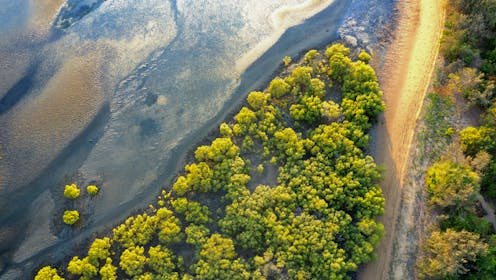
The accounts also reveal how coral reefs, sandbanks, dunes and mangroves protect our coastlines against tides and storm surges.
The ABS estimates mangroves protected 4,006 dwellings around Australian coastlines. This prevented more than $57 million worth of building damage.
The accounts also track changes in Australia’s ecosystems.
Some 281,000 hectares of mostly farmland were converted to urban and industrial uses between 2015–16 and 2020–21. And 169,000 hectares of “steppe” land – flat, unforested grassland – was converted to sown pastures and fields.
Feral animal and weed species continue to spread. Meanwhile, the number of threatened native species is increasing.
Why do we need ecosystem accounting?
Think of a logged forest. The value of the timber produced counts towards Australia’s gross domestic product. But cutting trees down also produces a loss. For example, the forest is no longer there for the community to enjoy. And it no longer provides “services” such as filtering water and preventing soil erosion.
There are many reasons to measure the value of those services. For example, governments might then be able to charge a logging company a licence fee which reflects the community value of the forest. A government may decide the forest is too valuable to allow logging at all, or the fee may just be set too high for any company to find it profitable to log it.
To date, the value lost when trees are cut down, or other ecosystems are damaged, has not been included in the national accounts. The new environmental accounts seek to change this.
Obviously, ecosystems are complex and difficult to measure. The ABS has been guided by an international framework developed by the United Nations.
The ecosystem accounts are a collaboration between several federal agencies: the ABS, the Department of Climate Change, Energy, the Environment and Water, and the CSIRO.
Boundless plains and golden soil, girt by sea
The accounts distinguish between environmental “realms”.
About half of Australia’s terrestrial (dry land) realm is desert. About a quarter is savanna and grassland. Intensively used land, such as pastures, is a smaller proportion.
There are contrasts between the states. Western Australia has 158 million hectares of desert while Victoria, Tasmania and the Australian Capital Territory have none. Queensland, Western Australia and the Northern Territory host 97% of Australia’s mangroves.
About half of Australia is the marine realm, covering 681 million hectares. Some 30% of this is the marine shelf and 70% deep sea. About 14 million hectares comprise coral reefs. The darker areas in the map below show where most fish are caught.
The coastal realm comprises mangroves and saltmarsh. In 2021, mangroves covered an estimated 1.1 million hectares of Australia’s coastal areas.
A small but important proportion of Australia is our freshwater realm, comprising rivers and streams. The accounts show between 2015–16 and 2020–21, 4% of natural environments along perennial rivers were converted to higher intensity land uses.
Where to now?
These accounts are just the first step in estimating the value of Australia’s natural assets.
The ABS will update Australia’s ecosystem accounts annually. It describes the inaugural accounts as “experimental” and says the government agencies involved will run a consultation process to improve them.
We can expect the accounts to become more useful over time as data accrues and trends can be identified.
According to the ABS, policy uses for the accounts include managing healthy and resilient ecosystems, and integrating biodiversity into planning.
Poet and playwright Oscar Wilde defined a cynic as someone who “knows the price of everything but the value of nothing”. In today’s society we often underrate things that do not have a dollar value attached.
So this compilation of Australia’s ecosystems, and their value to us, is a welcome development. It should lead to more informed, holistic decisions about whether natural assets should be protected, or damaged for economic benefit.
Authors: John Hawkins, Senior Lecturer, Canberra School of Politics, Economics and Society, University of Canberra


















