

A quantum computing startup says it is already making millions of light-powered chips
- Written by: Christopher Ferrie, A/Prof, UTS Chancellor's Postdoctoral Research and ARC DECRA Fellow, University of Technology Sydney
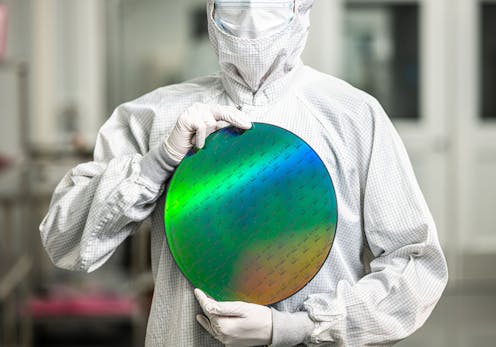
American quantum computing startup PsiQuantum announced yesterday that it has cracked a significant puzzle on the road to making the technology useful: manufacturing quantum chips in useful quantities.
PsiQuantum burst out of “stealth mode” in 2021 with a blockbuster funding announcement. It followed up with two more last year.
The company uses so-called “photonic” quantum computing, which has long been dismissed as impractical.
The approach, which encodes data in individual particles of light, offers some compelling advantages — low noise, high-speed operation, and natural compatibility with existing fibre-optic networks. However, it was held back by extreme hardware demands to manage the fact photons fly with blinding speed, get lost, and are hard to create and detect.
PsiQuantum now claims to have addressed many of these difficulties. Yesterday, in a new peer-reviewed paper published in Nature, the company unveiled hardware for photonic quantum computing they say can be manufactured in large quantities and solves the problem of scaling up the system.
What’s in a quantum computer?
Like any computer, quantum computers encode information in physical systems. Whereas digital computers encode bits (0s and 1s) in transistors, quantum computers use quantum bits (qubits), which can be encoded in many potential quantum systems.

The darlings of the quantum computing world have traditionally been superconducting circuits running at temperatures near absolute zero. These have been championed by companies such as Google, IBM, and Rigetti.
These systems have attracted headlines claiming “quantum supremacy” (where quantum computers beat traditional computers at some task) or the ushering in of “quantum utility” (that is, actually useful quantum computers).
In a close second in the headline grabbing game, IonQ and Honeywell are pursuing trapped-ion quantum computing. In this approach, charged atoms are captured in special electromagnetic traps that encode qubits in their energy states.
Other commercial contenders include neutral atom qubits, silicon based qubits, intentional defects in diamonds, and non-traditional photonic encodings.
All of these are available now. Some are for sale with enormous price tags and some are accessible through the cloud. But fair warning: they are more for experimentation than computation today.
Faults and how to tolerate them
The individual bits in your digital computers are extraordinarily reliable. They might experience a fault (a 0 inadvertently flips to a 1, for example) once in every trillion operations.
PsiQuantum’s new platform has impressive-sounding features such as low-loss silicon nitride waveguides, high-efficiency photon-number-resolving detectors, and near-lossless interconnects.
The company reports a 0.02% error rate for single-qubit operations and 0.8% for two-qubit creation. These may seem like quite small numbers, but they are much bigger than the effectively zero error rate of the chip in your smartphone.
However, these numbers rival the best qubits today and are surprisingly encouraging.
One of the most critical breakthroughs in the PsiQuantum system is the integration of fusion-based quantum computing. This is a model that allows for errors to be corrected more easily than in traditional approaches.
Quantum computer developers want to achieve what is called “fault tolerance”. This means that, if the basic error rate is below a certain threshold, the errors can be suppressed indefinitely.
Claims of “below threshold” error rates should be met with skepticism, as they are generally measured on a few qubits. A practical quantum computer would be a very different environment, where each qubit would have to function alongside a million (or a billion, or a trillion) others.
This is the fundamental challenge of scalability. And while most quantum computing companies are tackling the problem from the ground up – building individual qubits and sticking them together – PsiQuantum is taking the top down approach.
Scale-first thinking
PsiQuantum developed its system in partnership with semiconductor manufacturer GlobalFoundries. All the key components – photon sources and detectors, logic gates and error correction – are integrated on single silicon-based chip.
PsiQuantum says GlobalFoundries has already made millions of the chips.
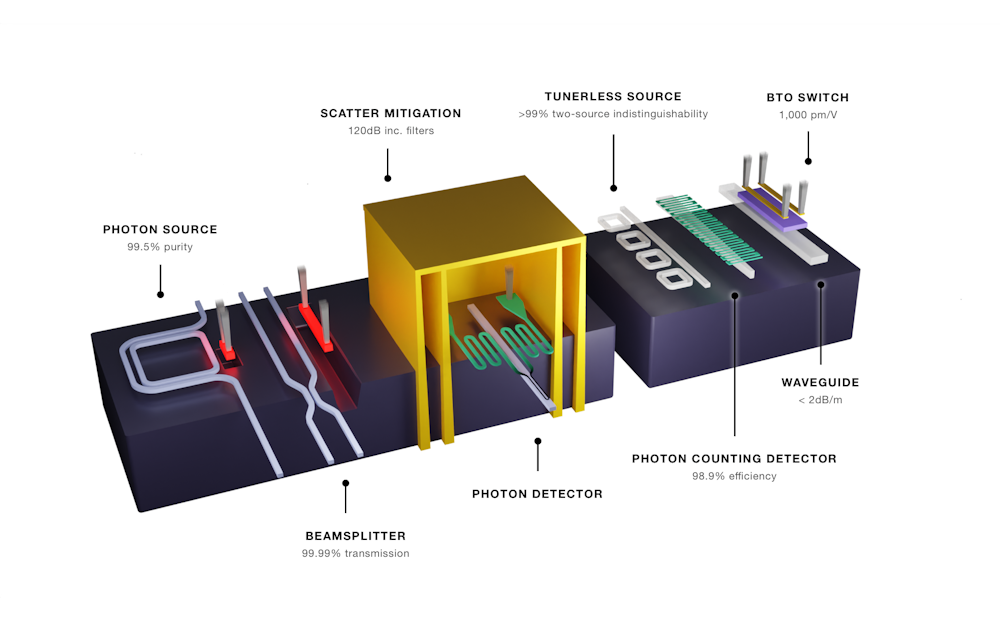
By making use of techniques already used to fabricate semiconductors, PsiQuantum claims to have solved the scalability issue that has long plagued photonic approaches.
PsiQuantum is fabricating their chips in a commercial semiconductor foundry. This means scaling to millions of qubits will be relatively straightforward.
If PsiQuantum’s technology delivers on its promise, it could mark the beginning of quantum computing’s first truly scalable era.
A fault-tolerant photonic quantum computer would have major advantages and lower energy requirements.
Authors: Christopher Ferrie, A/Prof, UTS Chancellor's Postdoctoral Research and ARC DECRA Fellow, University of Technology Sydney


















